
Five Athletes Got Justice. Footballers Are Still Standing in the Rain.
China is punishing online abuse against table tennis and diving stars. The sport with the loudest, most vicious fan culture is still waiting for the same protection.
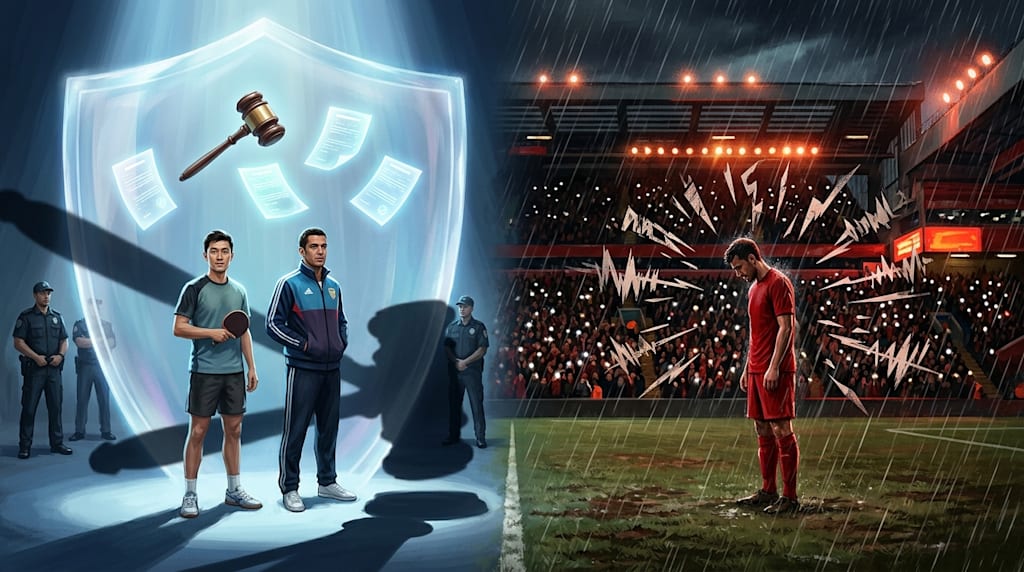
Five penalty notices. Football still waits.
Xinhua reported five people. Cui posted insulting and defamatory remarks on Douyin about a table tennis player. Ke posted on Weibo disparaging another table tennis player. Jia posted insulting and defamatory remarks. He posted doctored images and insults. Wei posted videos insulting and belittling other divers on Douyin and organized fan groups to carry out online violence together. Administrative penalties. The sports: table tennis and diving.
Five penalty notices, delivered where they should be. Insult, defamation, doctored images, organized online violence. None of those words is light. Athletes sweat on the field. They should not have filth thrown at them from behind a screen. The law stepped in. That is how it should work.
The five cases leave a gap: football. Many people asked about it. The question is fair.
Chinese football players have faced online violence for as long as professional football has existed in China. On the Chinese internet, cursing Chinese football and Chinese players has long been a cost-free emotional release. Lose, curse. Win, curse. Make a mistake, curse. Avoid a mistake, curse. Play badly, curse. Play well but not hard enough, curse. The target is no longer football. It is specific people and their families.
Wu Xi is one example. In the 2022 World Cup qualifiers, China lost away to Vietnam. A moment in one defensive play, his head dipping, was screenshotted, enlarged, and looped. “The dodger” became his name online. One instant was torn out of the match and turned into a verdict on his character. No one cared about his position, his judgment, or his physical reaction. No one cared how many years a veteran in his thirties had run for the national team. One action was enough to erase a person.
People later made comparisons. When a similar action appears on another team, in another player, it is instinct, self-protection, a defensive habit. When it appears on a Chinese player, it becomes cowardice, timidity, lack of fight, shamelessness. The same bodily instinct, in a different shirt, gets a different verdict.
Wei Shihao was insulted. His family was dragged in. The fan involved was administratively detained for seven days and banned from watching matches. The law can govern football. It rarely does. Wu Lei has endured attacks far beyond normal criticism. His family has been insulted. Rumors have spread that he faked injuries. These are not isolated cases. They form a system. In that system, players are treated as punching bags for public emotion. As soon as they put on the national team shirt, they are expected to give up reputation, privacy, and human dignity.
The law does not say that only table tennis players and divers have reputations worth protecting. The Public Security Administration Punishments Law has clear penalties for publicly insulting or defaming others. It does not classify by sport. Enforcement attention, public tolerance, and the will to govern the industry have long been dormant in football.
The five cases share one feature: fan identity, incitement, organized attacks. Ke in Xiamen, Fujian, was a fan of a table tennis player. He repeatedly posted content disparaging another table tennis player and incited antagonism. Wei in Nanning, Guangxi, was a fan of a diver. He repeatedly posted videos insulting and belittling other divers and organized fan groups to carry out online violence. Public security organs are focused on the fandomization of sports. This round of governance targets disparagement, incitement, and organized siege.
Online violence in football looks different. It is more diffuse, more everyday, more self-righteous. It often appears as criticism, as hating the iron for not becoming steel, as caring enough to reproach. It is embedded in stadium cursing culture and social media venting. That diffuseness makes it hard to frame as fandom chaos. It also makes it easier for enforcement to overlook.
An insult is an insult. It does not become criticism because the person hurling it calls himself a fan. It does not become culture because the crowd is large. It does not become reasonable emotion because it happens in a football stadium. A table tennis player subjected to organized disparagement faces online violence. A football player cursed by tens of thousands in unison faces online violence. The first is organized. The second has scale. Neither belongs outside the law.
The enforcement threshold differs. In table tennis and diving, one organized round of disparagement, one set of doctored images, a few accounts posting continuously, can trigger administrative punishment. In football, it often takes insults reaching family members, public outrage, and a trending topic before an individual perpetrator might be dealt with. This dual track tells football players that protection of their reputation must wait until the harm gets worse.
Every time football online violence is discussed, a voice appears: the results are so bad, and we are not even allowed to curse. That logic is popular and dangerous. It conflates athletic results with human dignity. Bad results can be criticized. Tactics can be analyzed. Mistakes can be reviewed. Attitude can be questioned. Insults, defamation, doctored images, and dragging family members in are illegal, not criticism. Between criticism and online violence lies a clear legal line.
Some people use football players’ salaries to justify online violence. Players’ salaries are set by the market. Players did not rob anyone. Clubs signed those contracts because the market environment and industry rules at the time allowed such pricing. Club losses are a matter of club operations and industry policy. Players did not force anyone to sign. Shifting the consequences of failed industry governance onto individual players as personal humiliation makes the weakest link bear the strongest fire.
If “you are poor, so you deserve to be bullied” is not a valid principle, then “your results are bad, so you deserve to be insulted” is equally invalid. If someone earning a million yuan a year can bully someone earning a hundred thousand without burden, then someone earning ten million can humiliate the one earning a million. That is a jungle society. Sports should not replicate it.
Football’s problems have never been only the players’ problems. If the professional league is still not properly run, how can the national team suddenly explode? The league is the soil. The national team is the fruit. When the soil is barren, expecting abundant fruit is unrealistic. Management authority has not been fully returned to clubs. Massive investments that violate league fairness remain unrestricted. Long-term centralized training still disrupts clubs’ normal preparations. Unreasonable expenditures still burden clubs. Money that should have been distributed to clubs has been withheld. Cursing the players does not fix any of that.
Players are the easiest link to curse. They are the least deserving of bearing all the responsibility.
Football requires creativity. Creativity comes from an environment tolerant of trial and error. Without room for mistakes, there is no adventure. Without room to try things, there is no inspiration. Insult players year after year. Invade their personal lives the moment they make a mistake. Then complain that players lack creativity. The environment produces that result.
In the Chinese Super League, cursing is everywhere. Some treat it as football culture. In England, where football hooliganism is governed most strictly, responses to stadium insults and discrimination are clear: warning, removal, ban, and in serious cases criminal prosecution. English clubs have issued stadium bans for racist abuse. One Liverpool fan was banned during bail from every English stadium and from coming within a mile of one. Arsenal banned 17 fans in a single season for online violence and other reasons. The logic is simple: neither the stadium nor the internet is outside the law. Fan identity is not grounds for exemption.
We see the thief. We do not see the thief punished. We treat the thief as a role model. The same scrutiny should apply to fan conduct, sports media’s promotional capacity, and sports administration’s attention to detail.
Cursing a table tennis player should be punished. Cursing a diver should be punished. Cursing a football player should be punished the same way. Equal protection under the law does not depend on the sport.
Platforms should not distribute protection by sport. Media should not decide the boundary of criticism by results. Law enforcement should not decide whether to act based on how hot public opinion is. The football association and clubs should support players in defending their rights. Fan organizations should discipline themselves. Stadium management should have zero tolerance for cursing. Civilized spectating starts with respecting opponents and players, and leaving families out of it.
The 20th Asian Games will open in Nagoya, Japan, on September 19, 2026. We cheer for table tennis and diving athletes. We also cheer for football athletes. Every athlete is a person first, and an athlete second. Honors, results, and tactics are fair game for argument. Human dignity is not.
In the players’ tunnel, someone stuffs shin guards into a backpack. Someone sets a phone to silent. In the stands, before the whistle blows, someone swallows the insult back. Tomorrow, training goes on as usual.
Cursing a table tennis player should be punished. Cursing a football player should be punished the same way. The law already says so. So does fairness.
About the Creator
Jin
Writer of reamstories
https://reamstories.com/jin
Enjoyed the story? Support the Creator.
Subscribe for free to receive all their stories in your feed. You could also become a paid subscriber, letting them know you appreciate their work.
Comments
There are no comments for this story
Be the first to respond and start the conversation.