
FIFA: Between 0.85 and 3.2
In 2022 his fouls were called “the composure of champions.” In 2026 the same actions became “arrogance.” The only thing that changed was the final score.
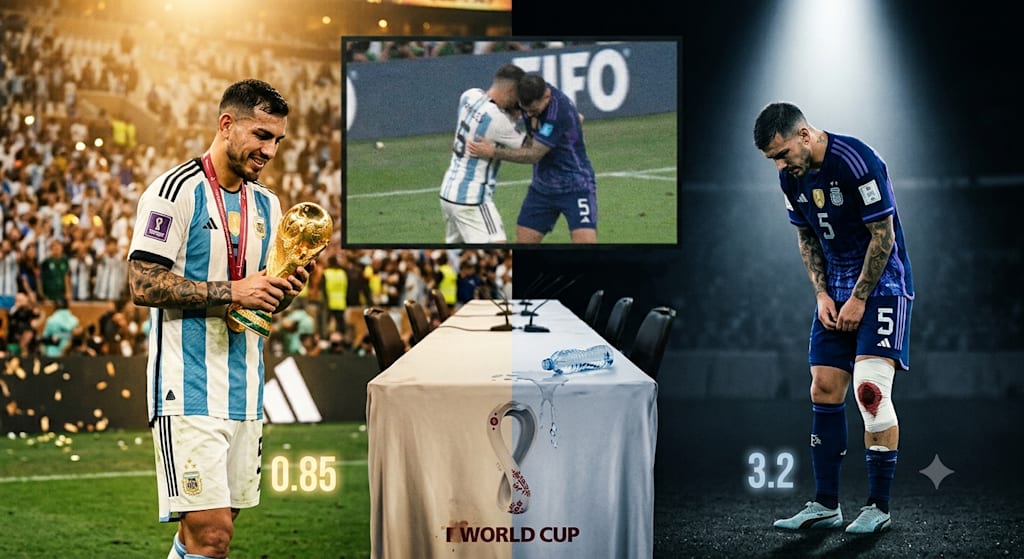
The mixed‑zone lights hit his face before he could adjust. Argentina’s players were still in their match jerseys. Paredes came out last, a bandage wrapped around his left knee. He didn’t look at anyone.
The bandage was white, but blood had seeped through the gauze, forming an irregular, dark‑red coin on the outside of his knee. He walked with his right leg first, dragging the left, each step causing that dark‑red coin to swell slightly. No one helped him. He didn’t ask for help.
Behind him, the big screen still displayed the score. 1‑2.
Four years ago in Lusail, under the same lights, it was also him. After the final whistle, he had stuffed the match ball under his shirt, waddled around like a pregnant woman, teammates chasing him and slapping his belly. That day, his foul count was 3, no card. When the final whistle blew, he lay on the ground, face buried in the grass. When he stood up, his eyes were red—but the corners of his mouth were turned up.
Today, his foul count was 7, one yellow card. The extra four fouls came in the 17th, 34th, 67th, and 82nd minutes, each corresponding to an opposition transition from defense to attack. The referee called three of them; the fourth happened on the touchline, too far from the main referee, the linesman didn’t raise his flag, play went on.
Numbers don’t lie. But numbers also lie.
The foul count doesn’t tell you: in the 17th minute, Paredes sprinted from ten meters away. His right foot never even went for the ball. His left shoulder drove straight into the ribs of the opposing centre‑back. The ball rolled away, the man went down. The referee whistled. Paredes spread his hands, his lips moved, but no sound came out. When the camera pushed in for a close‑up, he was smiling. Not a provocative smile. The kind that said, “I know you have to give me that card.”
That smile, on the night of the 2022 championship, was called “the composure of champions.” On the night of the 2026 final, it was reduced to two words: “arrogance.”
Same expression. Two different books.
I. Two résumés for one man
Paredes’ career can be split into two spreadsheets. One for club scouts to read. One for the national team coach.
Spreadsheet A: Paris Saint‑Germain, Roma, Juventus—463 appearances, 396 fouls, average 0.85 per game.
Spreadsheet B: World Cup knockout stages—13 appearances (up to the 2026 final), 42 fouls, average 3.2 per game.
The gap between those two numbers is not a technical decline, nor is it referee bias. It’s a role change. More precisely, he was allowed to do different things.
At club level, he was a deep‑lying playmaker. Standing in front of the centre‑backs, receiving the ball, turning, passing wide. His defensive duty was “positioning” rather than “tackling.” His running coverage was minimal; he rarely appeared in positions requiring a one‑on‑one sliding challenge. At PSG, his average distance covered consistently ranked third from the bottom of the squad, behind only the two centre‑backs. His foul count stayed low because he didn’t need to foul—the ball came to his feet to be passed, not to be won.
With the national team, Scaloni added a small line to his job description. That small line never appeared in any published photo of the tactical whiteboard, but every opponent who faced Argentina knew it.
That small line read: “Break every opposition transition, regardless of cost.”
“Regardless of cost” meant: when the opposing centre‑back just won the ball and looked up to find a passing outlet, Paredes’ shoulder should appear at his waist. Not to win the ball. Just to make him, the next time he looked up, think one extra frame: “Will I get hit?”
This is a business of trading yellow cards for seconds. The cost of one yellow card buys one moment of hesitation on a counter‑attack, one quick throw‑in turned into a slow one, one mental check of “where is Paredes?” If a match yields three such hesitations, the value is three neutralized transition opportunities. Among those three, one might have led to a shot, one might have led to a goal. Betting a yellow card against that. Mathematically, it makes sense.
In 2022, the business paid off. The yellow cards bought a championship, and all those “regardless of cost” actions were collectively rebranded as “iron will.” Post‑match tactical shows looped Paredes’ foul compilations set to rock music and slow motion, with titles like “Argentina’s Grit.”
In 2026, the business didn’t pay off. The yellow cards were still yellow cards, but the price tag changed from “champion’s steel” to “sore loser’s filth.” The same compilations now ran to funeral marches, titled “The Meat Grinder That Lost Control.”
The compilations never changed. What changed was the result that surrounded them.
II. Why Paredes “isn’t afraid” of cards
This is the most perverse part of the whole affair.
From an outsider’s perspective, Paredes’ fouls in the World Cup carry a near‑provocative calm, a “I know this will be called” composure. After a tackle, his expression isn’t “oh no,” but “yeah, the ref blew it, fine.”
He isn’t afraid of cards.
Not because he’s brave. Because he did the math.
There is a clear statistical pattern in how referees show cards in World Cup finals. FIFA’s referee committee training manuals contain an unspoken rule: in major tournament finals, the yellow‑card threshold is about 30% higher than in the group stage. The official rationale is “to ensure the flow of the game.” The practical translation is: referees don’t want to become the protagonist of the final; they lean toward only punishing more serious infractions.
Paredes and his coaching staff knew this rule. So they calibrated the intensity of his fouls precisely into the grey zone “between a group‑stage yellow and a final‑stage yellow.” Every collision was pushed to the edge, but none crossed it. The yellow card he received in the final wasn’t for a heavy tackle. It was for time‑wasting, a line that any referee would draw regardless of the occasion.
This is a carefully engineered “moral cost‑benefit analysis”: as long as you don’t get a red, yellow cards are expendable supplies. If one yellow can buy the referee’s psychological hesitation on the next similar foul, the internal whisper “I already gave a card for that,” then you’ve made a profit.
So Paredes’ “ultra‑aggressive” face at the World Cup is not a personality mutation; it’s a tactical disguise permitted by the environment. He doesn’t do this at club level because club referees don’t give leeway for “killing transitions.” Club VAR checks every round, every stamp is replayed. The World Cup final is different. The referee weighs that card in his hand longer than at any other time.
But Paredes miscalculated one thing: the referee’s hesitation only lasts until the final whistle. After that, public opinion doesn’t hesitate.
III. 2014 and 2026, more than four years apart
In the 2014 Maracanã final, Argentina’s starting defensive midfielder was Mascherano. He committed 4 fouls that night, all behind the halfway line, all designed to stop German players from running directly at the centre‑backs.
Mascherano’s fouls were almost equally ferocious. In the semi‑final against the Netherlands, he flew into a tackle on Robben, studs up, sending a chunk of turf flying. But no one called him “dirty.” Because that foul occurred two meters outside the penalty area—Robben would have been clean through on goal. Mascherano traded a one‑on‑one with the keeper for a free kick, and that free kick didn’t go in.
He used a foul to do something that, if he hadn’t, would have conceded a goal. That was the last line of defense. Observers could do the math: before the foul, danger level 100%; after the foul, danger level dropped to the 30% of a set‑piece. He gained 70%.
After the match, Mascherano swapped jerseys with Schweinsteiger. Argentina’s players stood below the stands and watched the Germans lift the trophy. Messi walked past the World Cup, glanced at it for an extra second, but didn’t stop. No conflict, no arguments, no silent mixed‑zone after the game. The consensus that night was: we gave everything, we lost, we accept it.
In the 2026 final, 3 of Paredes’ 7 fouls occurred in the opposition half, and 2 were off‑the‑ball physical contacts. Not a single one was committed in front of the “last line of defense.” When he fouled, the opposing centre‑back was still forty meters from his own penalty area. The danger level was 30%; his foul reduced it to 20%. Net gain: 10%. Cost: one yellow card.
Mascherano gained 70% and no one said a word. Paredes gained 10% and the internet exploded.
Because that 10% profit was bought with a stamp that “you didn’t have to make.” It didn’t stop a goal, it didn’t break up a one‑on‑one. It just made that centre‑back “think one extra second” the next time he won the ball. The value of that second, on the coaching staff’s ledger, was “slowing the transition.” In the eyes of the public, it was “why did you push my man?”
Argentina in 2014 were the challengers. Reaching the semi‑final against the Netherlands was already their limit. Facing peak Germany in the final, losing was “expected tragedy.” In that context, fouls were the claw marks of survival. You forgive a drowning man for grabbing anything—he’s going under.
Argentina in 2026 were the defending champions, walking into the final carrying the halo of 2022 and the afterglow of the 2024 Copa América. Now, fouling was no longer passive survival; it was active suppression. When you win, suppression is called “dominance.” When you lose, suppression has one name: “bullying.”
Same actions, different verdicts. The verdict wasn’t written by the referee. It was written by the “expectation” before the match. The expectation in 2014 was “just making it this far is already beyond expectation.” The expectation in 2026 was “anything less than a championship is failure.”
When “failure or nothing” anxiety meets the “regardless of cost” tactic, players don’t pull their feet back—they tackle harder. And after a loss, all that hardness rebounds with interest. Because in the onlooker’s eyes, hardness is a cloak only the winner is entitled to wear. If you wear it after losing, you’re the villain in a farce.
IV. VAR replays and memory replays
There’s another overlooked variable: technology.
In the 2014 final, there was only one controversial moment—Higuaín’s disallowed goal from an offside position. The broadcast gave one replay, from an imperfect angle. It was discussed for two days, then no one mentioned it again.
In 2026, every single foul had at least six camera angles in slow motion. Paredes’ shoulder clashes, his stamps, his glances back after collisions—all dissected into 300‑frame‑per‑second step‑by‑step replays. On social media, each foul could be trimmed into a 3‑second looping GIF. The GIF came without context—it just repeated the “moment of contact”: the shoulder deforming, the ankle twisting, the shreds of turf flying through the air.
No context. No ledger of “what would have happened if he hadn’t fouled.” Just images.
Images are the most dangerous medium. Because they don’t show the cost—they only show the action. If Mascherano’s 2014 tackle had been replayed 300 times from six camera angles, it would have looked no different from Paredes’ fouls—studs up, body launched, turf flying. The difference is that in 2014, no one turned Mascherano’s tackle into a 3‑second GIF. No GIF, no trial.
In 2026, Paredes’ off‑the‑ball shoulder check in the 34th minute was turned into a GIF with text overlaid: “Pure malice.” That GIF exceeded 20 million views within four hours after the match. Twenty million people saw Paredes’ shoulder driving into the opposing centre‑back’s ribs. Twenty million people did not see what happened four seconds earlier: that centre‑back had just made a clean interception, and the direction he looked up toward was exactly the gap three meters behind Paredes.
That gap was the only opening Argentina’s entire defensive line hadn’t covered.
Paredes’ shoulder took that gap away. But the GIF doesn’t show the gap. It only shows the man going down.
The evolution of technology transferred the “judgment” of football matches from the referee’s hands to the screens in the audience’s hands. The referee sees it once; the audience can see it 300 times. The referee judges by the rules; the audience judges by “what I want to see.” When you win, the audience sees “toughness”; when you lose, the audience sees “dirtiness.” Same 300 frames, different labels.
Paredes is not the first player to be destroyed by a GIF, and he won’t be the last. But he happens to stand right at the intersection of technological transition and public‑opinion reversal. In 2022, GIFs were celebrating Argentina. In 2026, GIFs were judging the world against them.
V. The same yellow card, two commentary scripts
In the 2022 final, Paredes kicked a dead ball away in extra time, sending it crashing into the substitutes’ bench. The referee gave him a yellow card. The commentator said: “Experienced. Disrupting the opponent’s rhythm.”
In the 2026 semi‑final, the same thing happened in the 88th minute. Argentina were leading by one goal. Paredes, with the opponent about to take a throw‑in, booted the ball ten meters behind the advertising hoardings. The referee gave him a yellow. The commentator paused for three seconds, then said: “Time‑wasting.”
Same action. Same yellow card. Different labels.
The only difference: in 2022, Argentina won the penalty shootout. In 2026, Argentina were equalised in the 4th minute of stoppage time.
When you win, it’s called “experience.” When you lose, it’s called “infringement.” That’s not written in the Laws of the Game. It’s written in the laws of public discourse.
Public discourse is never rational. It’s as biased as the terraces. It grants the winner immunity and hands the loser a reckoning. By the 2022 final, Paredes had already been stamped with the label “iron‑willed warrior,” so his kicked dead ball was “cunning.” By the 2026 final, he had been stamped with the label “card magnet,” so the same act was “habitual offender.”
The label determines the meaning of the action, not the other way around.
Paredes’ paradox is that his club statistics prove he is capable of playing “clean.” He is not a thug who “only knows how to foul.” All his “ultra‑aggressive” actions at the World Cup were choices, not instincts.
And the cost of those choices was forgiven when he won, but collected with compound interest when he lost.
This has nothing to do with morality and everything to do with victory and defeat. Morality is just the makeup artist of victory and defeat. Win, and you’re made up as a hero. Lose, and you’re made up as a villain. Paredes’ face never changed. Only the lighting in the dressing room did.
VI. The water stain
In the post‑match press conference, Scaloni was asked about Paredes’ yellow card.
He said: “He did what we asked him to do.”
A reporter followed up: “But this was the final.”
Scaloni didn’t answer. He stood up and knocked over the water bottle in front of him. Water soaked into the tablecloth, on which the World Cup logo was printed. It only reached the first three letters of “WORLD.”
As he turned to leave, the water stain kept spreading. The edge of the water slowly crawled past the last stroke of the “L,” advancing toward the “D.” When the staff came to clear the table, the full “WORLD” had become illegible. The wet cloth was crumpled into a ball and tossed into a recycling bin in the corner.
Paredes’ club average fouls per game: 0.85. His World Cup knockout‑stage average: 3.2. The difference between those two numbers is the permission given by the coaching staff, and the weight he must carry.
But weights come in categories.
In 2014, Mascherano averaged 3.6 fouls per game, and no one called him dirty. Because he used his fouls to stop clear goal‑scoring chances. In those moments, not fouling meant a one‑on‑one.
Paredes used his fouls to make opponents “think twice before releasing the ball next time.” The former is football. The latter is business.
When the former loses, someone bows. When the latter loses, there’s only a slowly fading water stain on a tablecloth.
Paredes walked out of the mixed zone, his left knee bandage now loose. The gauze dragged on the ground, gathering dust. The dark‑red coin remained the same size. Neither expanding nor receding.
Someone called his name. He glanced back, but didn’t stop.
The TV camera followed his back, zooming in until he disappeared around the corner at the end of the tunnel. Just before the feed cut back to the studio, a stat line popped up in the lower left corner:
Leandro Paredes. Total fouls in this World Cup: 31. Yellow cards: 4. Fouls per game: 3.44.
The same stat line four years ago read: Total fouls: 14. Yellow cards: 2. Fouls per game: 1.75.
It doubled.
But the scrolling news ticker at the bottom of the screen also carried a line: Argentina have reached at least the final in three consecutive World Cups. Only the second team in history to do so.
History will remember the latter. Social media will remember the former.
When Paredes walked into the darkness at the end of the tunnel, both memories were behind him. But he didn’t look back, so neither memory could catch him.
Only that crumpled tablecloth dried slowly in the recycling bin. After the water stain disappeared, “WORLD” was still there. Just wrinkled. And impossible to iron flat.
About the Creator
Jin
Writer of reamstories
https://reamstories.com/jin
Enjoyed the story? Support the Creator.
Subscribe for free to receive all their stories in your feed. You could also become a paid subscriber, letting them know you appreciate their work.
Comments
There are no comments for this story
Be the first to respond and start the conversation.