
England vs. Britain: The Strange FIFA Loophole That Splits a Country Into Four World Cup Teams
One nation on the map. Four distinct voices on the pitch. The 160-year-old story that explains why you’ll never see a “Team GB” in the World Cup.
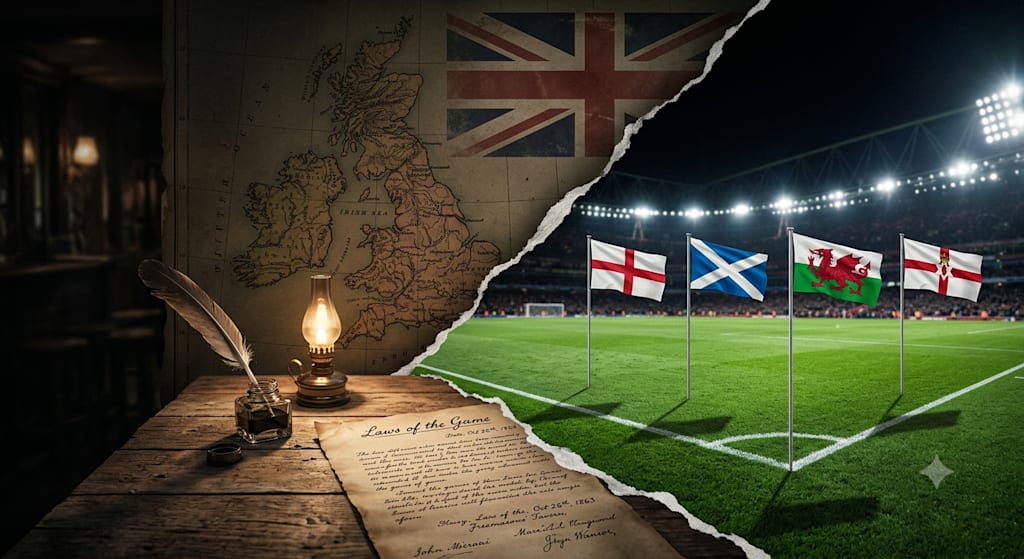
On any World Cup matchday, two flags flutter side by side in the stands: the Union Jack and the St George’s Cross. Same country, two different banners. The first‑time viewer often stumbles over the same question: If Britain is a single sovereign state, why does its World Cup team call itself “England,” and not “Team GB”?
The answer isn’t in your civics textbook. FIFA’s own rulebook runs on a completely different logic.
I. First came the FAs, then came FIFA
On 26 October 1863, at the Freemasons’ Tavern in London, a group of gentlemen from public schools gathered under gaslight. They weren’t debating national sovereignty; they were arguing about whether handling the ball should be legal and where the offside line ought to be drawn. Late that night, the world’s first football association, the Football Association of England, was born. In black and white, they laid down a set of Laws of the Game. Modern football had its birth certificate.
Over the next decade, the other nations of the British Isles followed suit:
1873 — Scottish FA
1876 — Football Association of Wales
1880 — Irish FA (later to become the Northern Irish FA)
In 1872, at Patrick’s Cricket Ground in Glasgow, England and Scotland played the very first international match. 0‑0. No prize money, no broadcast: just two sets of young men running through mud for 90 minutes. But that match established one principle for good: representative teams belong to football associations, not to nation‑states.
In 1886, these four FAs formed the International Football Association Board (IFAB), the body that still, to this day, holds the final say on changes to the Laws of the Game. Stoppage time, VAR protocols, and drinks breaks — issues that sound like FIFA’s domain — must actually pass through IFAB. And IFAB’s eight votes are split equally: the four British FAs hold one each, and FIFA holds the other four.
When FIFA was founded in Paris in 1904, the four British associations had already been running the show for forty years.
The chronology says it all. FIFA came late to the table. Trying to force the “grandfathers” of the game into a single UK team wasn’t simply undesirable; it was impossible.
II. 1946: A privilege written into the charter
What made this arrangement permanent was the settlement of 1946.
After the Second World War, FIFA urgently needed to rebuild the global football community, and the birthplace of modern football — the four British FAs — still weren’t full members. FIFA wanted them in, but the British had their own terms:
“We’ll join — but only as four separate members.”
That was the deal. The special status was written into the FIFA Statutes, and the principle is still there: FIFA membership belongs to regional “football associations,” not to sovereign states recognised by the United Nations.
The result is a delicate paradox. At UN headquarters in New York, Britain holds a permanent veto as one of the P5. But at FIFA’s headquarters in Zurich, England, Scotland, Wales and Northern Ireland each have one vote, and none can cast a ballot on behalf of the others.
On the political map, one country. On the football map, four distinct voices. The two maps do not overlap.
III. Why does the Olympics field a “Team GB” then?
If the World Cup has four separate teams, what happens at the Olympics? In 2012, London hosted the Games, and Great Britain sent a unified “Team GB” football squad. Same country, same sport — but a different system. That’s not double standards; that’s two parallel rulebooks.
The International Olympic Committee requires members to be National Olympic Committees (NOCs). Britain has only one — the British Olympic Association. So when the Olympics come around, players from all four home nations must squeeze into one shirt and march out as “Team GB.”
The World Cup divides; the Olympics unites. Each tournament follows its own governing body’s statutes. Neither is wrong; they simply don’t copy each other.
IV. Britain isn’t alone
Some might call this a British “privilege” — and in a way it is. But it’s not unique.
FIFA’s “association‑based” model has given full World Cup eligibility to many non‑sovereign territories. Scroll through the qualifying entry lists and you’ll find names that barely appear on political maps:
China: four separate FAs: China PR, Hong Kong, Macau and Chinese Taipei.
USA: alongside the US Soccer Federation, Puerto Rico, Guam and the US Virgin Islands all have their own teams.
Netherlands: besides the Dutch national side, Caribbean constituent countries like Curaçao have their own FA. In the 2022 World Cup qualifiers, Curaçao managed a draw against Ecuador, and after the match, the Dutch King and Queen, having just watched the Netherlands play, walked straight into Curaçao’s dressing room to celebrate with them.
This logic sidesteps a host of geopolitical deadlocks. Kosovo, for example, is not recognised as sovereign by many countries, but its FA competes freely in UEFA and FIFA tournaments. In 1982, China and Saudi Arabia hadn’t yet established diplomatic relations — but their football teams played each other in World Cup qualifying. In 2002, China and Costa Rica also had no formal ties — yet they met on the pitch in Korea/Japan.
Football dialogue doesn’t require a diplomatic nod first. It’s a parallel system — it doesn’t solve political disputes, but it lets the game keep rolling past them.
V. So why do we only see England?
At this point you might ask: if Britain has four teams, why does the World Cup finals always seem to feature just England?
First, strength. England are regulars at the finals; Scotland, Wales and Northern Ireland more often than not fall in qualifying. Wales’s return in 2022 after 64 years was so newsworthy precisely because it’s rare. Visibility shapes perception: if England is always on your screen, viewers naturally equate “England” with “Britain.”
Second, geographical shorthand. England covers 53% of the UK’s landmass and holds 84% of its population. London is the capital, the pound is the currency, English is the official language. In casual speech, using “England” for the whole United Kingdom is a common linguistic shortcut, just like saying “Holland” for the Netherlands or “Russia” for the Russian Federation. It’s a metonym, not a precise designation. But on the football field, that shortcut can mislead: you think you’re cheering for all of Britain, when you’re actually cheering for only one quarter of it.
VI. Final word: The football map never matches the political map
When we cheer an England goal or lament a Scottish exit, we’re watching more than just victory or defeat; we’re watching a century‑old institutional legacy unfold in real time.
That writing desk at the Freemasons’ Tavern in 1863. That 0‑0 draw at Patrick’s Cricket Ground in 1872. Those lines inserted into the FIFA Statutes in 1946. These moments together have shaped a lasting fact: on the World Cup stage, Britain isn’t “one country, one team”; it’s one history, four voices.
And on this patch of green grass, the identity that qualifies you isn’t the coat of arms on your passport. It’s the year your football association was born.
About the Creator
Jin
Writer of reamstories
https://reamstories.com/jin
Enjoyed the story? Support the Creator.
Subscribe for free to receive all their stories in your feed. You could also become a paid subscriber, letting them know you appreciate their work.
Comments
There are no comments for this story
Be the first to respond and start the conversation.