
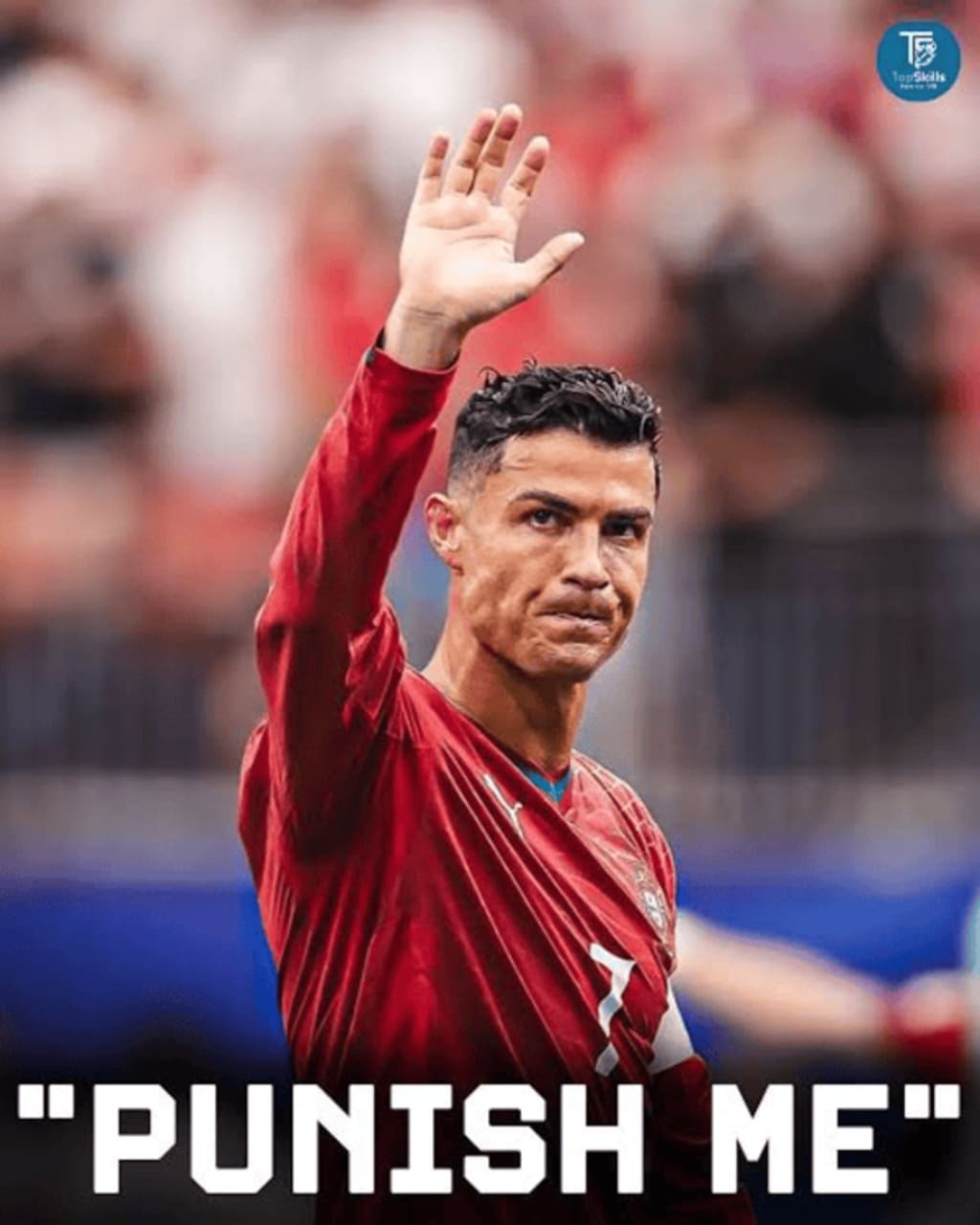
Cristiano Ronaldo asked to be punished. That is not the whole story.
He left Portugal’s camp after a warm-up he never got. His apology also accuses his coach and pressures the federation.
On September 27, 2026, at Ullevaal Stadium in Oslo, Portugal played Norway in the Nations League group stage.
In the 60th minute, Ronaldo left the bench and began to warm up. He ran for seven or eight minutes. He did a few sprints. Then he stood near the fourth official. The night was cold, under ten degrees. He wore a long-sleeved training top. His breath showed in the floodlights.
In the 75th minute, Jorge Jesus used his last substitution. He brought on a center-back. Ronaldo’s bib stayed on.
In the 82nd minute, Norway won a corner. The Portuguese box turned into a scramble. Goalkeeper Diogo Costa punched the ball clear. Ronaldo stood near the touchline, less than two meters from the fourth official. His hands were on his hips. He watched.
Full time. Portugal won 2-1. Ronaldo walked straight down the tunnel. He did not shake hands with teammates. He did not salute the away fans. The broadcast followed him for three seconds, then cut back to the pitch.
Three days later, Copenhagen. September 30. The pre-match press conference. Jesus was asked about the starting lineup. He said: “Gonçalo Ramos.”
According to the Portuguese newspaper Competição, Ronaldo was listening in the room. He stood up and said he was leaving. That afternoon, he flew by private jet from Copenhagen to Madrid. Portuguese Football Federation president Pedro Proença and Jesus went to the airport to persuade him. They failed.
On October 7, Ronaldo released a first-person statement. The same day, in Buenos Aires, at the Monumental, Lionel Messi played his Argentina farewell match. 85,000 people watched him score once and assist twice.
The statement does three jobs at once
It apologizes. It accuses. It applies pressure.
First, the apology. Ronaldo says he owes his national-team teammates an apology for leaving camp. He says he had lost trust in the coach’s promises. He adds that he still should not have left. He calls the responsibility his. Then he asks for a heavier punishment. He writes that he is not an ordinary member. He is the captain. That should be an aggravating factor.
Second, the accusation. The statement’s main story is that the coach broke his word twice. Ronaldo says that after the Norway match, he had a three-way conversation with Jesus and Simão Coutinho, sporting director of Al-Nassr. They agreed on a statement. Jesus promised to clarify the situation at the press conference. He did not. Ronaldo calls this the second broken promise.
Third, the positioning. “If my physical condition is good, if I am still playing at club level, then after serving my suspension, I will be ready, as I always have been, to play for our national team and fight for victories.” He will accept punishment. After punishment, he still plans to return.
One line deserves attention: “In almost 25 years of my career, I have never at any moment interfered with the technical or tactical decisions of any club coach or national-team coach.”
But in the 2022 World Cup, then-coach Fernando Santos benched Ronaldo in the knockout stage. Multiple reports say that after the 6-1 win over Switzerland, Ronaldo argued with Santos in the dressing room and at one point threatened to refuse to play. In the 2026 World Cup, predecessor Roberto Martínez let a 41-year-old Ronaldo play almost every minute. Portugal lost to Spain in the round of 16.
Ronaldo insists he never interfered. The gap between that claim and those facts is the same gap between Jesus and Martínez. Jesus does not plan to repeat the mistake.
The arithmetic of asking for severe punishment
Asking for severe punishment looks noble. It is also a calculation.
Under Article 160 of the Portuguese Football Federation’s disciplinary code, leaving camp without justification carries a suspension of one to six months and a fine of 510 to 1,020 euros. For a player earning tens of millions a year, the fine is not even symbolic.
The suspension is the variable that matters. By raising the expected punishment to “the captain should be punished more heavily,” Ronaldo gives the federation room to be lenient. If the final punishment is a one-month suspension, the federation can say it considered his apology and his history. The procedure is satisfied. The November call-up is not affected.
If the federation imposed six months, Ronaldo would be 42 when it ended. The March international window would become awkward.
On October 2, a federation spokesman denied reports of a six-month ban. He said Ronaldo could return to the national team normally at any time. The threat of a heavy ban was probably never the federation’s plan. Ronaldo’s request for severe punishment is better understood as a move to take the moral high ground. He can say he asked to be punished. That makes it harder to accuse him of refusing responsibility.
Everyone is offering a way back, but not to the same place
Federation president Proença calls the incident “a misunderstanding to be solved internally.” He says Ronaldo “represents Portugal’s greatest symbol.” Jesus says he hopes to call up Ronaldo in November for the final two Nations League group games against Denmark and Wales.
Commercially, Ronaldo’s absence could cost the federation 8 to 9 million euros in the 2027-2030 cycle. In the worst case, 45 to 50 million euros. The federation’s annual budget is just over 100 million euros. Ronaldo remains Portugal’s biggest commercial and international asset.
Returning and returning in what role are two different questions.
Jesus has already drawn a line with his actions. Against Norway, he let Ronaldo warm up for more than half an hour and still did not send him on. It was not impulse. At the post-match press conference he was direct:
“As coach, what I promise is my business. I told the player he would not start, but I would put him on the bench. If I needed him for 30 minutes, he would play. If not, he would not. Before the match I told Cristiano: if the game needs you, you will play twenty or thirty minutes. He said fine.”
Portugal led 2-1. Norway had more possession and more shots. Jesus needed to strengthen the defense, not add a forward. That is a basic in-game decision. Lautaro Martínez did not leave Inter because a center-back injury kept him from playing in a Champions League final.
But in Ronaldo’s account, this was not a tactical choice. It was the second broken promise.
Forty-one, and the problem of no longer being needed
One line in the statement may be the most honest:
“I felt that from that moment on, if I stayed, I would only harm the team. So I did what I always said I would do: if I feel I can no longer play a role, I pack my bags and leave.”
“Can no longer play a role.” That is his explanation. But what role? Starter? Captain’s armband? Ninety minutes every match? The first person the coach thinks of when the game is on the line?
Jesus gave his answer: no.
At the 2026 World Cup, Martínez let a 41-year-old Ronaldo play every minute. Portugal lost to Spain. After the tournament, Ronaldo said he had written a farewell letter. The federation president asked him to stay. He chose to continue. When the Nations League began, Jesus replaced Martínez with a different logic. Ronaldo could play in certain situations. He was no longer the irreplaceable starter.
That logic played out on a Norwegian autumn night. Ronaldo warmed up for thirty minutes and sat back down. He did not salute the fans. He walked to the dressing room.
Then, in Copenhagen, he heard Jesus say “Gonçalo Ramos” at the press conference. He stood up and left.
Two kinds of ending
Messi’s ending was inevitable. He won the Copa América and the World Cup. He completed the full set of national-team honors. Then he stepped aside at the Monumental for Enzo, Álvarez, Lautaro and the next generation. Argentina brought back Otamendi, De Paul and other 2022 World Cup winners. The stadium poured itself out for one man. He finished as the main character one last time: one goal, two assists.
Ronaldo’s situation is different. He did not win the World Cup. Portugal’s golden generation is running out of time. His 2026 World Cup performance is widely seen as having held the team back. He could have walked away cleanly after the tournament. By his own account, he had already written a farewell letter to the Portuguese people. The federation president asked him to stay. He chose to continue. Then, in a conflict over a rotation plan, he left in the middle of a camp.
Behind the two endings are two understandings of the self and the collective. Messi’s farewell was about stepping aside after completing his individual achievements. Ronaldo’s trap is the instinctive resistance of a man who has always defined himself as the absolute center when the collective no longer needs him in that role.
He will probably return, but the problem will not disappear
Ronaldo will probably be in the Portugal squad in November. The federation needs his commercial value. Jesus does not want to be remembered as the coach who drove away a legend. Ronaldo wants to return. The punishment will likely be a one-month suspension or a symbolic fine. All three sides can keep face.
A face-saving return is not the same as a face-saving ending. As long as Ronaldo defines his relationship with the national team by needing to be needed, and as long as he cannot accept being left on the bench by a coach for tactical reasons in a tight match, the seed of the next conflict remains.
Jesus says the misunderstanding can be solved. Proença says Ronaldo is Portugal’s flag. But what needs to be solved may not be the misunderstanding between Ronaldo and Jesus. It may be the question between Ronaldo and himself: whether a man who is no longer used as a savior can still find meaning in the same shirt.
On that Norwegian night, he warmed up for thirty minutes and did not play. On that Copenhagen morning, he stood up and left. The next time may not be so clean.
About the Creator
Jin
Writer of reamstories
https://reamstories.com/jin
Enjoyed the story? Support the Creator.
Subscribe for free to receive all their stories in your feed. You could also become a paid subscriber, letting them know you appreciate their work.
Comments
There are no comments for this story
Be the first to respond and start the conversation.