
Can Mexico Win a World Cup in the Next 20 Years? A Brutally Honest Analysis
Between the eternal dream and the reality of the fifth game curse: what needs to change for El Tri to stop being the perpetual "almost"

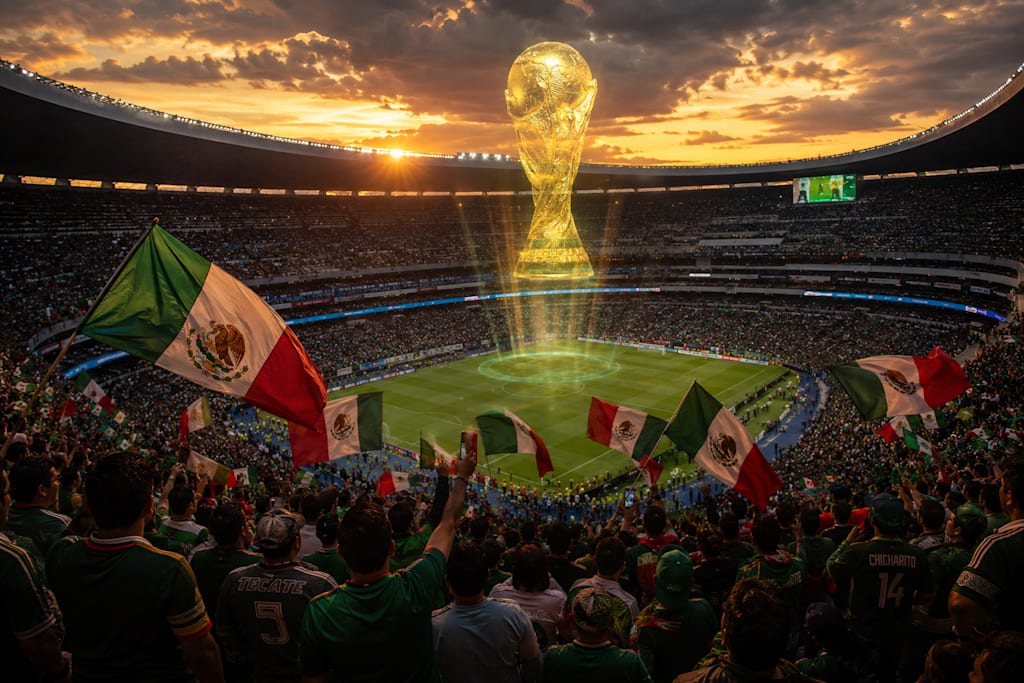
Every four years, millions of Mexicans sit in front of our televisions with the same renewed hope. "This is the year," we tell ourselves. "This generation is different." And every four years, the same result hits us like a bucket of cold water: Round of 16, elimination, and waiting another four years.
But here's the question nobody wants to ask out loud: Can Mexico realistically win a World Cup in the next 20 years? Don't worry, I'm not going to give you the politically correct answer. Let's be brutally honest.
## The Fifth Game Curse: More Than Superstition
Since 1994, Mexico has fallen in the Round of 16 in seven consecutive World Cups. Seven. That's not bad luck—that's a systemic pattern revealing deep problems in our football structure.
When we analyze those elimination matches, we find a common denominator: lack of composure in decisive moments. It's not that Mexican players lack individual talent. Hugo Sánchez proved we can produce world-class strikers. Rafa Márquez captained Barcelona. Chicharito broke records in the Premier League.
The problem runs deeper. It's a combination of psychological pressure, insufficient tactical preparation against elite rivals, and a domestic league that doesn't demand the level necessary to compete against world powers.
## Liga MX: The Comfort Zone That's Killing Us
Here comes the uncomfortable part. Liga MX is one of the richest leagues in the Americas, but is it really developing world-class players?
The data is revealing. While European leagues constantly export talent, Mexico imports foreign players who occupy spots that could belong to young prospects. Mexican clubs prefer paying competitive salaries to established players rather than investing in youth academies that could produce the next Messi or Mbappé.
The result is predictable: Mexican players who feel comfortable earning good salaries without needing to prove themselves in more competitive leagues. Why risk everything in Europe when you can be a star at home?
This mentality is costing the national team dearly. Players who emigrate young to Europe develop mental and technical fortitude that simply cannot be acquired in Liga MX. Edson Álvarez at West Ham, Raúl Jiménez in the Premier League—these players show a different level precisely because they were forged in more demanding contexts.
## The 2026 Factor: Our Best Historical Opportunity?
Mexico will co-host the 2026 World Cup alongside the United States and Canada. This represents a unique opportunity we cannot waste.
Historically, host countries have significant advantages: massive local support, elimination of exhausting travel, familiarity with climate conditions and pitch surfaces. South Korea reached the semifinals in 2002 as hosts. Russia reached the quarterfinals in 2018 on home soil.
However, being a host guarantees nothing. South Africa was eliminated in the group stage in 2010. Qatar didn't even win a single match in 2022. The difference lies in preparation.
If Mexico wants to seize this historic opportunity, the work needs to start now. Not in 2025—now. That means identifying the generation that will be between 24 and 28 years old in 2026 and ensuring they're playing at the highest possible level.

## What Needs to Change: A 20-Year Plan
For Mexico to have real chances of lifting the World Cup trophy before 2045, we need deep structural transformations. Not patches, not temporary solutions—root changes.
First, youth academies must become a national priority. Brazil, Argentina, Germany, and France consistently produce talent because their youth development systems are well-oiled machines. Mexico has the raw talent; what's missing is systematic refinement.
Second, we must incentivize the export of young players. This sounds counterproductive for Liga MX clubs, but it's essential for national development. A player who was forged in the Bundesliga or Serie A from age 18 returns transformed.
Third, the mentality must change. The conformism with "playing well" or "putting up a fight" needs to die. Champion national teams don't celebrate honorable defeats; they demand victories.
## Comparison With Other Emerging Nations
Let's look around us. Morocco reached the semifinals in Qatar 2022, becoming the first African nation to achieve this. How did they do it? With a generation of players trained in the best European academies and a mentality that the limit doesn't exist.
Croatia, a country of barely 4 million inhabitants, has reached two recent World Cup finals. Their secret: a development system that prioritizes technique from early ages and a football culture that doesn't accept excuses.
Mexico has 130 million inhabitants, undeniable football passion, and economic resources superior to many nations that have surpassed us. The problem has never been potential; it's been execution.
## The Psychological Factor: The Elephant in the Room
Nobody wants to talk about this, but it's fundamental. There's a collective mental block in the Mexican national team when knockout matches arrive.
Players feel the weight of decades of failures. The press amplifies pressure to unbearable levels. Fans oscillate between irrational euphoria and merciless criticism. This toxic environment doesn't help anyone.
Champion national teams have something in common: they genuinely believe they can win. It's not empty arrogance; it's confidence built on meticulous preparation and previous successful experiences.
Mexico needs to break the cycle. One fifth game won, then a sixth, building positive momentum that replaces decades of collective trauma.
## So, Can Mexico Win a World Cup?
The honest answer is: yes, but only if everything changes.
With the current structure, the current mentality, and the current priorities, Mexico will continue being the eternal almost. We'll keep celebrating group stage victories as if they were titles and crying over eliminations we should have seen coming.
But if there's real willingness for transformation—if the Federation, the clubs, the players, and the fans align toward a common goal—Mexico has all the potential to shock the world.
Twenty years is enough time to develop two or three generations of players. It's enough time to revolutionize youth academies, change Liga MX culture, and build a winning mentality.
The question isn't whether Mexico can win a World Cup. The question is whether we're willing to do what it takes to make it happen.
The dream is there, waiting. The decision is ours.
About the Creator
ELIAS PULIDO
Storyteller by necessity. The best stories don't live in headlines — they live in the details nobody notices. I write about people, ideas, and the moments when the world shifts direction. Sometimes without anyone realizing it.
Enjoyed the story? Support the Creator.
Subscribe for free to receive all their stories in your feed.
Comments
There are no comments for this story
Be the first to respond and start the conversation.