
The Decline of America
How a Global Superpower Faces Its Greatest Challenges

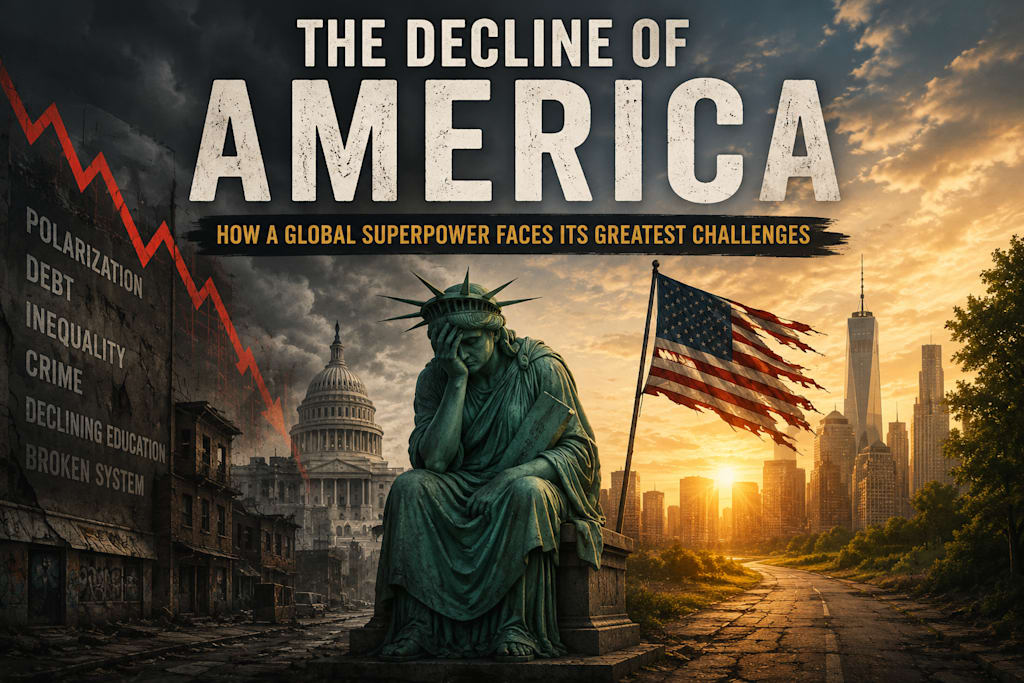
The Decline of America
How the World's Most Powerful Nation Reached a Crossroads
For generations, America was seen as the land where anything was possible.
People crossed oceans, deserts, and borders chasing a dream. They came seeking opportunity, freedom, wealth, and a better future for their families. Hollywood spread images of success across the globe. American companies dominated world markets. Its universities attracted the brightest minds. Its military projected power across continents.
To many, the United States was not merely a country—it was an idea.
But today, a growing number of people are asking a difficult question:
Is America beginning to decline?
The question is controversial. America remains one of the richest and most influential nations on Earth. Yet beneath its enormous wealth and power lie cracks that have become increasingly difficult to ignore.
The signs are not always dramatic. There are no invading armies marching through its cities. No sudden collapse of government. Instead, the concerns come from slower, deeper problems that have been building for years.
A Nation Divided Against Itself
One of the greatest threats facing America may not come from abroad but from within.
Political divisions have reached levels that would have seemed unimaginable decades ago. Neighbors argue over politics. Families stop speaking to one another. Social media amplifies anger and hostility.
Many Americans no longer see political opponents as people with different opinions. They see them as enemies.
This growing polarization makes it increasingly difficult to solve national problems. Every issue becomes a battlefield. Every compromise is viewed as surrender.
History has shown that great nations are strongest when they can unite around common goals. Division weakens even the most powerful countries.
The Growing Gap Between Rich and Poor
America remains incredibly wealthy, but that wealth is unevenly distributed.
Some individuals possess fortunes worth billions of dollars. Luxury neighborhoods continue to expand. Technology companies generate unimaginable profits.
At the same time, millions of ordinary Americans struggle to pay rent, afford healthcare, or save for retirement.
The American Dream once promised that hard work would lead to success. For many citizens today, that promise feels increasingly out of reach.
Young people graduate with massive student debt. Housing prices continue to rise. Living costs consume larger portions of household incomes.
When large sections of society feel left behind, frustration grows. Economic inequality has become one of the defining issues of modern America.
The Weight of National Debt
The United States government has accumulated enormous levels of debt over many decades.
Borrowing money is not unusual for governments. However, when debt grows faster than economic growth, serious concerns emerge.
Future generations may face difficult financial choices. Interest payments consume resources that could otherwise be invested in education, infrastructure, healthcare, and scientific advancement.
Many economists warn that long-term financial stability requires responsible management and difficult political decisions.
The Disappearance of Manufacturing Jobs
There was a time when American factories symbolized national strength.
Manufacturing cities thrived. Stable jobs supported middle-class families. Communities grew around industrial success.
Over time, globalization transformed the economy. Many manufacturing jobs moved overseas where labor costs were lower.
Consumers benefited from cheaper products, but entire communities paid a heavy price.
Factories closed. Local businesses suffered. Families lost economic security.
While technology and service industries created new opportunities, not everyone benefited equally from the transition.
The scars of industrial decline remain visible across many parts of the country.
Challenges in Education
America is home to some of the world's finest universities.
Yet its broader education system faces significant challenges.
Schools in wealthy neighborhoods often have access to better resources than schools in poorer communities. Educational outcomes vary dramatically depending on location and income.
In a world increasingly driven by science, technology, and innovation, educational excellence is more important than ever.
The nations that educate their citizens most effectively are often the nations that shape the future.
A Healthcare System Under Pressure
Healthcare remains one of America's most debated issues.
Medical innovation in the United States is among the best in the world. Yet many citizens struggle with the cost of accessing care.
Unexpected medical emergencies can create enormous financial burdens. Prescription drugs and insurance premiums often place additional strain on household budgets.
For many families, healthcare expenses have become a source of constant anxiety.
A healthy population is essential to a strong nation. Addressing healthcare affordability remains a major challenge.
Aging Infrastructure
Infrastructure is often overlooked until it begins to fail.
Roads, bridges, airports, water systems, and transportation networks form the backbone of a modern economy.
Across America, many of these systems require upgrades and repairs.
While other countries invest heavily in modern transportation and urban development, America faces the challenge of maintaining and improving infrastructure built decades ago.
Economic competitiveness depends heavily on the quality of these foundations.
The Rise of Global Competitors
For much of the modern era, America stood alone at the top of the global order.
Today, the world is changing.
New economic powers have emerged. Competition in technology, manufacturing, artificial intelligence, and scientific research has intensified.
Global leadership can no longer be taken for granted.
The future will belong to nations capable of adapting, innovating, and investing in their people.
America still possesses tremendous strengths, but the competition is stronger than ever before.
Declining Trust
Trust is one of the most valuable assets a society can possess.
When citizens trust institutions, cooperation becomes possible.
In recent years, however, confidence in government, media organizations, corporations, and other institutions has declined.
Many people feel disconnected from leaders and skeptical of information they receive.
Without trust, solving national challenges becomes far more difficult.
A society that cannot agree on basic facts struggles to make collective progress.
Is Decline Inevitable?
History teaches an important lesson.
No nation remains dominant forever.
Ancient Rome, the British Empire, and many other great powers eventually faced decline. Yet history also shows that nations can reinvent themselves.
America has overcome extraordinary challenges before.
It survived civil war, economic depression, global conflict, and periods of intense social unrest.
Its greatest strength has never been perfection. Its greatest strength has been resilience.
The United States still possesses enormous advantages: world-class universities, innovative businesses, abundant natural resources, a dynamic economy, and a culture that encourages entrepreneurship and creativity.
The future remains unwritten.
Final Thoughts
The decline of America is not a certainty. It is a possibility.
The warning signs are real: political division, economic inequality, rising debt, educational challenges, healthcare costs, aging infrastructure, and growing international competition.
Yet great nations are defined by how they respond to adversity.
America stands at a crossroads. The decisions made today will shape the country for generations to come.
Whether the future brings renewal or decline will depend not on America's past achievements, but on its willingness to confront its present challenges.
The story of America is still being written.
About the Creator
younas khan
1. Emotional Storyteller
I write stories that carry emotions, silence, and hidden truths. Every word I share is a piece of heart, every story a journey of feeling
Enjoyed the story? Support the Creator.
Subscribe for free to receive all their stories in your feed.
Comments
There are no comments for this story
Be the first to respond and start the conversation.