Politics
Adolf Hitler: A Historical Biography and the Rise of a Destructive Regime. Content Warning.
Few individuals in modern history have left a mark as catastrophic and far-reaching as Adolf Hitler. His actions reshaped the political landscape of Europe, ignited a global conflict, and resulted in unprecedented crimes against humanity. Studying Hitler is not an exercise in fascination, but rather an effort to understand how fragile democratic systems can collapse and how extremist ideologies gain influence.
By Haroon Pasha8 months ago in Chapters
Mojahedin-e Khalq (MEK) Claims 250 Operatives Attacked Iran Supreme Leader’s Residence — Tehran Calls It Fake News
The organization Mojahedin-e Khalq (MEK) has claimed that around “250 of its operatives” carried out an attack in central Tehran targeting the office and residence of Iran’s Supreme Leader, Ayatollah Ali Khamenei. However, Iranian officials and state media have denied that any such incident occurred. No evidence or images of the alleged attack have surfaced. The Pasteur district—where the Supreme Leader’s residence, the Presidential Office, the Supreme National Security Council, the Judiciary Secretariat, the Guardian Council, and the Assembly of Experts are located—remains under strict security measures. In a statement issued last night, the MEK said its operatives launched the attack on Monday morning at that location and caused some damage, but that “100” of its members were killed or arrested. Iranian media described the claim as a “comical and theatrical reaction,” writing that four MEK members had attempted to create noise in central Tehran using “a plastic pipe made to resemble a children’s toy,” but were arrested during a patrol. Ahmad Bakhshayesh Ardestani, a member of the Iranian parliament’s National Security Committee, said: “I think it is unlikely for them to carry out such an operation, but I am not aware of the details of this news, nor do I know whether such an incident has occurred.” The extremist group Mojahedin-e Khalq (MEK), which blends Islamic and Marxist ideology, supported the 1979 Iranian Revolution that led to the overthrow of the Shah. However, its relations with Ayatollah Khomeini soon deteriorated. The MEK is banned in Iran. The Iranian government designates it as a terrorist organization and accuses it of conspiring and carrying out actions against the state. Many MEK members have been imprisoned or executed for membership in the group. What did the MEK claim, and what are Iranian officials and media saying? The MEK said its operation began at the time of the morning call to prayer and continued until noon. According to its statement, the attack targeted the “Motahari Complex” inside the Supreme Leader’s residential compound, and “150 out of 250” operatives safely returned to their bases. The group further claimed that its members inflicted “heavy casualties” on the security personnel guarding the complex. Pasteur Street and its surrounding area house the Supreme Leader’s residence, the Presidential Office, the Supreme National Security Council, the Judiciary Secretariat, the Guardian Council, and the Assembly of Experts. Although Ahmad Bakhshayesh expressed ignorance about the source of the report, he added: “They believe the country has become weak and that the security and intelligence institutions are preoccupied with other matters, so they want to portray the country as weak through terrorist operations. The website “Bolten News,” which is considered close to the Islamic Revolutionary Guard Corps, wrote that “last night, the sound of consecutive explosions in the Pasteur Street area considered the most secure area of the capital raised serious questions among officials and supporters about how the enemy dared to reach the heart of Tehran. Yesterday, the hashtag “Pasteur” briefly trended on the social media platform X in Iran. However, aside from reports of explosions and gunfire, no images or concrete evidence have emerged so far. Iranian news agencies have denied these reports. According to the newspaper Hamshahri, strict security measures are in place around Pasteur Street, South Palestine Street, Azerbaijan Street, Keshvar-Doust Street, and Imam Khomeini Street. Entry into the area requires a special card, and only security units, armed forces vehicles with green license plates, or vehicles belonging to authorized officials and diplomats with special permits are allowed access. The anti-Iran group Mojahedin-e Khalq (MEK) The MEK is an exiled opposition group that supports the overthrow of the Islamic Republic. It is also known as the People’s Mojahedin Organization of Iran (PMOI). Founded in 1965 as a left-wing militant organization, it strongly opposed the Shah of Iran and participated in protests that ultimately led to the end of his rule and the establishment of the Islamic Republic in 1979. Initially, the group supported Ayatollah Khomeini, founder of the Islamic Republic. However, after its leader Massoud Rajavi was barred from participating in the first presidential election, the MEK adopted an anti-government stance. It began an armed struggle to overthrow the Islamic Republic and claimed responsibility for the assassination of several key figures. As authorities cracked down on MEK supporters also known as the People’s Mojahedin Organization of Iran (PMOI) Massoud Rajavi fled to Paris. Later, he and most of his followers moved to Camp Ashraf in Saddam Hussein’s Iraq near the Iranian border. There, the movement gradually took on characteristics of a cult, including the veneration of Massoud Rajavi and his wife Maryam. Maryam Rajavi joined the resistance movement as a student in Tehran in the early 1970s and, in 1985, assumed joint leadership of the group at her husband’s direction. During the 1980s Iran–Iraq War, the MEK carried out several armed attacks inside Iran with the support of Saddam’s forces, which caused it to lose much of its domestic support. The MEK’s relationship with the West has been complex. During the presidency of reformist Mohammad Khatami, the United States and the European Union designated the group as a terrorist organization. However, during the tenure of his hardline successor Mahmoud Ahmadinejad, those designations were later revoked. The MEK achieved a propaganda success in 2002 when it revealed the existence of key Iranian nuclear facilities, contributing to prolonged tensions between the Islamic Republic and the West. In post-Saddam Iraq, the group disarmed and was eventually relocated to Camp Liberty, a former U.S. military base near Baghdad. Later, the MEK transferred its members to Albania, where they now reside at Camp Ashraf 3. Today, the organization’s headquarters is based in Albania. Camp Ashraf 3 is located near Manëz in Albania’s Durrës district and serves as the central headquarters for the People’s Mojahedin Organization of Iran (MEK), housing approximately two to three thousand members. After relocating from Iraq, the exiled Iranian opposition group has settled in a secure compound, focusing on activities aimed at overthrowing Iran’s government. The MEK’s leaders are based in France, and in 1993 they selected Maryam Rajavi as Iran’s “future president.” Group members also refer to her as the “President-elect of Iran in exile.” The Council on Foreign Relations, in an article about the group, wrote that analysts describe the militant organization as a cult due to its complete loyalty to the Rajavi family. It has been reported that in the late 1980s, older women in the group were forced to divorce their husbands, and young women were not allowed to marry or have children. The article also states that Massoud Rajavi has been missing since the 2003 U.S. invasion of Iraq, and his current status and whereabouts are unknown. Some analysts consider him dead. Iran expert Karim Sadjadpour told the Council on Foreign Relations in an interview: “Cult leaders generally don’t retire. They either die or go to jail. If Massoud Rajavi is alive, I would be surprised.”
By Real content8 months ago in Chapters
Can the Taliban win a war against Pakistan? Retaliation for Pakistani airstrikes in Paktika, US weapons left in Afghanistan 2026
On February 22, separate airstrikes in Afghanistan’s Paktika and Nangarhar provinces killed and injured multiple people. Military sources in Pakistan claimed that seven hideouts of the TTP (Tehreek-e-Taliban Pakistan) or Pakistani Taliban and other militant groups were targeted across three provinces—Nangarhar, Paktika, and Khost. However, after visiting the affected areas, Al Jazeera’s team confirmed civilian casualties. It is worth noting that Al Jazeera is an impartial news organization. Following the Pakistani airstrikes on Afghan territory, the Taliban government’s Ministry of Defense warned of retaliation, stating that they would respond “at the appropriate time in an appropriate manner.” But what could such a response look like? In a recent interview, Taliban government spokesperson Zabihullah Mujahid said, “It will become clear then; no crime will go unanswered.” After the attacks in Nangarhar and Paktika, Afghan citizens have been seen in local media demanding that the Taliban government take action in “revenge.” The Taliban Government’s Military Strength and Weapons The Taliban government’s military equipment has largely been acquired from three sources: weapons and equipment from the former Afghan army, arms left behind after the withdrawal of U.S. and other foreign forces, and newly obtained weapons from various sources such as the black market. According to experts, videos of past clashes between Afghan Taliban forces and Pakistani troops show that the Taliban primarily used light weapons against Pakistan, with very little evidence of heavy or long-range weaponry. During the 20-year war, reports from the U.S. Special Inspector General for Afghanistan Reconstruction (SIGAR) and the country’s Ministry of Defense indicate that more than 1.6 million light and heavy weapons and pieces of military equipment were supplied to the former government. Approximately 70 percent over one million ultimately fell into Taliban hands. Currently, the Taliban government’s light weapons include Kalashnikovs, American M16s, M4s, and M249 light machine guns. They also possess heavy machine guns such as the M2 and M240, grenade launchers, RPG-7s, AT4 rocket launchers, and anti-tank missiles. According to U.S. Department of Defense (Pentagon) reports, the Taliban also have heavy armored vehicles, aircraft, and other heavy military equipment previously provided to the former Afghan army. Among these are 122mm howitzers known as D-30s. An estimated 100 to 120 of these guns remain in Afghanistan. Additionally, the Taliban possess approximately 155mm howitzers and various Russian weapons, such as the ZU-23(-2). In 2024, during a military parade at Bagram Air Base, the Taliban government displayed heavy weaponry, including Scud missiles R-17 and Elbrus R-300, with a range of about 300 kilometers. They also showcased Luna missiles (also known as “Frog-7”), Grad rocket launchers, Milan anti-tank missiles, Uragan rocket systems, and other weapons capable of striking targets up to approximately 35 kilometers away. These weapons have not been used in Afghanistan for at least three decades. Some were stored in Ministry of Defense warehouses, while others were kept in mountainous areas. Although the Taliban Ministry of Defense claims to have reactivated some of them, their technical condition and actual combat readiness remain unclear. One advantage Pakistan holds is its modern fighter jets and established air force, whereas the Taliban government does not possess comparable air power. Although the Taliban have repaired some helicopters inherited from the former Ministry of Defense and trained pilots, they cannot match the Pakistani Air Force. According to Pentagon reports, aircraft captured by the Taliban include C-280 planes, MD-530 helicopters, Black Hawks, A-29 aircraft, Mi-17 transport helicopters, Mi-24 attack helicopters, and MD-500 light attack helicopters. With these recent developments, the Taliban’s apparent willingness to engage in war with Pakistan seems beyond conventional calculation. Abdul Hadi Himmat, head of the Taliban government’s northeastern military court, speaking at a gathering in Kunduz on Tuesday (February 24), said, “If the Amir permits, we will spend the next night in Peshawar.” He insisted that if war breaks out, they will emerge victorious. A senior Taliban government official, speaking on condition of anonymity, said that while they may lack long-range missiles or air power, “our war with Pakistan is at hand. We have ground routes where air power is not as necessary.” The official emphasized the guerrilla warfare experience Taliban fighters gained against U.S.-led NATO forces and earlier during the war against the Soviet Union. Echoing this sentiment, Syed Irfan Ashraf, a university professor and researcher in Peshawar, said that while Pakistan has a well-organized military and equipment, “there is significant fear of guerrilla warfare from the Taliban side.” He noted that militant groups are already active in Pakistan. If direct fighting begins, these groups could exploit the situation for their own benefit, making it difficult for the Pakistani military—already engaged on multiple fronts—to control the conflict. According to him, “suicide attacks are another factor that strengthens the Taliban and spreads fear.” His assumption is that Pakistan is aware of all these aspects and is not attempting to organize a large-scale direct war. Instead, such strikes are being used to pressure the Taliban government to implement policies aligned with Pakistan’s preferences and to consider Islamabad’s strategic and geopolitical interests. Islamabad openly accuses the Taliban government of sheltering its enemies, such as the TTP, and providing them with safe havens. Ashraf further stated that a structured war requires a strong economy, and Pakistan does not wish to face such a conflict given its fragile economic condition. The Legal Dimension of the Conflict Two days after the strikes, the Taliban government’s Foreign Minister Amir Khan Muttaqi spoke by phone with UN Under-Secretary-General for Political Affairs Rosemary DiCarlo. According to a Foreign Ministry statement, Muttaqi said that Afghan civilians were killed in the recent Pakistani strikes and that “over the past four years, such repeated attacks by Pakistan have only targeted civilians. Moreover, no militants have ever been killed in these attacks, contrary to Pakistan’s claims.” Afghanistan’s Permanent Mission to the United Nations also submitted a “formal complaint” to the Security Council regarding the recent Pakistani airstrikes in Nangarhar and Paktika. Nasir Ahmad Faiq, who represented the former Afghan Republic at the UN and currently serves as Afghanistan’s fourth Permanent Representative to the organization, wrote on his Facebook page on February 23 that “women and children” were among the civilians killed in the recent Pakistani airstrikes. “Today, Afghanistan’s Permanent Mission submitted its official complaint to the UN Security Council,” Faiq stated. He added, “We demand the proper cessation of these violations, investigation, accountability, respect for territorial integrity, adherence to the UN Charter, and full compliance with international law. In a statement issued yesterday, Afghanistan’s Permanent Mission to the UN condemned Pakistan’s strikes as a “clear violation of the UN Charter” and of “recognized principles of international human rights. Analysts say the Taliban government, which lacks broad international diplomatic recognition and is reportedly recognized only by Russia, is unlikely to gain significant support. So far, only India has clearly condemned Pakistan’s attacks on Afghanistan; no other countries have issued formal condemnations. Nasrullah Stanekzai, a former Kabul University professor, stated that the complaint by Afghanistan’s former representative at the UN would be recorded as “moral outrage.” He said, “The Taliban may now realize the importance of membership in international organizations and engagement with them.” Regional players with close ties to Pakistan—such as China, Turkey, Qatar, and Saudi Arabia even though some have accepted Taliban diplomats, have remained largely silent. However, Turkey, Qatar, and Saudi Arabia have reportedly attempted mediation efforts.
By Real content8 months ago in Chapters
Donald Trump — Power, Politics, and a Divided Nation
Donald John Trump is one of the most recognizable and polarizing figures in modern American history. Known first as a businessman and television personality, he later became the 45th and 47th President of the United States. His life story is filled with ambition, success, controversy, and constant public attention. Whether admired or criticized, Trump’s influence on politics and media is undeniable.
By Haroon Pasha8 months ago in Chapters
US-Iran Crisis: Trump Sets 10-Day Deadline as Geneva Nuclear Talks Resume
Iran has once again made it clear that any type of American attack would be considered “aggression” and would be met with a response. Iran’s Foreign Ministry spokesperson, Esmail Baghaei, said in a press conference that “aggression has no limits. Any kind of attack, even if limited, is an example of aggression and will have its own consequences.” Accusing the United States of making “contradictory claims,” the Iranian Foreign Ministry spokesperson said that Iran has no interest in prolonging negotiations. He added, “Whether it was the negotiations before June last year or the rounds of talks taking place in the current period, we have repeatedly announced that for meaningful progress we are ready to continue uninterrupted negotiations for days and weeks. Holding talks at intervals of ten or fourteen days is not our preferred method, and we have no interest in dragging out the negotiations.” It is worth recalling that three days ago U.S. President Donald Trump said that if a nuclear deal is not reached, he may consider a “limited” military strike on Iran. In an earlier statement last week, Trump also said that it would become clear within the next ten days what would happen with Iran, and that if no agreement is reached within that timeframe, the possible consequences would be very severe. Two rounds of indirect talks between the United States and Iran have taken place under Omani mediation. On Monday (February 22), Oman’s foreign minister confirmed that the third round of talks between the U.S. and Iran will be held in Geneva on Thursday. Oman, which is acting as a mediator between the two sides, said the talks were arranged as “an additional effort to finalize an agreement with positive progress.” It should be noted that after the second round of talks between the U.S. and Iran held in Geneva on February 17, both Washington and Tehran expressed concerns along with some encouraging statements. Following the February 17 meeting, U.S. Vice President J.D. Vance said that diplomatic talks between the U.S. and Iran had been good “in some respects” and that the parties had agreed to hold another meeting. Meanwhile, Iranian Foreign Minister Abbas Araghchi said that “an understanding on fundamental principles” had been reached with the United States. Vice President Vance also said that Iran is still not ready to accept “certain red lines” set by President Trump. He indicated that the U.S. would continue on the diplomatic path, but that President Trump would decide “when to abandon diplomacy.” He further said that Washington does not expect matters to reach that point, but if they do, the decision would be President Trump’s. On the other hand, Iranian Foreign Minister Abbas Araghchi described the second round of talks as more positive than the first and said that “both sides will prepare two draft documents of a possible agreement and exchange them. But this does not mean we will soon reach an agreement; however, we have certainly set out on the path toward one.” Prepared to defend the country On Tuesday, Iran’s Commander-in-Chief of the Army, Major General Amir Hatami, said that amid current tensions with the United States, “millions of soldiers are ready to sacrifice their lives in defense of the country.” According to the Tasnim News Agency, Major General Hatami said at a graduation ceremony for military officers that although the “enemy” believes it has superiority over the Islamic Republic of Iran, “great Iran cannot be swallowed.” He stressed that “resistance” is the most effective weapon against opponents. He also praised Supreme Leader Ayatollah Ali Khamenei’s February 17 warning that U.S. aircraft carriers “can be sent to the bottom of the sea.” He added that the Iranian people will remain steadfast and defeat this “dangerous plan,” which he described as American bullying. He argued that the U.S. is not invincible, as demonstrated in decades-long wars in Vietnam, Afghanistan, and Iraq. What is Oman’s role in mediating between Washington and Tehran? Following regional diplomatic efforts, Oman is trying to help both sides reach an agreement. Oman’s Foreign Ministry has emphasized the importance of returning to the negotiating table and resolving differences peacefully to help establish peace and security in the region and the world. It is worth recalling that under Omani mediation, Tehran and Washington began indirect talks in Muscat on February 6. Last year, talks between the two sides were halted when Israel launched a war against Iran in June. After that major impasse, this dialogue marks the first progress. Oman’s Foreign Minister Badr Hamad Al Busaidi has stressed in several official meetings the need to expand opportunities for compromise and coordination so that an agreement can be reached in line with the expectations of all parties. Military preparations and exercises Alongside negotiations, both Washington and Tehran appear to be taking steps to increase pressure on each other. U.S. officials have said that the American military is preparing for the possibility of operations against Iran that could last several weeks if President Donald Trump orders strikes following a failure of negotiations. Meanwhile, Iran said that on Tuesday its Revolutionary Guards had conducted military exercises in the Strait of Hormuz in recent days and temporarily closed parts of the strait for several hours as part of those drills. The Strait of Hormuz is a key international waterway and the main route for oil exports from Gulf Arab countries. On Monday, Iran began military exercises in the strait, which continued into Tuesday. In light of the situation, Gulf countries have called for a diplomatic solution to end the dispute. It should be noted that in January the United States deployed the aircraft carrier USS Abraham Lincoln along with other warships to the Gulf, and afterward the Gerald R. Ford was also deployed to the Middle East. On Monday, Mohammad Akbarzadeh, commander of the Revolutionary Guards Navy, said that all foreign warships in the region are “under full intelligence surveillance and within range of our defensive capabilities.” According to him, Akbarzadeh stressed that “the armed forces are fully prepared and monitoring enemy movements. No kind of threat will be ignored.” Do you like this personality?
By Real content8 months ago in Chapters
El Mencho Killed: Mexico at a Crossroads After CJNG Cartel Leader’s Death
Cartel Leader Killed Mexico at a Crossroads Mexico woke up to bombshell news this week: Nemesio Rubén Oseguera Cervantes, better known as El Mencho, is dead. He wasn’t just any criminal he was the boss of the Jalisco New Generation Cartel (CJNG), one of the world’s most feared and elusive drug lords. Now, after years on the run, he’s gone. For a long time, El Mencho’s name meant trouble. He represented both the insane reach of organized crime and the massive challenges Mexico faces in trying to beat it back. His death is a huge moment in that fight. Does it mean things get better now? Or is it just the beginning of more chaos? Right now, nobody can say for sure. How They Got Him Officials say Mexican security forces tracked him to some remote spot near Tapalpa, up in the mountains of western Jalisco. The army led the charge, finally closing in after years of gathering intel, keeping watch, and working with other agencies. Not a lot of details have come out, but here’s what’s clear: when they moved in, it turned violent. By the end, one of the world’s most wanted men was dead. El Mencho had managed to slip away for over a decade, hiding behind loyal followers, safe houses, and heavily armed guards. He ran things with secrecy and wasn’t afraid to use brutality to keep people in line. That ability to stay hidden made him almost legendary in the criminal world. But now, with his death, that legend’s been shattered. Who Was “El Mencho”? Oseguera’s rise tells the story of how Mexico’s criminal world changed. The old cartels started splitting up around 2010, and from that chaos, CJNG exploded onto the scene—fast growth, ruthless tactics, and no fear about picking fights or forming alliances. Unlike many old-school gangs, the CJNG was known for: Using military-style operations and propaganda Expanding quickly into new territory Controlling synthetic drugs, especially meth and fentanyl Making bold, public shows of force to scare both enemies and the government With El Mencho at the top, they went global—trafficking drugs into North America, Europe, even Asia. The U.S. put a massive bounty on his head, calling him one of the world’s most dangerous drug bosses. Thing is, cartel power isn’t permanent. It never is. What Happened Next: Streets on Edge It didn’t take long for the fallout to begin. Hours after the news broke, violence erupted across western Mexico. People started seeing burning vehicles, roadblocks, and shootouts in Jalisco and nearby states. Social media lit up with photos of smoke billowing over highways and city streets. Even tourist spots got hit by the tension. In Puerto Vallarta, a place people usually go to relax, security was everywhere. Vacationers talked about the uneasy mood as police told everyone to stay inside. The U.S. Embassy jumped in almost immediately, warning Americans in the area to hunker down and follow official updates. That’s just a reminder: what happens in Mexico doesn’t stay in Mexico. Cartel violence spills over borders, and everyone feels the impact. Travel and Economy The chaos reached some of Mexico’s busiest airports. Flights in and out of Cancún and Mexico City faced delays and cancellations while airlines scrambled to figure out if it was safe. Tourism is huge for Mexico. It brings in billions and keeps millions of people working. Even a few days of trouble can cause major headaches, especially in places that depend on international visitors. Hotels and travel companies rushed to tell tourists that things were under control. But public perception is powerful. When people see headlines about cartel violence, it changes how they feel about visiting, no matter what’s actually happening on the ground. Investors are watching, too. If things stay unstable, it could shake up foreign investment, supply chains, and trade. The Cartel Splinters When a big boss falls, the people under him often start fighting for control. Different groups want a piece of the action, and that can mean even more violence as they fight to take over. Mexico’s seen this play out before power struggles, turf wars, and a spike in bloodshed as new leaders try to prove themselves.
By Real content8 months ago in Chapters
Pakistan Bombs Afghanistan: Nangarhar and Paktika Airstrikes Kill Civilians, Taliban Condemns Attack
Provincial officials in eastern Afghanistan’s Nangarhar province told the BBC that a house belonging to a man named Shahabuddin was targeted in the Gardai Kach area of Behsud district, killing and injuring around 20 people, including women and children. A member of the family said, “Everything is finished. My children are gone, my brother and my husband are gone, and my unmarried daughters have died.” Eyewitnesses said the house was targeted in a late evening airstrike. In addition to Behsud, strikes were also reported in the Khogyani and Ghani Khel districts of Nangarhar province. What happened in Paktika?
By Real content8 months ago in Chapters
Despite heavy casualties in the war with Israel, Hamas regained 90% control of Gaza.
When the ceasefire imposed by the United States last October halted the war in Gaza, Hamas’s fight for survival against Israel turned into a battle for control at home. The war had reduced the group’s regular military units to scattered guerrilla forces, killing most of its leaders. Gaza’s buildings and infrastructure were heavily destroyed, its population displaced, and its economy devastated. The Hamas-run Ministry of Health says more than 72,000 Gazans have been killed in the fighting and Israeli attacks. Four months after the ceasefire, Gaza residents say Hamas is once again increasing its control over security, taxes, and government services, raising questions about the group’s long-term strategy and whether it is willing to relinquish its weapons and authority. Gaza activist Mohammed Diab said Hamas has regained control over more than 90% of the areas where it is present. He added, “Their police and security agencies are back on the streets, maintaining order and security, and pursuing those they consider collaborators with [Israel] or dissenters.” Across Gaza’s markets, shopkeepers talk about the return of regular police patrols and strict control over official duties and taxes. Everyone we spoke to about Hamas’s control in Gaza asked not to be named. One shopkeeper said, “Markets are calm, but the municipality is still pressuring us to pay rent. They come aggressively every day with the same demands and determination, saying that if we don’t pay, they will throw us and our goods onto the street.” The shopkeeper told our correspondent in Gaza City that he and his 12-member family were displaced from Shujaiya in eastern Gaza, where his shop was located. Today, Shujaiya is a field filled with rubble. Nearby, a cigarette vendor said, “The municipality comes every day. I let them count inventory and sales one by one, thread by thread, and then they ask, ‘Do I pay them or feed my children?’” Since the ceasefire, food and some basic goods have been flowing more freely in Gaza. A few key merchants allowed to import from Israel say Hamas has once again imposed strict taxes on imports. A merchant, who agreed to share details anonymously, said force is used against those who refuse to pay. He said, “The taxes imposed by Hamas depend on the type and quantity of goods, but prices start at 20,000 shekels and above. If a merchant refuses to pay, force is used, and in some cases, abductions or threats occur. No one can avoid paying taxes on goods.” He said that merchants use a code to refer to Hamas when discussing tax payments, so Israel does not realize the money is going to the group. Gaza activist Mohammed Diab said Hamas now has a database of all merchants importing goods into the Gaza Strip. “Merchants pay in cash, not via bank transfer, so the flow of money cannot be traced. The group is gradually restoring the system that existed in the past, but out of sight to avoid monitoring.” Hamas spokesperson Hazem Qassem said the Gaza Strip is in an emergency and “extraordinary measures” are required. He said, “Some merchants have [Israeli] occupier connections and try to make excessive profits, so administrative authorities sometimes have to deal decisively with uncooperative merchants or those failing to meet obligations. This is purely an administrative issue and has nothing to do with Hamas. Since 2007, Gaza has been governed by Hamas, responsible for paying salaries and, according to the Israeli military, for ultimately rebuilding its war machine. Israeli army spokesperson Lt. Col. Nadav Shoshani said Hamas sees the time after fighting against Israel as an opportunity. He added that it is therefore crucial to see them disarmed because they have made it clear that if they have weapons, they will use them in the future. The Israeli military says it continues to face daily attacks from Hamas against its forces. Since the ceasefire began, four Israeli soldiers have been killed. While Israeli attacks continue against Gaza’s innocent civilians, the Gaza Ministry of Health says 603 Palestinians have been killed since the agreement. When asked whether the two-year intense military conflict failed to destroy Hamas’s military capabilities, one of Israel’s key objectives, Lt. Col. Shoshani remained firm. He said the war will not end until Hamas is disarmed. “Now there is an agreement [and] we expect that to happen. If not, there are many tools on the table to ensure it does.” A Trump-led peace delegation, consisting of leaders interested in Gaza’s future, recently held its first meeting in Washington. The next phase of Trump’s plan for Gaza, including reconstruction, depends on Hamas disarming, but negotiators are quietly working out the practical details of weapons transfer—how Hamas will hand over weapons, which weapons will be handed over, and how the process will be verified. Hamas spokesperson Hazem Qassem said he is confident that “we can resolve the weapons issue in a way that removes the pretext for restarting the war and aligns with President Trump’s plan.” But Hamas, ideologically committed to fighting Israel, is deeply rooted and armed throughout the Gaza Strip. Full disarmament verification will be difficult, and some within the group reportedly insist on keeping personal weapons for defense against internal enemies. When the fighting with Israel ended in October, Hamas immediately redirected its weapons against rival factions taking advantage of the chaos to increase their power in Gaza City, Rafah, and elsewhere. Israeli leaders have rejected the idea of Hamas keeping personal weapons and have pressured the group to disarm by threatening renewed war. Meanwhile, the International Stabilization Force, which is supposed to take responsibility for security in Gaza, remains stalled, and the new Palestinian technocratic council, intended to manage Gaza’s civil administration, is waiting in Egypt. Earlier this month, Hamas said it was willing to transfer “authority and governance in all areas” to the new technocratic council. But Gaza activist Mohammed Diab said there is little evidence that Hamas is preparing to relinquish power. On the contrary, he said, last week they heard that Hamas made mass appointments to vacant government positions and announced them on social media and official platforms. Hazem Qassem denied the hiring of new officials, saying all appointments were technical and low-level positions with no impact on power transfer. Critics question whether this step is an attempt to maintain influence over Gaza’s future government. At an evacuation site near Nasser Hospital run by international aid organizations, a person said Hamas ministry officials arrived the next day to help oversee the evacuation. This is a key moment for Donald Trump’s plan, which, despite obstacles and delays, is moving forward with persistent pressure and steady progress. Despite repeated threats to restart the war if not fully disarmed, some in Israel believe that the most effective pressure on Hamas leadership may be to advance the plan without their direct involvement. Land has been cleared around Israeli-controlled areas near Rafah, preceding a U.S. plan to build new housing for approximately 200,000 Gaza residents. The plan aims to attract people from Hamas-controlled areas by promising food, water, and medical services. Many in Gaza see entering the extensive Israeli-controlled areas as siding with the enemy, and so far, very few have taken this route.
By Real content8 months ago in Chapters
Iran-US War Scenario: Can Tehran Rely on China and Russia for Military Support?
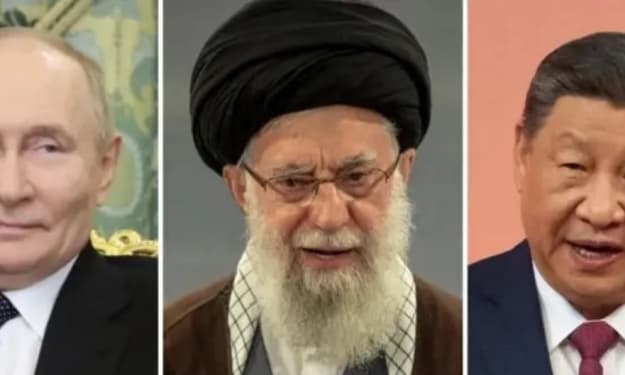
With every new wave of tension between Tehran and Washington, the same question resurfaces: if the conflict escalates into war, what would China and Russia do? Can Iran truly rely on the support of these two powers, or are the relationships largely temporary and strategic rather than a firm alliance? The core issue lies in the nature of Iran’s relationships. Media narratives often use terms like “axis” or “bloc,” but in reality, Iran has no formal military alliance with either Russia or China. In international relations, an alliance means that if one country is attacked, the other is obligated to come to its defense. No such commitment exists between Iran and these two countries. However, “strategic partnerships” in certain areas have led some observers to speak of a new level of relations among Iran, China, and Russia. In the most recent example, the Iran–Russia strategic partnership agreement signed in January 2024 emphasized defense and security cooperation, yet it did not include any commitment to direct military intervention if one party were attacked. The agreement contains clauses preventing the use of either country’s territory against the other, but this differs significantly from a comprehensive defense pact. Yes, there is a “strategic partnership” in certain sectors, including defense and security cooperation, but it does not guarantee direct military assistance. International relations expert Hamidreza Azizi noted in an interview that alliances represent the highest level of relations between states, and in Iran’s case, no such alliance exists with China or Russia. He believes that even if war breaks out, the likelihood of direct military intervention by Russia or China is low, and their activities would mainly remain at the diplomatic level. Although some Western security reports and analyses portray Iran as part of an anti-Western alliance with Russia and China—or as an equal threat alongside them—many international relations analysts argue that Tehran’s alignment with Moscow and Beijing is more about “alignment of interests in the face of U.S. pressure” than a full security partnership. In other words, their shared opposition to Washington’s policies does not guarantee that Russia and China would be ready to directly confront the United States in defense of Iran. Why Direct Intervention Would Be Costly Another important dimension of this scenario is geopolitics. Both China and Russia have diverse and complex relationships in the Middle East. Beijing is a major economic partner of Saudi Arabia, the United Arab Emirates, and even Israel. Moscow, while aligned with Tehran, also maintains ties with Tel Aviv and several Arab countries. Entering a direct war alongside Iran could jeopardize these relationships. Russia is already entangled in the war in Ukraine, and its military and political resources are limited. China, strategically, is focused on its competition with Washington, particularly in East Asia and over Taiwan. Opening a new and risky front in the Middle East even indirectly does not align with their priorities. However, Professor Yulia Roknifard of Taylor’s University in Malaysia offers another perspective. She closely follows Iran–Russia relations. According to her, Russia and China may see recent developments as an opportunity to demonstrate support for a key partner. Iran is not only a member of BRICS but also of the Shanghai Cooperation Organization. Moscow and Beijing cannot afford to let the credibility of these cooperative frameworks be undermined or called into question through what they view as illegitimate processes. Nevertheless, most Russian observers emphasize that Moscow seeks to maintain the balance of power in the region, not to jump into a war that would create further instability. From China’s perspective as well, avoiding direct intervention and pursuing a political solution remains the priority. A similar approach was observed in the Ukraine war, where China provided Russia with behind-the-scenes political and economic support without directly entering the conflict or openly bearing the costs of overt backing. The Experience of the 12-Day War To better understand China and Russia’s role, one can look at the example of the 12-day war between Iran and Israel. During this brief conflict, neither Moscow nor Beijing offered Iran assistance beyond cautious rhetoric and political support. There was no military cooperation and no open political backing. Iran also made clear that it had not requested assistance from either country. After the war, in November 2025, a spokesperson for the Islamic Revolutionary Guard Corps stated that “we have no defense treaty with these two countries, and there was no need to request help.” According to Hamidreza Azizi, although there has been no fundamental shift in China and Russia’s broader strategy toward Iran, certain aspects have been reassessed. He argues that concerns about a potential U.S. attack disrupting the regional balance of power have compelled China and Russia to reconsider some of their policies. These reassessments have occasionally led to new developments, such as China supplying missile fuel to Iran or Russia and China providing Tehran with direct intelligence regarding U.S. military movements. Azizi believes that if tensions escalate, the more likely pattern will be continued limited informational, diplomatic, or technical support without direct involvement in the war. Professor Roknifard, however, suggests that Russia and China do not necessarily need to make their support public, much as Iran maintained ambiguity about the assistance it provided to Russia during the early stages of the Ukraine war. Fear of Regime Change Some analysts also argue that a regime-change scenario in Iran could alter Moscow and Beijing’s calculations. Iran is a member of BRICS and the Shanghai Cooperation Organization and serves as a crucial geopolitical link between Central Asia and the Middle East. From this perspective, a complete collapse or overthrow of Tehran’s political system could be seen by Moscow and Beijing as a blow to the credibility of the multilateral mechanisms they aim to strengthen. Meanwhile, concerns about a government in Iran more aligned with Western governance models represent another factor that could influence Chinese and Russian policy calculations. Roknifard noted that the prospect of Iran’s fragmentation or the rise of a new government could be perceived by Moscow and Beijing as a threat to their interests, given the possibility that such a scenario could transform Iran into a platform for pressure against Russia. However, many observers believe that even in this scenario, their response would not necessarily be military. Economic, intelligence, and arms cooperation might increase, but direct entry into war would still appear to be a costly option. The Economy what Iran Needs Most An essential part of the equation is economic. Relative economic stability could help the government in Tehran endure. China plays a significant role in this sphere, though recent experience suggests Beijing has been highly cautious in practice. Recent reports indicate that Beijing has significantly reduced its purchases of Iranian oil in recent months. According to tanker-tracking company data, China’s oil imports from Iran—which at times reached 1.4 million barrels per day last year—have recently fallen to around 800,000 to 900,000 barrels per day, a decline of roughly 30 to 40 percent. Some estimates suggest that at certain points last month, the figure dropped below 750,000 barrels per day. This decline followed increased pressure from U.S. sanctions and tighter insurance and shipping conditions for tankers. If tensions rise further, Iran’s ability to maintain foreign currency earnings could be directly affected. Since the autumn of 2025, the volume of Iranian crude accumulating in tankers and floating storage has reached record highs, signaling unusual pressure at the final stage of Iran’s oil export chain. Recent remarks by President Masoud Pezeshkian that certain Chinese financial projects have not been implemented serve as a reminder that even at the peak of pressure on Tehran, Beijing is unwilling to risk U.S. secondary sanctions. This has led some in Iran to speak of China’s “unfulfilled promises.” Russia, too, has demonstrated in recent years that its cooperation with Iran is largely driven by mutual and temporary interests. From the Bushehr power plant case to delays in supplying defense systems, political considerations have often played a role. Political and Diplomatic Backing—but Not Military Intervention
By Real content8 months ago in Chapters