Adventure
The Conduit: Chapter 7
Research becomes exciting when you’re close to a discovery. The words sounded good in the head of Jonas Quinn, an archaeologist working on his doctorate. As he filled in for the professor, he struggled to figure out how to turn from student to lecturer. It wasn’t part of his plan to teach, not at this point in his life. Jonas wanted to be in the field, finding artifacts and researching their history. The world of an archaeologist sounded fun, even exciting, but he’d only been on two digs during his years at the university and had yet to find anything important.
By Jason Morton2 years ago in Chapters
Ashes of the Drowned Part 3
The relic whispered in the dark. It hadn’t stopped since Elira touched it. The conch—once dormant, sealed in sea-crystal and warded runes—now pulsed with a rhythm not unlike a heartbeat. A slow, wet thrum, felt more in the bones than heard in the air. When Elira closed her eyes, she could feel the sea breathing inside her skull. And sometimes, the whispers became words.
By Richard Bailey2 years ago in Chapters
The Deal
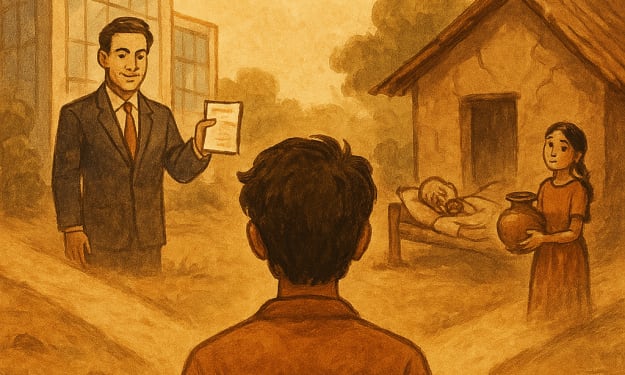
Ravi sat on the old wooden bench near the village tea shop. The sun was high in the sky, and sweat ran down his face. His shirt stuck to his back. It was summer, and the heat was worse than usual. But it was not just the weather that made Ravi uncomfortable — he had a big decision to make, and it was troubling his heart.
By Tahir khan2 years ago in Chapters
Ashes of the Drowned Part 2
The water was ice-cold, and it didn’t feel natural. Vaelin and Elira trudged through the southern quarter of Nareth, where the map she recovered had marked something hidden beneath the streets. Mossy stonework arched over their heads in crumbling remnants of coastal architecture—half-drowned, half-forgotten.
By Richard Bailey2 years ago in Chapters
Imran Ahmed Khan Niazi’s Government: A Distinct Chapter in Pakistan’s 74-Year Political History
Introduction Since gaining independence in 1947, Pakistan has witnessed a variety of leadership styles, political ideologies, and governance structures. Among the many political leaders who held the office of Prime Minister, Imran Ahmed Khan Niazi stands out not only for his cricketing fame but also for his ambitious and reformist approach to governance. Leading the Pakistan Tehreek-e-Insaf (PTI), Imran Khan assumed office on August 18, 2018, and served until April 10, 2022 — a period of approximately 3 years and 8 months. His tenure, though short of the full five-year term, left a significant impact on Pakistan’s political, economic, and social landscape. This article explores the beginning of his government, the challenges he faced, the initiatives he introduced for the welfare of the common man, and how his overall performance compares to the governance of Pakistan over the past 74 years and 9 months. --- The Beginning of Imran Khan’s Government Imran Khan’s political journey began in 1996 with the formation of PTI. For over a decade, the party remained on the fringes of Pakistani politics. However, Khan’s charismatic leadership, persistent campaigning against corruption, and the promise of a "Naya Pakistan" gradually gained public attention. By the 2018 general elections, PTI had become a formidable political force, securing enough seats to form a government at the federal level. His election victory was seen as a reflection of public frustration with traditional political parties like the Pakistan Muslim League-Nawaz (PML-N) and Pakistan Peoples Party (PPP), both of which had been marred by allegations of corruption, nepotism, and inefficiency. Imran Khan promised to bring accountability, transparency, and a new era of justice and welfare-oriented governance. --- Challenges Faced by His Government Imran Khan inherited a country riddled with deep-rooted economic, political, and administrative issues. From day one, his government had to deal with: 1. Economic Crisis: Pakistan was facing a severe balance-of-payments crisis with depleting foreign reserves. The government had to seek a bailout from the International Monetary Fund (IMF) to stabilize the economy, which brought its own set of conditions and austerity measures. 2. High Debt and Deficit: Khan’s government had to deal with a massive debt burden and a persistent fiscal deficit. Managing public finances without curtailing development or social programs was a major hurdle. 3. Opposition Pressure: Unlike some past governments, Imran Khan faced strong opposition from day one. Multiple parties joined forces against him, accusing him of being brought into power by the military establishment. 4. COVID-19 Pandemic: The global pandemic hit during his tenure, forcing a delicate balancing act between saving lives and saving livelihoods. Pakistan’s healthcare infrastructure was under immense pressure. 5. Civil-Military Relations: Though initially considered close to the military, cracks began to appear towards the end of his tenure, ultimately contributing to his removal through a vote of no-confidence. --- Welfare and Thoughtfulness for the Poor Despite economic and political challenges, Imran Khan’s government undertook several significant initiatives for the welfare of the underprivileged: 1. Ehsaas Program: Launched in 2019, it became Pakistan’s largest-ever social safety net. It included cash transfers, nutrition programs, interest-free loans, scholarships, and shelter homes for the homeless. During COVID-19, the Ehsaas Emergency Cash Program was internationally praised for delivering aid to over 15 million families. 2. Panagahs (Shelter Homes): To provide dignity and shelter to the homeless and daily wage laborers, panagahs were established in major cities where people could sleep safely and get free meals. 3. Sehat Sahulat Card: A landmark health insurance initiative that allowed citizens to avail free medical treatment at both public and private hospitals. It was initially introduced in KP and later expanded to Punjab and other regions. 4. Low-Cost Housing: Under the Naya Pakistan Housing Program, the government aimed to provide affordable housing to low and middle-income families. 5. Kamyab Jawan Program: Aimed at empowering youth through skills development and small business loans. 6. Digital Pakistan Initiative: To modernize Pakistan’s digital infrastructure and promote innovation among youth and entrepreneurs. --- Comparative Analysis: Imran Khan vs. 74 Years of Governance To fairly compare Imran Khan’s government to the rest of Pakistan’s 74 years and 9 months of governance, we can analyze across a few key dimensions: 1. Anti-Corruption Narrative Unlike many past leaders, Imran Khan consistently maintained a hardline stance against corruption. He established the Asset Recovery Unit, supported NAB’s actions (though critics claimed it was politically motivated), and highlighted money laundering and offshore accounts. In contrast, past governments often protected corrupt elements within their parties and failed to institute strong accountability mechanisms. 2. Focus on Welfare State While welfare programs have existed before (like Benazir Income Support Program), Imran Khan’s Ehsaas was more extensive in scope and implementation. He emphasized the Islamic concept of Riyasat-e-Madina, drawing inspiration from the early welfare state model of Prophet Muhammad (PBUH). 3. Economic Management This is a mixed bag. Under Khan, inflation remained high, especially in food prices, and the Pakistani Rupee depreciated significantly. Critics argue this hurt the middle and lower classes. However, structural reforms, current account improvements, and the rise in exports and remittances were notable achievements. Earlier governments often relied heavily on unsustainable debt and subsidies to mask economic problems. 4. Foreign Policy Khan adopted an independent foreign policy posture. He spoke against Islamophobia at the UN, maintained neutrality in Middle East tensions, and prioritized relations with China, Turkey, and Malaysia. His stance on India, especially after the revocation of Article 370 in Kashmir, was firm and vocal. In contrast, previous governments often adopted a more cautious, traditional diplomatic approach. 5. Media and Free Speech Imran Khan's government was criticized for curbing media freedom and using state machinery to suppress dissent. Journalists faced pressure, and digital censorship increased — a trend that unfortunately has existed under previous governments too. --- Legacy and Public Perception Imran Khan's removal from office through a no-confidence vote was a dramatic end to a polarizing tenure. However, his popularity among the masses, especially the youth, remains high. His messaging of sovereignty, anti-elitism, and public empowerment continues to resonate. His supporters see him as an honest leader who tried to change a corrupt system but was obstructed by the "status quo" forces. His critics argue he lacked experience and team strength to deliver on his promises. --- Conclusion Imran Ahmed Khan Niazi’s time in office may have been short compared to Pakistan’s long and complex political history, but it was certainly impactful. His focus on public welfare, digital transformation, and international standing marked a shift in governance. Despite economic challenges and political instability, his tenure introduced initiatives and debates that continue to shape the national discourse. In a country where leadership is often measured in missed opportunities, Imran Khan’s government represents both the promise of reform and the reality of entrenched resistance. When viewed against the backdrop of Pakistan’s 74 years and 9 months of governance, his chapter stands as a bold — albeit incomplete — attempt at redefining the country's future. The end……….
By Umair Ali Shah 2 years ago in Chapters
Demon Slayer: The Flame That Ignited a Phenomenon – A Complete Season 1 Breakdown
Demon Slayer: Kimet No Yaiba - Season 1 Deep Diving in as Demon Slayer: Yaiba was first broadcast in 2019. The series was produced by ufotable and is based on the comics of Koyo Hargotouji, and exploded thanks to its emotional story, with visually breathtaking animations and cast of deep human characters playing in a supernatural world.
By Atikur Rahman2 years ago in Chapters
Heartfelt Love and Trust Messages for Long-Distance Relationships
Once upon a time, in two different parts of the world, lived a boy named Daniel and a girl named Maya. They met during a summer camp in Italy. Daniel was from Canada, and Maya lived in India. Their meeting was short, just two weeks, but it changed their lives forever.
By Tahir khan2 years ago in Chapters
Whispers of the Heart
It all began with a message. Just one. Sent on a rainy evening, when the sky cried quietly and the world felt still. Jay had always been quiet, a man of few words. But when it came to her—Aisha—his heart was loud. He loved her in silence for years, carrying his feelings like secret letters in an invisible envelope. They had been friends since college, always close but never crossing the line. Until that one rainy evening.
By Tahir khan2 years ago in Chapters
Chapter Three: The Healer
Twig peeked out of Aidan’s pocket as he crawled, dumbfounded, across the floor toward Kyden’s limp form. They patted Aidan's face with an inquisitive chirp, but he neither noticed nor felt it. He was far too busy scooping the old Elfkin gently into his arms, his dark eyes permanently fixed on the pasty, slack face staring up at him. Breaking from his shock a bit, Aidan gave Kyden’s shoulders the gentlest shake.
By Natalie Gray2 years ago in Chapters