

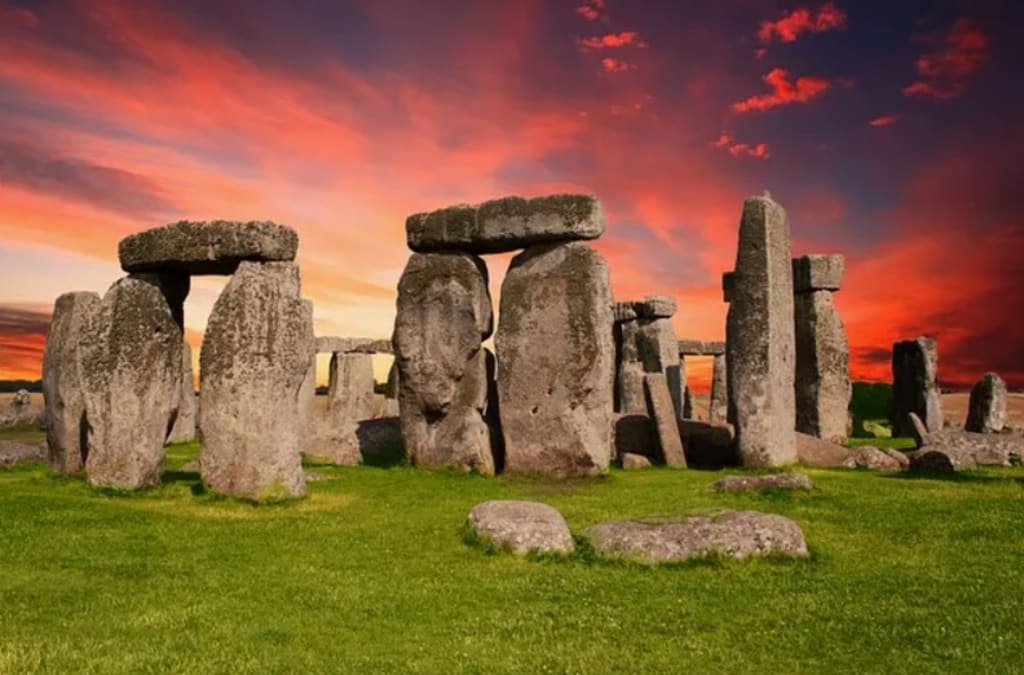
Standing on the windswept Salisbury Plain in Wiltshire, England, Stonehenge is one of the world’s most iconic and enigmatic monuments. Its giant stone circles have inspired wonder, curiosity, and countless theories for centuries. Though its true purpose remains shrouded in mystery, Stonehenge continues to serve as a powerful symbol of human ingenuity, spirituality, and connection to the ancient past.
The Origins of Stonehenge
Archaeologists believe that Stonehenge was built in several stages over a period of nearly 1,500 years, beginning around 3000 BCE during the late Neolithic period. The earliest phase consisted of a circular earthwork enclosure, or henge, surrounded by a ditch and bank. Within this enclosure, timber posts and small stones were erected — the first hints of what would become a monumental structure.
The Stonehenge we recognize today began to take shape around 2500 BCE, when massive sarsen stones — some weighing up to 25 tons — were brought from the Marlborough Downs, about 20 miles away. Smaller bluestones, transported from the Preseli Hills in Wales nearly 150 miles distant, were also added, a feat of engineering that continues to astonish researchers.
Engineering Marvel of the Ancient World
The construction of Stonehenge required extraordinary planning, organization, and skill. Without the aid of modern machinery, builders used ropes, wooden sledges, and sheer manpower to move and erect the stones.
The monument’s design reveals a deep understanding of geometry and astronomy. The stones are arranged in a series of concentric circles and horseshoe shapes, precisely aligned with the movements of the sun. On the summer solstice, the sun rises directly above the Heel Stone, creating a striking alignment that still draws thousands of visitors each year to witness the sunrise.
Purpose and Meaning: Theories Through Time
The question of why Stonehenge was built has fascinated scholars and dreamers alike. Over the centuries, theories have ranged from the practical to the mystical.
Some archaeologists believe Stonehenge was an ancient temple or a site for religious ceremonies connected to the sun and seasonal cycles. Others suggest it functioned as a burial ground — human remains found nearby indicate that it may have been a sacred resting place for elite individuals.
Another theory proposes that Stonehenge served as a prehistoric healing center, with the bluestones thought to possess magical properties. In recent decades, the discovery of nearby monuments, burial mounds, and processional avenues has led researchers to view Stonehenge as part of a much larger ceremonial landscape — a place where life, death, and the cosmos were closely intertwined.
Stonehenge in Myth and Legend
Long before archaeology provided clues, Stonehenge lived vividly in legend. Medieval writers claimed that the wizard Merlin magically transported the stones from Ireland. Others believed it was built by giants or even visitors from the stars.
These myths, though fanciful, reflect the awe that Stonehenge has inspired for millennia. Its age, size, and mystery naturally lent it an air of supernatural significance — one that continues to captivate modern imaginations.
Preservation and Modern Significance
Today, Stonehenge is a UNESCO World Heritage Site and one of Britain’s most visited landmarks. Managed by English Heritage, it attracts over a million visitors each year who come to walk among its ancient stones and feel a tangible connection to humanity’s distant past.
Archaeologists continue to study the site and its surroundings, uncovering new evidence that sheds light on the people who built it. Yet even as science advances, Stonehenge retains its mystery — perhaps because its builders left no written records, only the stones themselves, standing silently through the ages.
A Monument to Enduring Wonder
Stonehenge endures as a timeless testament to human ambition, faith, and creativity. It reminds us that even in the dawn of civilization, people sought to understand their world, mark the passage of time, and honor forces greater than themselves.
Whether a temple, a calendar, or a symbol of unity, Stonehenge speaks to the universal human desire to leave a mark that defies time — and in that, it has succeeded beyond measure.
About the Creator
Enjoyed the story? Support the Creator.
Subscribe for free to receive all their stories in your feed.
Comments
There are no comments for this story
Be the first to respond and start the conversation.