
A Sound Question pt 2
Chapters 3 and 4


About this story:
This story constitutes the second part of a speculative/British folk horror/literary/humour novel I'm writing. There are another 16 short chapters, as of writing – about 17,000 words in total so far and I'm coming up for air before I go on. I would be fascinated to read what you think. I will say at the outset that, if you had more of this, it would be apparent that it is written from 2 different perspectives: A first person interior view from the protagonist, and a third person omniscient view from an avuncular narrator, and it switches between the two.

Chapter Three: The Unsound
I’m back up in the booth after the owner bought me a drink at the end of my set. He must be pleased, he is famously as tight as a three-piece skiffle act. But also a bit of an old charmer, by which I mean one of those old hippies who never age in their own mind as much as it’s obvious they have to everyone else. It’s called latent self-image I think. I saw it in The Matrix, so it must be true. Anyway, face like a bag full of spanners. Avoid.
I’m checking the gear, the CDJs, the mixer. I squint at the LEDs of the club’s PA and realise my expertise ran out the moment the signal left the desk. I’m no propeller-head, but everything seems normal and yet, what happened with the sound was still weird. Could it be that the new sound guy is unsound?
Or is it me? Maybe not – if there’s one thing I know, there would have been a lot of mansplaining fired my way if it had been noticed by anyone else but me. The EDM peeps are pretty picky - less so when they are high enough to dance at 4 am to the rumble of the rooftop air con.
And it’s not the first time something has gone weird in this place. I’ve heard it all: That time when the minicab office started broadcasting over the booth monitors; the CD glitch from a sticky finger that turned two and a half random bars of hip-hop into an unexpectedly sentimental paean to the word ‘fuck’; or when the MC left the stage to go to the bathroom and forgot to turn off his radio mic. It was OK - I was doing a mini mix of Enya, so there was already a lot of swishing going on.
Tonight’s weird phase cancellation was a first and now I can’t reproduce it. Perhaps I should lay off the heavy delay, sweep and transform FX combo for a while. Stacked filters turn feral in double-time.
I give in and walk home in blissful stereo isolation, wearing my TMA-2 cans, checking out my DJ friend Cola’s latest rock-heavy stream. We’ve been trying to get a back-to-back together but she keeps the schedule of a jet-lagged sloth.
It’s a relaxing walk that feels like Dire Straits’ Lions tune, but in slippers. I am such an old lady sometimes. The streets are wet enough to be picturesque with the LEDs and neon smudged reflections marking a corridor of light back to the flat.
I open the door of my studio flat, slip off the ‘phones, and nothing.
Well, not quite nothing. There is an absence of sound, but it isn’t silence.
As well as a front door, it seems my flat suddenly sits behind a noise gate.
I can’t hear the extraneous sound that always pierces silence: a car passing on a wet street outside; the subliminal hums of the wiring in the walls and the kitchen strip light; the far-away swish and bang of the fire door on the landing; the wobbling subsonic wub of nu-jazz from an overpowered subwoofer located in the literal – and metaphorical – basement.
Even when I say ‘weird’ out loud, it sounds weird. There’s no sense of reverb or presence there. The peaks and troughs are evened out. It’s as lifeless as a mortuary fridge.
I remember that sound recordists snatch 15-30 seconds of ambience before and after their take, in case they need to patch what passes for silence in the recording. The ambience is simply not here.
This flat is flat. It suddenly has nothing, except my heartbeat and it has started to race.
My breath catches in panic mode and I hear a serration in my throat. Something like this happened before, not with the sound but with my breathing.
Calm down. Because saying ‘calm down’ always helps.
Breathe. In through the nose – a cool white cotton throw over my head – out through my mouth.
Once I have a measure of my breath, I put the cans back on as inoculation. I spend the next few hours experimenting with taking the TMA–2s off only to replace them when the absence engulfs me again. I try everything in the cans; chillwave, ambient, nature sounds. Then a lunge in the opposite direction; techno, industrial, Cola’s Too Many Guitars set, hardcore punk. Every time the void of sound gets hungrier, every time I grow more tired. Worn away at my point of weakness until I leave my headphones on low and try to sleep.
I doze fitfully, unaware of what is happening outside my sound bubble. I get some patchy sleep, but not enough.
Light. An apparent quickening of the day as I lay on the sofa under a cotton throw, still dressed from the night before.
The night before.
I sit up and take the cans off. I can hear my neighbours talking and laughing in the hallway - it’s a bit muffled and tilted towards a low pass filter, but the door is closed. Then more doors close between me and my neighbours, each step an attenuation of sound. The ambience of the room too, temporarily restored then lost again. The neighbours seemed untouched by whatever this is. The punters last night couldn’t hear what I couldn’t hear. This is a very local problem.
I put the headphones back on against the sound cancelling world. I cry to the wonderful clatter of Sunday Morning by The Bolshoi. The song is sad in the angry, sardonic and disrespectful way of youth, but it’s the messiness of a Sunday School piano tuned a quarter tone down to help its old strings cling on a little longer. The piano plays Chopsticks as intro and outro and its tone is of melancholy and of forced exile. Its beautiful, arresting sadness carried on tired strings always stops me in my tracks and its effect this morning is profound. It has always reminded me of my childhood in Cornwall, the dour Methodist moorland chapel that, unlike the dour Methodist minister in charge, did not seem onboard with our Sunday morning presence there.
The last time I was in Cornwall was for my Dad’s funeral. I hadn’t ventured to the wild west far end of the county and kept myself in the genteel, ordered orbit of Truro, specifically the crematorium a few miles out of town.
Technically speaking, Truro’s a city, but I like to call it a town because it annoys the residents. A girl’s got to have some sport.
Some time in my early twenties, the chapel finally had its way and managed, with the unconscious aid of the Methodist Church, to scare all the children and, crucially, their parents away. The building had sprung leaks and Dad bought it for a song - maybe as little as a hymn - with the explicit condition it could not be turned into a pub, brewery, betting shop or general den of iniquity. It became his bolthole, spartan and cold, and he used it as a kind of audio lab.
He was onto something with the bolthole idea. He even gave me a key when he was not well and left it to me in his will, but I never made it there, there were a few formalities and I was afraid of losing it; I can’t even make it to the end of a goth tune, what hope do I have of wrapping up the personal effects and property of my dead father?
I removed the cans again and there it was: brief respite of normality bit-crushed into an enduring and profound absence. For something so subtractive, it feels like too much.
If only I could remember where the bolthole was. Online maps show very little detail in this part of Cornwall. Woongumpus or Bosullow Common? Carnyorth or Wheal Bal? They all sound like they came out of a Tolkien prayer book.
I say the words out loud, letting my mouth and tongue encompass their round forms like boiled sweets or chilled chocolate and ice cream.
Whichever way they are spoken, they emerge as grave, mumbled incantation. I wonder which disconsolate wail is closest? London feels like Mordor and the Mouth of Sauron rolled into one, and I need to leave. Now.
Chapter Four: The Drop
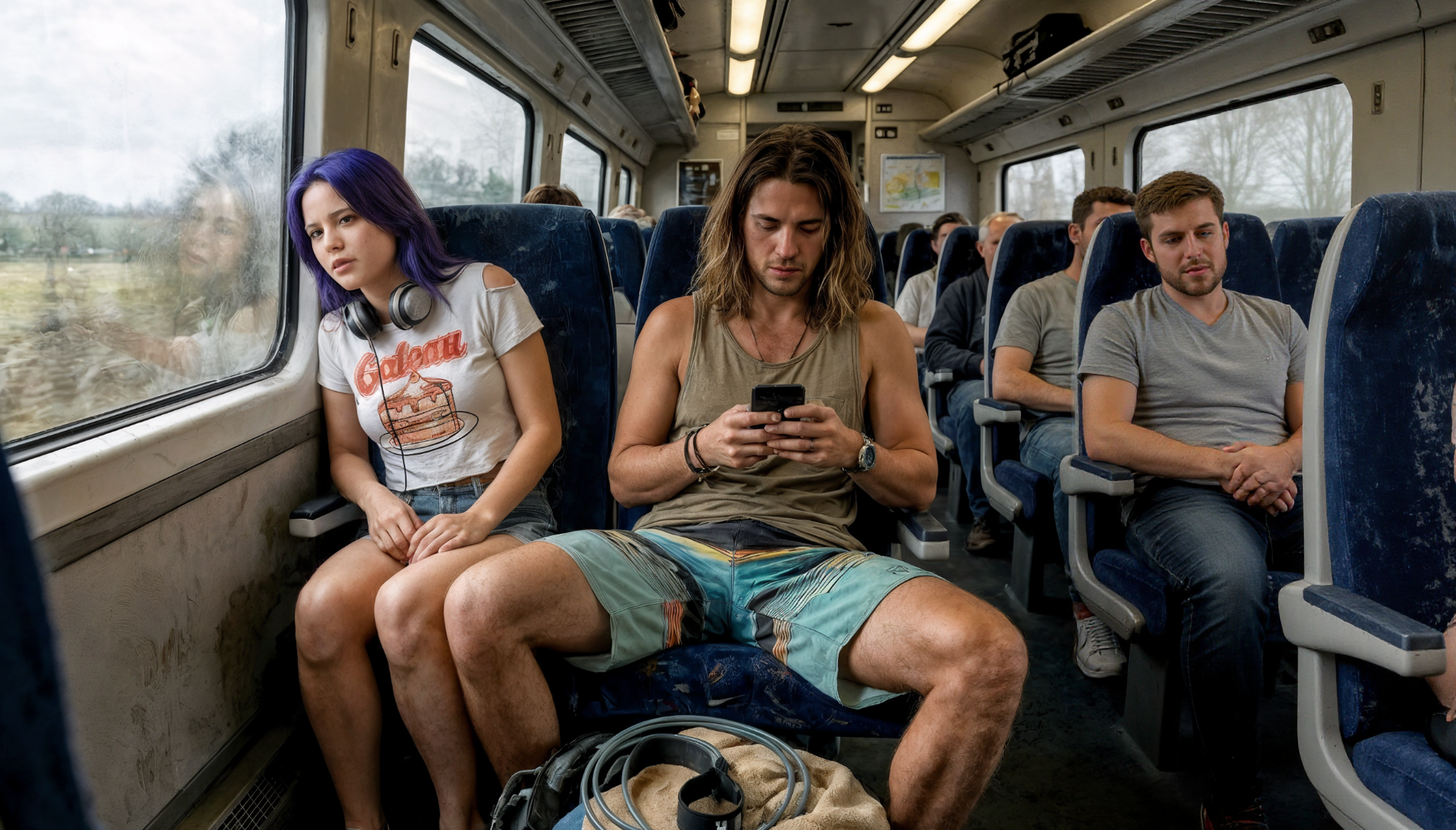
The DJ travelled as well as spun sugar decorations would in a hessian sack of Cornish cobbles thrown down a flight of stairs. Indeed, she spent the last hour of the train journey squashed against the window and jealous of her own luggage, thanks to the six-foot-something surfer who matched the occupying volume of his man-spread with an equivalent volume of unconscious, refined ignorance. He didn’t know he was a dick.
As she uncrumpled at the other end, Cake reflected on the fact that Penzance was the literal end of the line. It was a great metaphor, also, for a town that had come through hard times to find itself stranded on the other side. Not having the resources to foster notions of civic pride led to it becoming one of a few in Cornwall that belied the usual Westcountry image of neat, prim Hovis loaf cottages with roses around the door.
Like most British seaside destinations, Penzance had seen better days. Not to say there weren’t highlights, mostly in the shape of pricey boutiques, heritage attractions and an air of nautical whimsy. Penzance was the epitome of rough and smooth, tattered velvet; a tramp pretending to be a gentleman.
This wasn’t the only reason the DJ wanted to use the escape hatch potential afforded by the bus station, right there next to where the train lines ran out. Cornwall does Cornwall best out in the sticks. From deep sheltered valleys with sub-tropical gardens to blustery, chilling, numinous moorland, Cake was on her way to the latter.
After a few villages and some half-hearted countryside of pasture and ‘keep out’ signs on every field gate, she alighted - as the bus’s recorded announcement insisted on calling it - a few miles short of Lands End, a magnificent headland cosplaying in tourist tat. She had seen the flyers for the visitor attraction. The primary colour typography that indicated fun and noise also indicated to Cake that it was really not her thing. Too loud, too much plastic strawberry aura around places of deep time and harrowing darkness; cognitive dissonance tourism. Like Mickey Mouse doing a presentation on cattle mutilations it was just all wrong. Perhaps if she had young children or a lobotomy…
Her plan was to find the chapel of her childhood, dad’s bolthole. A walk over the moorland of Penwith towards a campsite a few miles to the north, would settle her in the middle of tin mining country where Methodist chapels congregated like alcoholics outside a pub at opening time. The walk passed stone circles, dolmen, quoits and all the other field furniture of the Bronze Age death cult that Cornwall wears like a badge.
The mist seeped in at the last stone circle. One of the stones picked up a low zither-like howl as the wind blew in low cloud from the southwest. Getting wet and suddenly cold in the silk dress she sometimes wore out and about in the world and away from her work, the DJ moved on up to the brow of the hill and unexpectedly found sanctuary.
An abandoned chapel stood on an eminence of the Cornish moor. A rough, steep track led up and widened slightly to meet the chapel's tumbledown stone boundary wall.
The track and the wall had been acquainted for at least 500 years, so neither remarked on the other’s appearance.
Cake was new to this scene, and the track regarded her with some skepticism. La-dee-da entitled city girl, thought the track and let a little gravel roll a few feet in passive-aggressive disgust. The woman had cheated and come over the hill, through the bracken and not done it the proper, difficult way. As for the wall – well, you can’t get anything past a wall. Walls know things.
She had dressed for London, which is to say she had dressed for a city that believes it controls the weather through sheer force of will. What she couldn’t have known was that her outfit of the silk dress, latterly paired with wellies, was tantamount to dressing for two competing seasons, Summer and Cornwall. There is a long-discredited Inuit urban legend that states that they have 50 words for ‘snow’ on account of the tremendous variety of it they see, but the Cornish have the opposite problem: for 90% of the time they see a very specific kind of rain. A kind of drizzly, condensing mist that they call ‘mizzle’. It’s basically rain that refuses to fall until you move through it.
It may be that this is why it takes so very long to get anything done in the county.
It’s not just the weather. There is also the problem of dreckly. Commentators on Cornwall define dreckly as an unspecified period of time between 'soon' and 'less urgent than tomorrow’. For some builders and trades people the delay is billable and forms a line item on their invoice that amounts to ’after I have had a cup of tea and a shit and spent thirty five minutes on your time doing it’.
Beyond pretty views and a slower pace of life, Cornwall carries a deeper resonance and otherness. The lone DJ who tramped through the bracken was not aware of any otherness as she reached the chapel. That’s not unusual for someone who has spent less than a day in the county, but she had already released the tumult of London and the headspace it inspires for the sake of survival. For her, survival was all about managing noise and sound and the synaesthesia that sprang from it. The city was a fusillade of sound. Every hour of every day and every night, the strobing lights of emergency vehicles cut tunnels built from melodrama and doppler-shifting sound. Every emergency was a menace threatening to arrive at your door right up to the moment it passed by, released by the semitone shift of somebody else’s situation.
Cake would reach the chapel soon, which is to say considerably less time than dreckly, which is to say that the bracken was not going anywhere and neither, it turned out, was she, not really, not any more that day, nor in any of the ways that mattered. This was something else she did not currently know.
She dropped her canvas backpack onto the weathered boards of an old bench in the porch, lay down and used the bag for a pillow. It was damp, but it was still warm and it took no time at all until she fell asleep.
To the casual observer—had there been one within five miles—she was as good as a glitch in the local reality. The white silk of her dress offered roughly the same thermal protection as damp tissue, as the afternoon wore on into the creeping chill. The green wellies were the single practical decision she had made all day, anchoring the ridiculous, urban beauty of her to the old bench. Her violet hair spilled across the canvas of her bag, a slash of neon against the muted, indifferent greys and browns of the Cornish moor.

She looked peaceful. She looked like someone who had finally escaped the noise.
She was entirely wrong. But as the mizzle drifted through the porch and the daylight began to fail, she slept on and dreamed of sanctuary, blissfully unaware that the stone behind her had been awake for a very long time.
About the Creator
Ian Vince
Erstwhile non-fiction author, ghost & freelance writer for others, finally submitting work that floats my own boat, does my own thing. I'll deal with it if you can.
Top Writer in Humo(u)r.
Enjoyed the story? Support the Creator.
Subscribe for free to receive all their stories in your feed. You could also become a paid subscriber, letting them know you appreciate their work.
Comments
There are no comments for this story
Be the first to respond and start the conversation.