
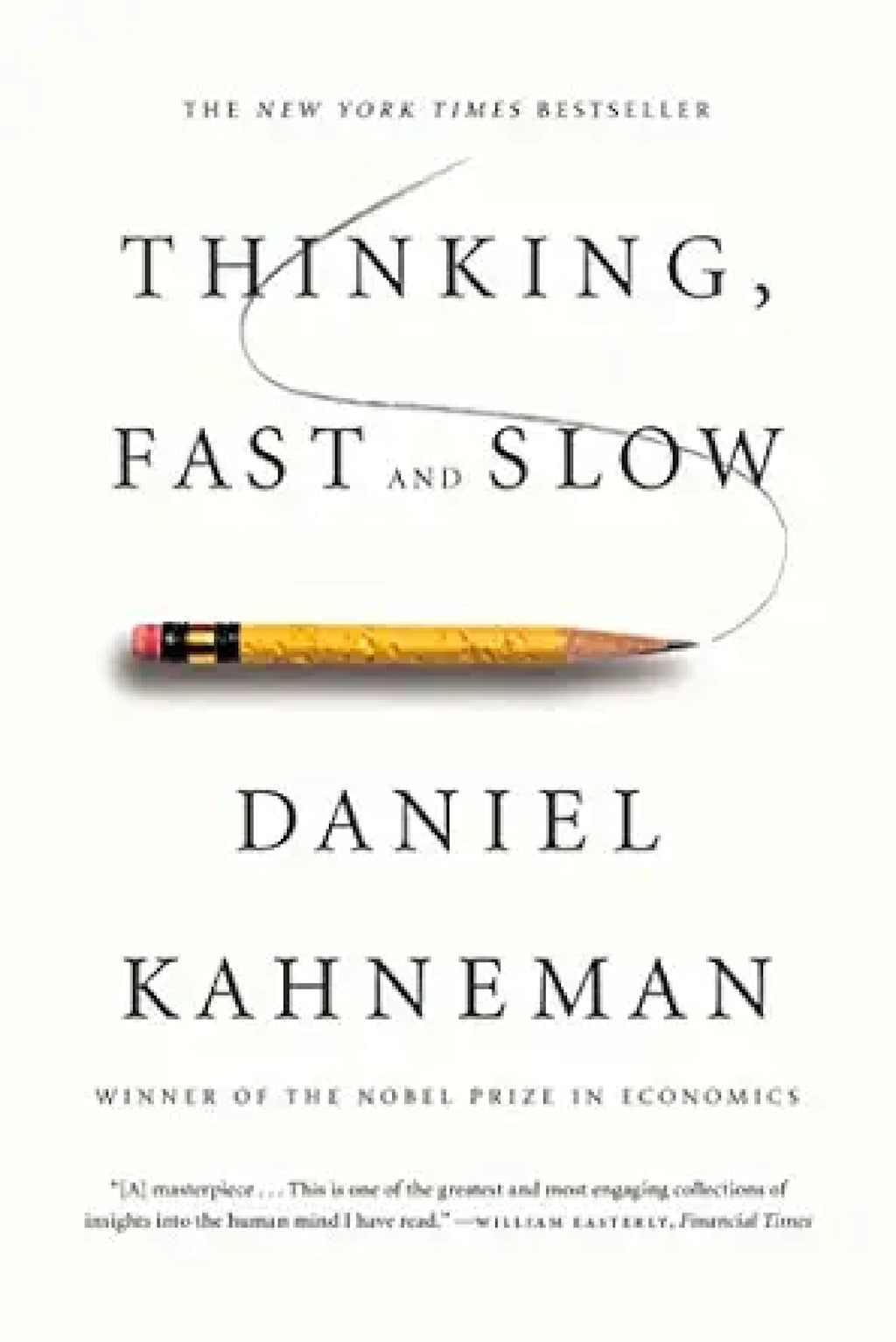
Daniel Kahneman’s Thinking, Fast and Slow is ostensibly a book about behavioral economics, but at its core, it is one of the most profound manuals for self-improvement ever written. It strips away the comforting illusion that we are entirely rational, logical creatures who make decisions based on careful analysis. Instead, it reveals the biological reality: our brains are remarkably efficient, energy-conserving machines that rely on shortcuts, and those shortcuts often sabotage our best intentions. Reading this book doesn't just teach you about psychology; it provides a mechanical blueprint for why we fail, why we procrastinate, and how we can actually change our behavior. Here is a breakdown of the most transformative lessons I took away from it for self-help and personal growth. The Dual Operating System of the Brain The foundational premise of the book is that our minds operate on two distinct tracks, which Kahneman dubs System 1 and System 2.
System 1 is fast, automatic, emotional, and reflexive. It operates with zero effort. It’s the system that instantly knows that 2 + 2 = 4, reads the emotion on a friend's face, or flawlessly navigates the route home while you daydream. System 2 is slow, deliberate, and analytical. It requires focused attention and has a high metabolic cost. It’s the system you use when parking in a tight space, filling out a complex application, or learning a completely new software interface. The Self-Help Application: Understanding these two systems completely reframes the struggle of learning and productivity. Because System 2 requires so much glucose and mental energy, our brains are wired to avoid using it whenever possible. This explains why passive learning—like watching a video essay or highlighting a textbook—feels so productive but yields so little retention. It allows us to coast on System 1. True comprehension demands the heavy lifting of System 2. When you force yourself to close the book and explain a concept from scratch (like using the Feynman technique) or when you grind through spaced repetition flashcards, the immense friction you feel isn't a sign that you're bad at learning. It is simply the biological friction of System 2 powering up. Recognizing this prevents self-judgment. The exhaustion means the process is working. The Danger of WYSIATI (What You See Is All There Is) One of Kahneman's most critical concepts is the acronym WYSIATI: What You See Is All There Is. System 1 is a story-generation machine. It takes whatever limited, fragmented information is currently available to us and instantly weaves it into a coherent, confident narrative, completely ignoring the vast amount of information we don't have. The Self-Help Application: WYSIATI is the root of intellectual arrogance and poor decision-making. When we draft a new project—whether it's writing an ebook, editing a complex video, or planning an exam schedule—we base our timeline only on the best-case scenarios we can currently visualize. We fall victim to the Planning Fallacy, dramatically underestimating the time and friction involved because we literally cannot "see" the unexpected hurdles. To counter this, self-improvement requires building deliberate roadblocks against our own confidence. Before launching a project or committing to a massive goal, we have to consciously engage System 2 to ask: What am I not seeing? Where are the blind spots in this plan? It forces us to move away from rigid, overly optimistic timelines toward more adaptable, realistic systems. Taming Cognitive Biases The book catalogues dozens of cognitive biases, but a few stand out as absolute roadblocks to personal growth. Recognizing them is the first step to mitigating their impact. 1. The Sunk Cost Fallacy We are deeply averse to loss. The Sunk Cost Fallacy occurs when we continue investing time, money, or energy into a failing endeavor simply because we have already invested so much into it. Whether you are halfway through a master's degree assignment that you realize is fundamentally flawed, or you've spent hours tweaking a visual design that just isn't working, the brain screams at you to keep going so the past effort isn't "wasted." Kahneman teaches us that rational decision-making must only look forward. The time is already gone; the only question that matters is whether the next hour is worth investing. 2. Confirmation Bias System 1 loves to be right. It actively seeks out information that confirms our pre-existing beliefs and swiftly filters out data that contradicts them. If you believe you are a terrible writer, your brain will amplify every typo and ignore the moments your prose flows beautifully. If you believe a specific diet or study hack is the ultimate truth, you will subconsciously ignore the scientific literature that proves otherwise. Growth requires setting up environments that actively challenge our assumptions. It means seeking out the smartest critics of your own ideas. The Experiencing Self vs. The Remembering Self Perhaps the most philosophically profound takeaway for daily life is Kahneman’s distinction between our two "selves." The Experiencing Self lives in the present moment, feeling the immediate joy, boredom, or pain of an activity. The Remembering Self is the storyteller. It is the part of you that evaluates the past and makes decisions about the future based on those memories. Crucially, the Remembering Self does not care about the duration of an experience; it only cares about two moments: the absolute peak of the experience (best or worst), and how it ended. This is known as the Peak-End Rule. The Self-Help Application: We can use the Peak-End Rule to "hack" our own habits and routines. If you engage in a rigorous three-hour study session but end it by fruitlessly struggling with an impossible problem for 20 minutes, your Remembering Self will encode the entire three hours as a miserable, frustrating ordeal. When tomorrow rolls around, you will feel an immense, inexplicable resistance to sitting down at your desk. To build sustainable habits, we must manage how activities end. Always end your deep work, study blocks, or creative sprints on a high note. Finish with a problem you know how to solve, review a flashcard you have perfectly memorized, or simply stop writing when you know exactly what the next sentence will be. By ensuring the "end" is positive, you trick your Remembering Self into anticipating the next session with motivation rather than dread. The Ultimate Lesson: Design Over Willpower Ultimately, Thinking, Fast and Slow teaches us that relying on sheer willpower is a losing game. Willpower is a function of System 2, and System 2 tires out quickly. True self-help is not about fundamentally rewiring our nature or trying to force System 2 to run the show 24/7. It is about environmental design. It’s about structuring our lives so that our lazy, automatic System 1 makes the right choices by default. If we understand how our biological machinery actually operates—flaws, biases, and all—we can stop fighting ourselves and start working with the grain of our own psychology.
About the Creator
Enjoyed the story? Support the Creator.
Subscribe for free to receive all their stories in your feed.
Comments
There are no comments for this story
Be the first to respond and start the conversation.