
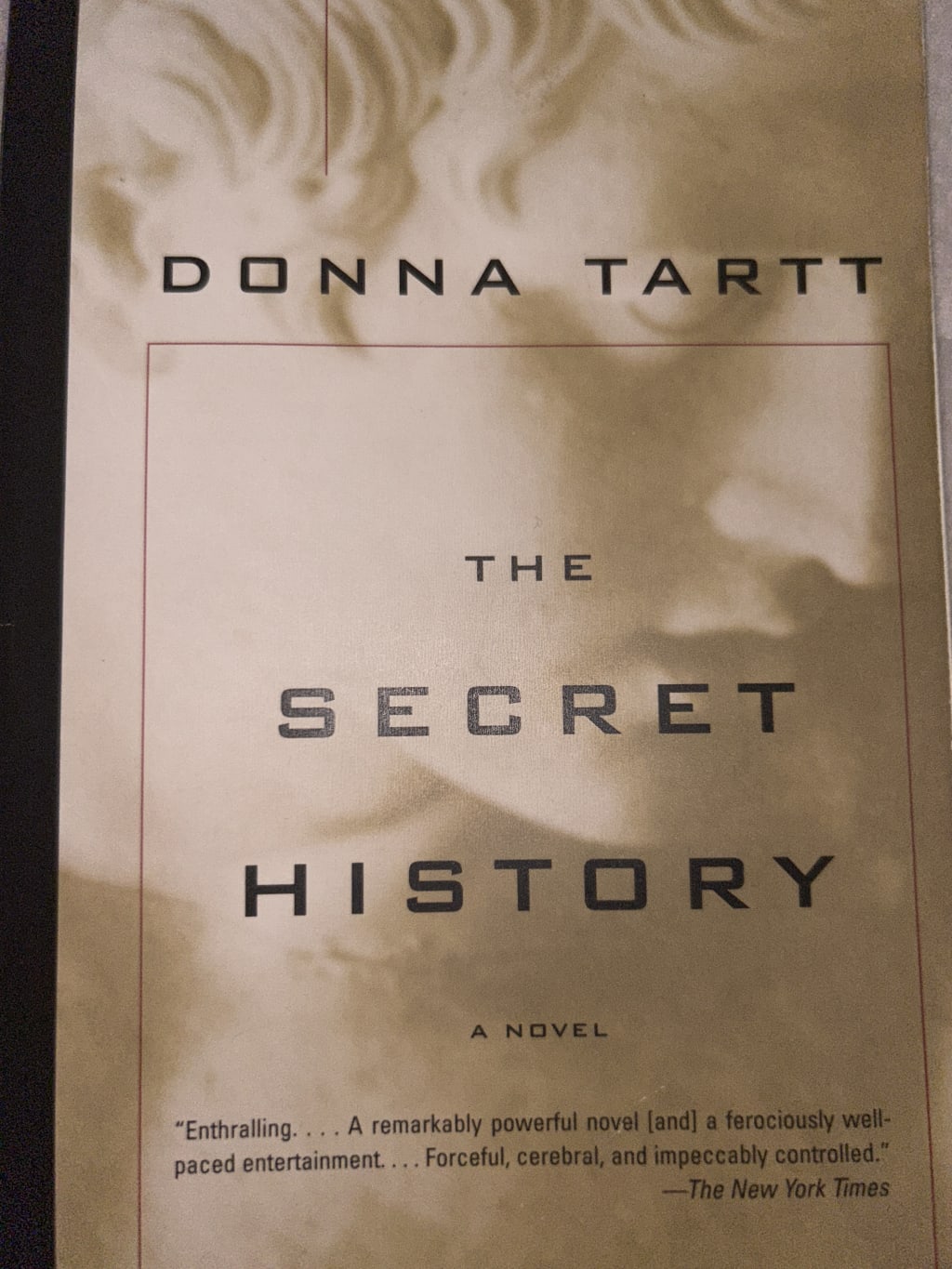
The Secret History by Donna Tartt
Book Review!


“And if beauty is terror,” said Julian, “then what is desire? We think we have many desires, but in fact we only have one. What is it?”
“To live,” said Camilla.
“To live forever,” said Bunny, chin cupped in palm.
-Donna Tartt, The Secret History
—
Oh, Donna Tartt. How I love you for writing this novel.
This book has been on my to-read list for what has probably been years at this point. I was very excited to finally delve into it, and it did not disappoint.
The Secret History tells a story of a small, elite group of students from a liberal arts college in rural Vermont who study Greek language and literature with a strange, enigmatic teacher named Julian. They’re a class of five, now six, as our main character manages to successfully weasel himself into their prestigious midst.
The premise of the book is quite an interesting one: five of the students decide that for their own well-being, one of their own has to die, and they actually go through with it and kill him. The book brings us up until that event and beyond it, letting us live vicariously through these students and their choices during and after the murder. We witness the deterioration of a bunch of very flawed humans through Tartt’s beautiful prose and expert storytelling.
Drawing what I can from popular culture, there are some The Talented Mr. Ripley vibes off of this one, as well as some Dead Poet Society vibes as well. The Secret History is a famous example of a “dark academia” novel, a genre of fiction that focuses on intellectualism and a thirst for knowledge, often with at least a twinge of romanticism towards higher education. And that’s definitely what this book has.
Looking at the characters from the outside in—these people should be completely unsympathetic. Besides our main character, these students are a bunch of spoiled rich kids with way too much time on their hands. They drink excessively, they do all kinds of drugs, and they dedicate their lives to this old-fashioned lifestyle that makes them look down on others. They have this odd, selective apathy, backing it up with a love for literature and the arts.
Our main characters are all dishonest, manipulative, and heinously pretentious. Richard, our narrator, lies almost constantly and is in no way reliable. Bunny is an arrogant, raging racist homophobe. Francis is panicky, presumptuous, and annoying. Camilla is purposefully secretive and manipulative, Charles is a drunk with anger issues, and Henry—the best character in the entire book, in my opinion—possesses this calm, strange sociopathy that’s just flat out scary to witness. Even Julian, their teacher, is not all that he seems to be.
And yet, there is such a magic and a care put into each and every one of these characters. There is a pull, a charm, and an intrigue to all of them. Their flaws make them who they are, but their good qualities, such as their intelligence, their wits, their senses of humor, and their desire to live like Julian tells them to and be free as they do it, define them just as much. Their imperfections make them extremely compelling, interesting, and so very human. These are some of the most complex characters I’ve come across in a good while.
(Side note: I’ve said it a million times and I’ll say it again: characters don’t need to be good people in order for you to like them. As long as you are not emulating or being explicitly inspired by these characters to excuse your own immoral actions or wrongdoings, there is nothing wrong with loving and relating to “immoral” characters, especially when they are fictional. It is only natural; it is only human.)
On the characterization, I have to say that I was personally struck quite powerfully by Richard as the narrator. Let’s just say I relate to Richard, and I relate a little harder than I’d like to. I also struggle with feeling eternally like an outsider, with being self-punishing, with distracting myself from self hatred with narcissistic delusions, with being a people pleaser to my core, with lying and creating stories and bending truths in order to be liked and accepted. As the kids say nowadays—he is just like me, for real.
I’m not proud of these things, and I’m actively working on changing them, but Donna Tartt really sucker punched me hard right in the gut with how much this goddamn character reminds me of myself. And at every turn where Richard found himself giving in, or being manipulated, or feeling guilt-ridden, or feeling sorry for himself, or finding himself hopelessly bored or elated or angry or disappointed, I thought to myself, wow—I can absolutely see myself doing this, or feeling this exact same way.
Richard Papen, you are a phenomenal character. But damn it, I hope this is the closest I ever feel to you.
The themes of love and sexuality in this book were very interesting. Tartt depicts love as animalistic and savage while also encompassing the lightness and beauty of it through different plot lines and characters. In an odd way, no character in the novel was truly capable of love as we usually think of it. In an even odder way, every single culmination of characters had love for one another, and not even in a necessarily romantic sense. The skewed types of love and the thin line between love and worship, or love and delusion, and the vastness of human sexuality were expressed so gorgeously and without shame in this novel.
I always stress, above all, the importance of good moments in a piece of fiction. I am so willing to forgive a lackluster story or lackluster characters in exchange for a good amount of really great moments. Fortunately, this novel has a great story and amazing characters while also having so many incredible moments.
The opening of the book, addressing Bunny’s death right off the bat before delving into the series of events that follow, catches the reader’s interest right away with its succinctnesses shrouded in gorgeous, rich verbiage and impeccable detail. It’s a murder mystery story without the mystery element, but it doesn’t even need it; in fact, it’s better without it. The students sharing this heavy secret with us, of being involved with the murder of their friend, adds more tension and weight to the story. And the scene near the end of the book between Richard and Henry in the garden, where Henry finally breaks through his steely, calm, purely intellectual façade to ask Richard a real question for the first time, about how much he truly feels about other people and how large his capacity to feel is, was some of the best writing I’ve read this year.
Sure, the book is pretentious. Sure, the book is long and certainly feels its length. Sure, I can understand why not everyone would be able to stay engaged through the whole story. But all of those aspects about it are things I absolutely adore. Tartt takes her time with us and tells the story of these students with richness, delicacy, and nuance. She is able to encompass both the beauty and the ugliness of humanity, and that is not easy to do. The themes of intelligence, freedom, mortality, and morality are stunningly addressed and delved into so well, and her storytelling and character building skills are simply next level.
I feel like I could talk about this book forever, but for now this is all I have to say: The Secret History is an incredible book. It was the perfect culmination of stunning, beautiful, and painful until the very end.
An absolute 5/5 from me.
Thank you everyone for reading! And when you get the chance, give this book a read—it’s worth your while.
—
You can check out some other reviews from me here:
About the Creator
angela hepworth
I want to erase the tears of all those who trusted in hope; I want them to be left with a smile on their faces.
-Madoka
I’m Angela! I enjoy writing fiction, poetry, reviews, dumb self-indulgent stuff, and much more. Come check me out! :p
Enjoyed the story? Support the Creator.
Subscribe for free to receive all their stories in your feed.
Comments
There are no comments for this story
Be the first to respond and start the conversation.