
The Cruel Stepmother.
Art and the Cremona Violin
Listen to this Article here
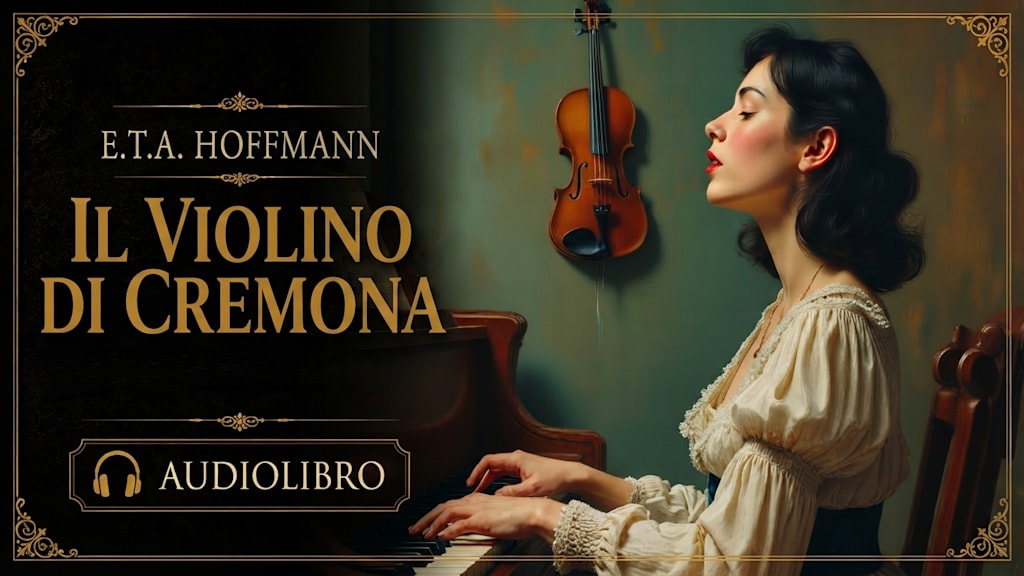
Councillor Crespel, a German jurist and violin maker, keeps his daughter Antonie locked away at home. She has a sublime voice, but singing threatens to kill her because of a particular malformation of the vocal apparatus. A young man, suspecting the father of being a jailer, induces her to sing, and Antonie dies. In the same instant the soul of the violin snaps, splitting its soundboard open. The reader is left not knowing whether he has witnessed a crime or a sacrifice, since the only witness to the illness is the very man who would have had every interest in lying.
The theme Hoffmann touches on is historically real. In the nineteenth century, the music-entertainment industry and the growing complexity of orchestras demanded ever greater effort from singers, who then performed without amplification, and such effort could indeed damage the performer’s body. The phenomenon would reach the international press a century later with the death of the Italian tenor Enrico Caruso, whose pressure on the diaphragm had aggravated a lung infection. His doctor maintained that the strain of carrying his bass voice up into the tenor register had worn him down over the years, so that the real culprit in his death was singing itself. Though aware of where it was leading him, he would not give it up.
One hundred years earlier, Hoffmann was interested in medicine, an eclectic and passionate scholar as well as a jurist and a musician in his own right, but the theme of the singer’s voice exploited to exhaustion had not yet been explored in depth. The first studies were just then being undertaken, and they were avant-garde studies for their time. Investigations of diseases of the chest and throat were already known, but there was as yet no true science of the voice capable of observing the activity of the larynx, or of showing how an abuse of singing might harm one’s health. No one had yet been able to watch the glottis at work.
A certain Bozzini of Frankfurt had tried, publishing in 1807 a work on illuminating the throat in order to study it, but real progress in this field would come only about ten years after the publication of Hoffmann’s tale. In 1827, mirrors began to be used in Geneva for the diagnosis of voice disorders, and in 1854 the Spaniard Manuel García became the first to see the vocal cords in action. We may therefore say that in Hoffmann’s day this field of study was still scarcely explored, and that his is less a fantastic tale than a tale of science fiction.
Hoffmann goes further, anticipating modern theories of music therapy. When Crespel understands that his daughter is ill and that an artistic career would kill her, he devotes himself to building and playing the instrument, so that, playing it, he may enter into such attunement with her that her soul and the sound of the instrument become perfectly identified. Listening to her father perform the arias composed for her, in the very style in which she herself interpreted them, Antonie has the impression of having sung them herself. What takes place in her is a musical catharsis. Quite interesting in this regard is the vocabulary of violin making, which speaks technically of a soul inside the violin, the part that vibrates within the resonating body to make the voice of the instrument more harmonious. Three souls, then, meet in Hoffmann’s tale: that of the girl, that of the instrument, and that of the father who plays it.
The tale belongs to a literary current especially dear to the Romantic mentality of the nineteenth century, that of art as stepmother. “Stepmother” is understood here in Leopardi’s sense of “cruel mother.” We find the theme again further on in Zola’s Claude Lantier, who hangs himself before the unfinished work that torments him; in Gogol’s portrait that drives the painter Chartkov to madness; in Tolstoy’s Kreutzer Sonata; and in Luigi Capuana’s pianist, who dies while playing a passage of rare intensity, from the sheer violence of the aesthetic experience it unleashes in him. Art that heals, art that kills, art that unites souls and consumes them. A timeless masterpiece.
About the Creator
Federico Berti
Writer, composer, actor. Internationally known as a performer, one‑man band, and audiobook narrator. Expert in the art of memory.
Enjoyed the story? Support the Creator.
Subscribe for free to receive all their stories in your feed.
Comments
There are no comments for this story
Be the first to respond and start the conversation.