
The Belly of the Market in Literature
From Sociability to the Alienation of Selling

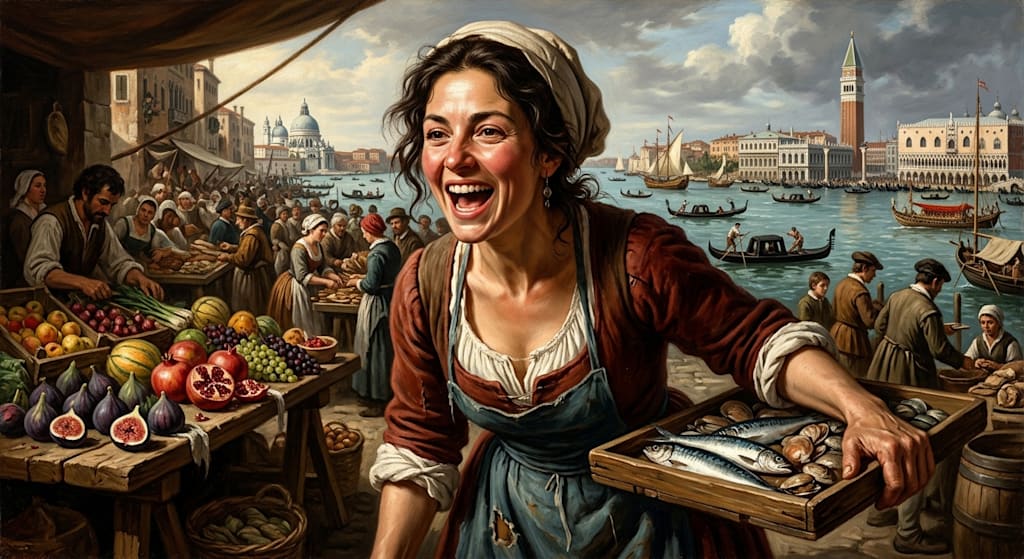
Do you want to know a people? Go to the nearest neighborhood market and watch what it trades, how it displays its goods, how it haggles: in an hour among the stalls of fruit, livestock, fish, clothing or (so we sometimes read) at the armorer’s shop, you will learn far more than from a treatise on sociology. In these notes we shall review a few illustrious literary passages, in order to mark the difference between the worlds that revolve around these markets in different places and times.
Zola’s Florent, for example, makes his way through the great market of Les Halles in The Belly of Paris, captured in a vivid and imaginative description at dawn, when the peasants’ carts arrive: the portrayal of the river of vegetation flowing through the city is impressionistic, built of patches of color that lettuces, endives and chicory, spinach, sorrel, artichokes, peas, beans, red carrots, white turnips, celery and leeks, cabbages and other greens form in green, red, orange and yellow.
From the belly of the Parisians to the Belly of Naples: Matilde Serao, eleven years after Zola, describes a market less bucolic and more human, where beside the greens and fruit are displayed macaroni of every shape, salami and cheeses, colonial goods, while donkeys laden with fruit come and go. Lively, noisy, chaotic in its cries, its songs, its loud negotiations, where the dominant sense is smell, excited by the odor of frying, pepper, vinegar and fish, the Neapolitan market is less impressionistic and more visceral.
From the Spanish Quarters we pass, then, to the Spain of Galdós, who describes the Madrid market on the Calle de Toledo, crossed by Jacinta lost in her thoughts while all around swarms a throng of vendors, stalls and customers, the streets cluttered with goods and sundry knick-knacks; here too the offers are shouted in tones that are positively aggressive, almost a buy-or-die; here attention falls also on clothes, fabrics, trinkets and other wares, and here again the market is a place of relationships before it is a pictorial fresco.
Dickens, then, recounting his nocturnal and early-morning walks through the city of London, describes Covent Garden with care, almost personifying it, speaking of it as of a pleasant companion, not merely as a place of exchange but as a world of men and animals waking before dawn. Through the eyes of his Tom Pinch, who crosses the market with his sister not to buy but for the pleasure of strolling there, he offers a sweeping survey of the goods, not neglecting the old women who shell peas before setting them out on the stall.
Goldoni, a man of the theater as he is, plays on the verbalized description of the cries, the voices of the vendors at the market of Malmantile, showing once more the market as a place of encounter, a movement of bodies before a movement of goods, a lively and bustling little theater:
Who wants capons, who wants hens?
Who wants to buy some little ricottas?
Who wants eggs, step up this way;
Folks coming, folks going, buying or selling,
At the market each may tend to his affairs
In perfect freedom.
More melancholy is the little market of birds and domestic animals in Moscow, in which Chekhov shows a sensibility uncommon for the era with regard to the way the poor creatures are kept in cages, with no consideration for them whatever, a place described as poor and desolate, with old carts and greedy sellers. The narrator in this case seems more interested in describing the carts, the cages, the physical appearance of the beasts, the timeless scenery of a decaying, squalid and sad place, the opposite of the Parisian cornucopia or of the histrionic stage on which Naples comes to resemble Venice.
This is not the place to take a census of every author who has taken the trouble to describe a marketplace; what I wish to observe is rather the double channel that moves their pens: on one side the variegated and vital aspect of the wares, luxuriant as in a garden when it comes to vegetables, yet at the same time melancholy as a slaughterhouse when it comes to animals; on the other the market as a place of encounter, of human relations, of bargaining or even simply of a stroll, a conversation. Spending time in pleasantness.
Set beside today’s great shopping centers, these neighborhood markets, which were once the pride of the rising bourgeoisie, seem the distant echo of a world that is dying. Today the background music, a subtle, subliminal euphony, discourages the wandering musician who might wish to slip inside to cheer the shoppers among the shelves, perhaps bringing his own commentary on the news of the day (heaven forbid!). The goods, cataloged as in a library, strip the customer of the curiosity of exploring: he always knows what he will find and where to find it.
A common sign fixes the price of the goods, absorbing any ambition to bargain; the goods themselves are no longer the produce of the farmer who comes to sell directly at the market, but pass through the wholesale markets, where products arrive from who knows where, and of which we very often do not even know how they are grown, in what soil, in what social context, how the farmhands are treated, and so on. Everything more impersonal.
As for clothing, one hardly sees the sale of fabrics anymore (for that there is the haberdasher’s), for the simple reason that nobody makes his own clothes at home anymore, within the family or the neighborhood; we buy them ready-made, on sale, without knowing who put them together. All this has a name: alienation. The modern market develops under the sign of alienation, where the customer must not be distracted from the act of buying and must therefore find as little sociability as possible; indeed, lingering between the aisles is frowned upon, everyone is in a hurry, chasing a time of which they are not the masters; what survives, as phenomena of fashion for the minorities, are those organic or zero-mile markets, where, however, the products cost far more and are therefore frequented by those radical chic elites who can afford to pay the price.
The rest is tedium.
About the Creator
Federico Berti
Writer, composer, actor. Internationally known as a performer, one‑man band, and audiobook narrator. Expert in the art of memory.
Enjoyed the story? Support the Creator.
Subscribe for free to receive all their stories in your feed.
Comments
There are no comments for this story
Be the first to respond and start the conversation.