
THE ANATOMY OF DESPERATION: HOW I TESTED A FACEBOOK "MARKETING EXPERT" 📈
AND WHY MATH ALWAYS WINS

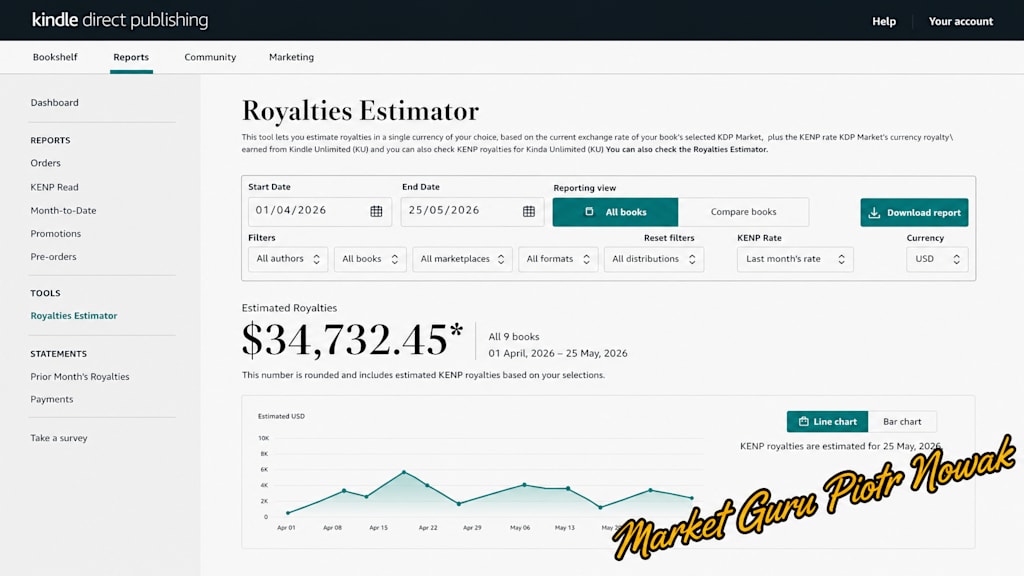
Every independent creator, writer, or small business owner knows this scenario. You publish something online, try to reach people, and suddenly, like mushrooms after the rain, "marketing saviors" pop up in your inbox. Profiles with stock photos, flowery promises, and legendary "mountains of gold" that you can conquer any minute. The catch? A small upfront fee. 📩
Recently, I decided not to ignore one of these messages. Instead of the usual spam deletion, I picked up the gauntlet. What happened next is a perfect, textbook example of how modern Facebook scammers operate—and how quickly their marketing superpowers crumble when pushed against the wall.
ACT I: THE PROMISE OF SUCCESS FOR PENNIES 💰
It all started with a classic hit to vanity and hope. A "female expert" from a Facebook group offered to "handle" the sales of my book. She promised incredible results, and her profile proudly displayed screenshots of ad dashboards with profits of around $1,400 depending on the month. The price for this ticket to wealth? A measly $30.
For someone just starting out who hasn't sold a single copy yet, $30 sounds like zero risk. And that's exactly what these people count on. It's the psychological trap of a "low entry barrier."
I decided, however, to apply the ultimate anti-spam filter: A BUSINESS MODEL BASED ON REAL RESULTS. I wrote back to her briefly:
"Since you're so confident in your results, let's do this: I won't pay anything upfront. In exchange for your commitment, I'll give you a whopping 50% of my net profit from every book sold for the next 12 months. With the profits you're promising, you'll make thousands of dollars, not a measly $30. Are you in?"
ACT II: A FESTIVAL OF EXCUSES AND PLAYING THE VICTIM 🎭
If her promises and earnings dashboards were real, this offer would be a goldmine for her. Who in their right mind would reject a year-long, 50% profit split from a brilliantly performing campaign in favor of a one-time thirty bucks?
At this point, the scammer's algorithm began to freeze. Instead of business arguments, a multi-stage surrender began:
Stage 1: Smoke and mirrors with procedures. She announced that she works with 15 clients at a time and her system relies on taking small amounts at the start and then increasing them. Simple math: 15 clients times 30 dollars is 450 dollars in profit from mass spamming. If she took my percentage, she would make a multiple of that from just one client. 📉
Stage 2: Emotional psychology and "strengthening the relationship." I learned that this $30 is needed to... "strengthen our relationship." Because nothing builds trust in business like a blind wire transfer to a stranger from the internet. 🤝
Stage 3: The victim card. When I pointed out her logical inconsistency, I heard a classic line: "I've already worked on commission with five people, but all of them cheated on me." In the 21st century, in the era of affiliate links, automated payment split systems, and transparent marketing tools, a professional hides behind the excuse that "someone cheated them." 🛑
ACT III: THE ULTIMATE SELF-OWN, OR "PAY ME AT LEAST TWENTY" 💸
When I wrote back that I didn't intend to pay for her alleged past bad experiences, and that the lack of transparent billing tools only confirmed my doubts, her professionalism shattered completely.
The "expert" got offended for good. She told me to hire someone else, that my $30 wouldn't make her rich, and that her only goal was to "grow her business partners." A classic hit to the client's ego: "Can't afford $30? Then don't waste my time."
I gave her my final response, thanking her for confirming my suspicions and wishing her luck. And at that exact moment came the absolute knockout that cracked me up.
Five minutes after a proud goodbye and assurances of high standards, a message popped up in my inbox:
"Well, can you pay at least $20?" 🤦♂️
In a split second, the great marketing strategy, the mission to develop partners, and rigid business principles melted away by 33%. Why? Because for an online scammer, any amount they manage to squeeze out of a naive creator is a win.
When I replied directly, asking what happened to her principles and why she was begging for $20 now, she indignantly declared that she would never write to me again because I called her a beggar. I won't be crying. 😉
LESSON FOR CREATORS: HOW NOT TO GET RIPPED OFF 🛠️
This brief exchange perfectly demonstrates the anatomy of a low-value internet scam. How do these people operate?
Fabricated proof of social proof: Screenshots showing earnings of $1,400 on their profiles are no proof at all. Nowadays, anyone who can use a basic graphics program or ask ChatGPT to generate a matching spreadsheet or dashboard can make such a graphic in a minute. Believing pictures from the web without hard data verifiable live is just asking for trouble. 💻
Lack of accountability for results: A scammer will never agree to a commission because they know their "work" consists of dumping your book's link into five dead Facebook groups that nobody visits anyway. 📋
Pressure and rushing: Bombarding you with messages and sending question marks every hour is meant to force the victim into making an impulsive decision. ⏱️
THE GOLDEN RULE OF MARKETING IS SIMPLE: If someone guarantees you massive sales but is afraid to tie their compensation to those sales—run. Real marketing costs money, but it is based on contracts, data, and tools, not on begging for twenty dollars on Facebook.
Respect your time, your money, and above all, your hard work. And steer clear of "relationship experts" for 20 bucks. 👋
About the Creator
Piotr Nowak
Pole in Italy ✈️ | AI | Crypto | Online Earning | Book writer | Every read supports my work on Vocal
Enjoyed the story? Support the Creator.
Subscribe for free to receive all their stories in your feed.
Comments
There are no comments for this story
Be the first to respond and start the conversation.