
Relating dreadfully to George Orwell’s Down and Out in Paris and London
Literature and poverty

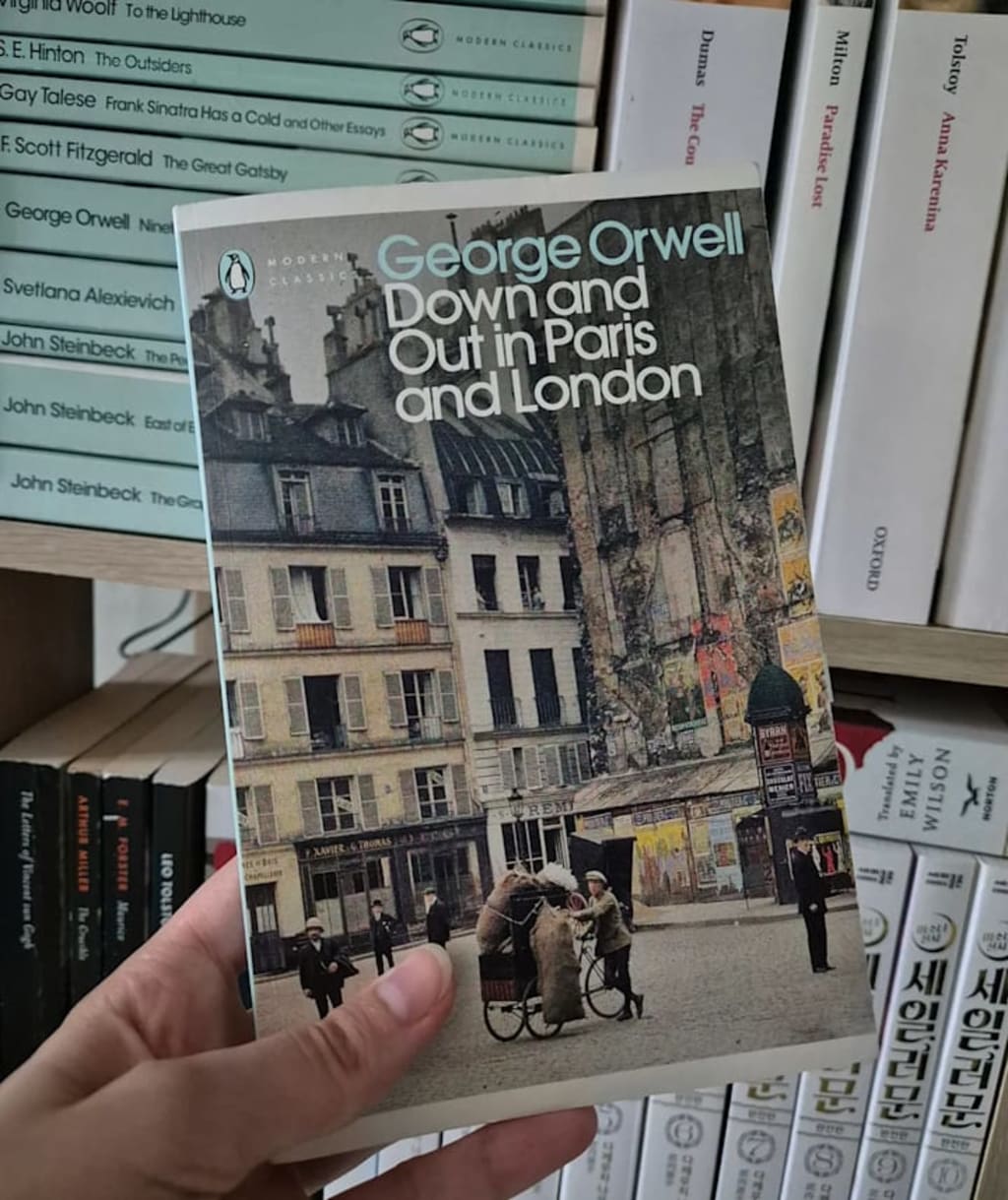
In preparation for my trip to Toyama, Japan, I scoured my bookshelves for the perfect novel that would keep me entertained during our flights, but not take up too much space in my carry-on. I skipped over the lengthy fantasy books and flipped through my queer romance collection before the itch to read a classic fell upon me. After much deliberation, I settled on Orwell’s first published book, Down and Out in Paris and London.
On the five-hour bus ride to the Busan Airport from my home in Seongnam, I devoured the first one hundred pages.
Orwell’s writing immediately captured my attention, but that was no surprise. I’ve read a few of his other works, including Animal Farm and Why I Write. He had a way of explaining the world around us in a way that gives both clarity and comfort, despite the chaos that humans in power constantly bring. He also had this endless supply of unwavering hope in the power of art, specifically in writing. He believed that reading could open our world and make us better people. And as an avid reader and a fellow writer, his books are a reminder of the goodness activism can bring.
Down and Out in Paris and London upheld Orwell’s tradition of politics, hope, and ugly truths. In this novel, he explored his experiences living in poverty in two of the wealthiest cities in the world. He described grotesque living conditions, malnutrition, and the burden of finding work in a society that doesn’t value all forms of labor.
While reading about Orwell’s battle against hunger and bedbugs, I was assaulted by unflattering memories of my college days, when I, too, was down and out and desperate for life to begin.
“It is a relief, almost of pleasure, at knowing yourself at last genuinely down and out. You have talked so often of going to the dogs — and well, here are the dogs, and you have reached them, and you can stand it. It takes off a lot of anxiety.” Orwell pg. 18
This emotional rollercoaster of a book, first published in 1933, highlights the beginning of Orwell’s vigorous political writing career as he navigates the brutal reality of poverty and homelessness. His time broke and downcast in these expensive cities, helped solidify his views on the corruption of political leaders and the social structures that keep poor men poor, and rich men in lavish, comfortable ignorance.
My edition comes with an excellent Afterword by Dervla Murphy. She notes how little our world has changed since Orwell’s time. Capitalism has taken us by the throat, and Orwell would have been disappointed in our fate.
Murphy also teaches the reader that Orwell, whose real name is Eric Blair, was a disappointment to his financially comfortable family. His parents detested the idea of their son being a writer, and a poor one at that, and a rift in their family opened for some time after the novel’s publication. Orwell’s parents thought it shameful to boast about poverty, as if it somehow made their son morally superior to them. But in Orwell’s view, poverty did change him for the better, and there was nothing to be ashamed about.
Because of poverty, he grew a hunger for writing and wrote widely about his experiences.
His struggle to survive on meager meals and grueling 12-hour workdays in hotels and restaurant kitchens gave him a larger scope of the world and its mistreatment of the working class. The empathy he gained during this time, without a doubt, fueled his artistic lens.
His poverty was a stepping stone in his path to success, so naturally, Orwell understood its significance and decided to remain truthful rather than coddle his parents’ prejudices. Though he did take on his famous pen name because of Down and Out’s publication, so perhaps a middle ground between him and his family was reached after all.

My time living in poverty was not something I’d wish upon myself again, but I can’t deny how important the experiences were to my emotional, political, and artistic development.
Down and Out in Paris and London was all too familiar to my experiences as a college student living in a poor area. I went to school in Utica, New York, which was once mocked on The Simpson’s for its status as New York’s poorest city.
Since I could not afford the thousands of dollars it costs to dorm, I lived in an apartment off campus. To my luck, I found a 300-dollar-a-month bedroom with a shared kitchen and living space, complete with a shattered window, rats, and moldy water-damaged floors. To make rent, I worked two jobs on top of my full-time studies.
Orwell described scenes in his novel where he stayed awake all night in his lodgings in fear of theft or bedbugs. I have only experienced bedbugs once on a trip to New York City. I remember the bumps on my legs and the relentless rashes that came with those bugs, but luckily, they did not follow me back to my little windowless room.
Theft, however, was on my mind constantly. One morning, I left my apartment for school only to find my car door wide open. I went back inside and got my landlord, who lived on the first floor, and asked for help. As I didn’t own much, the thief got away with two CDs and a few loose coins.
“There was a sort of heavy contentment, the contentment a well-fed beast might feel, in a life which had become so simple.” pg. 95
The worst part about my time living in poverty was the hunger. Much like how Orwell spent a huge chunk of his meager paychecks on tobacco, I also depended on drugs for a release from the hunger pains. Smoking and drinking helped me sleep and suppress the twisting in my stomach. As Orwell lived on bread with margarine, I lived on cup ramen, instant coffee, beer, and cigarettes.
I worked two to three part-time jobs each semester to make ends meet. The anxiety around choosing whether or not to buy groceries or pay next month’s rent was a burden I pray never to return to.
However, like Orwell, I became politically active and emotionally mature due to the hard times. My friends, like Orwell’s down and out companions in the shelters, helped me get food when I hadn’t any money left. They also provided me with a strong community that taught me about compassion for all the downtrodden in the world.
Because of the fatigue of school and hunger, I had no energy for creative pursuits. Orwell had no money for paper and pens, and only started writing after moving back to London and securing a job as a live-in nanny to an elderly man. This is one of the cruelest aspects of poverty, it strips people away from their hobbies, loves, and humanity.
Now that I am out of those times, I have a lot of past experiences to lean on as I am blessed to have enough money and safe spaces to write freely. Hell, I can even travel to Japan with my family. What an absolute blessing it is to have stable, decently-paid work.
Orwell’s writing often reflects anti-capitalist views. And his time in poverty, living amongst men whom he identified with and cared for, aided these views.
“Money has become the grand test of virtue. By this test beggars fail, and for this they are despised.” pg. 185
I think this novel, and all of Orwell’s works, are important companion pieces to our modern life. The ruling class is the out-of-touch billionaires who have never had a down-and-out day in their lives. Because of this, they cannot empathize and are slowly killing us and themselves in their capitalist greed.
I’d recommend this book to all folks, regardless of economic background. I was someone once in poverty, who climbed their way up to living paycheck-to-paycheck, and now I’m riddled with debt, but have enough money to live peacefully in my clean apartment. I even have a laptop to write with, and an adorable cat to care for, so you know, I’m doing really well.
I, like Orwell, will choose to have radical hope.
I hope people from wealthy backgrounds give this book a chance, so that they might increase their worldview and grow to see those who are down-and-out as human beings, deserving of respect and care.
About the Creator
Enjoyed the story? Support the Creator.
Subscribe for free to receive all their stories in your feed. You could also become a paid subscriber, letting them know you appreciate their work.
Comments
There are no comments for this story
Be the first to respond and start the conversation.