
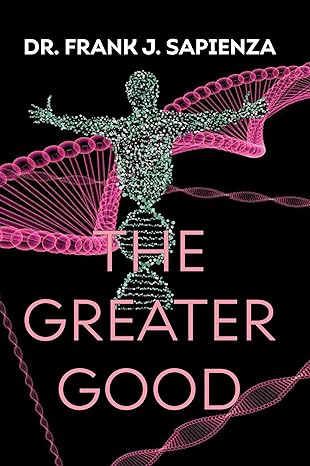
Rachel Reviews: The Greater Good by Frank Sapienza
Frank Sapienza gives us a modern moral thriller about Dr Jon Morrison who is given a choice to help his son but at what ethical cost?

One of the joys of reading is that you are often presented with situations that you can only hope to imagine. They could be fantastical but they could also be based on real life scenarios. Some of these can be good but some of them can be the embodiment of your worst nightmare. Books provide a sample menu, I think, a bit like films, where you get a taste of a situation or a world and you can see if you like it or realise it's one you hope never to encounter in real life. Like The Terminator or Sophie's Choice as two excellent examples.
That's one of the reasons that I like books that present ethical dilemmas as it is very easy to make statements about what you would or wouldn't do but how do you know until you are placed there or faced with it? I don't think you ever really can know. Books like The Greater Good get you thinking about what you would do without any of the consequences or drama.
So, imagine this. What would you do if you were presented with the means to help your medically disadvantaged child but knew that it was ethically dubious? That is the crux of Frank Sapienza's book, The Greater Good.
His main character, Dr Jon Morrison, recently separated, is the father of twin boys, Mike and Jack. It is Mike who concerns him, as Mike has Cystic Fibrosis and his prognosis for a long and healthy life is limited by this condition. Living in denial of the seriousness of his son's condition, Jon is given a rude awakening when he is brought face to face with Mike's mortality.
This life-or-death incident acts as a catalyst, as the stark reality of losing his son hits Morrison. He would do anything to save him and so, we arrive at a crossroads for our hero when he is presented with an moral dilemma: should he do something that goes against the ethical code of any health care professional and rules of confidentiality and receive money to help with expensive treatment for Mike; or potentially, watch his son die but keep his principles intact as a doctor and trusted health practitioner?
What I liked about this book most are the questions that it raises. It is very easy to sit as an observer and judge the actions of a character and be appalled at their behaviour but Sapienza portrays Morrison's situation with balance and humanity, showing the dilemma that he has in choosing his course of action. I don't want to go too much into the particulars here because that would spoil the story but I was constantly putting myself into Morrison's shoes and contemplating what I would do if faced with the same scenario.
The novel also raises questions about who to trust and, in particular, how we place a lot of trust in hospitals, surgeries, medical practitioners, and assume that they always have our best interests at heart but what if they don't?
As the book is a thriller, it is perhaps easy to guess that there are consequences for Morrison in the choices that he makes; however, Sapienza does not have Morrison completely disregard his conscience and it is ultimately his inability to ignore or override his principles that leads him into a dangerous situation and a further choice: to continue or confront?
The pace is good, the characters are believable, the conclusion credibly satisfying.
Rachel Rating: 4/5 stars
Parts of this book review were first published on Reedsy Discovery where I was privileged to read the book as an ARC. You can read it here:
Thanks for stopping by! If you did happen to read this review, please do drop a comment as I would love to interact with you!
About the Creator
Enjoyed the story? Support the Creator.
Subscribe for free to receive all their stories in your feed. You could also become a paid subscriber, letting them know you appreciate their work.
Comments
There are no comments for this story
Be the first to respond and start the conversation.