
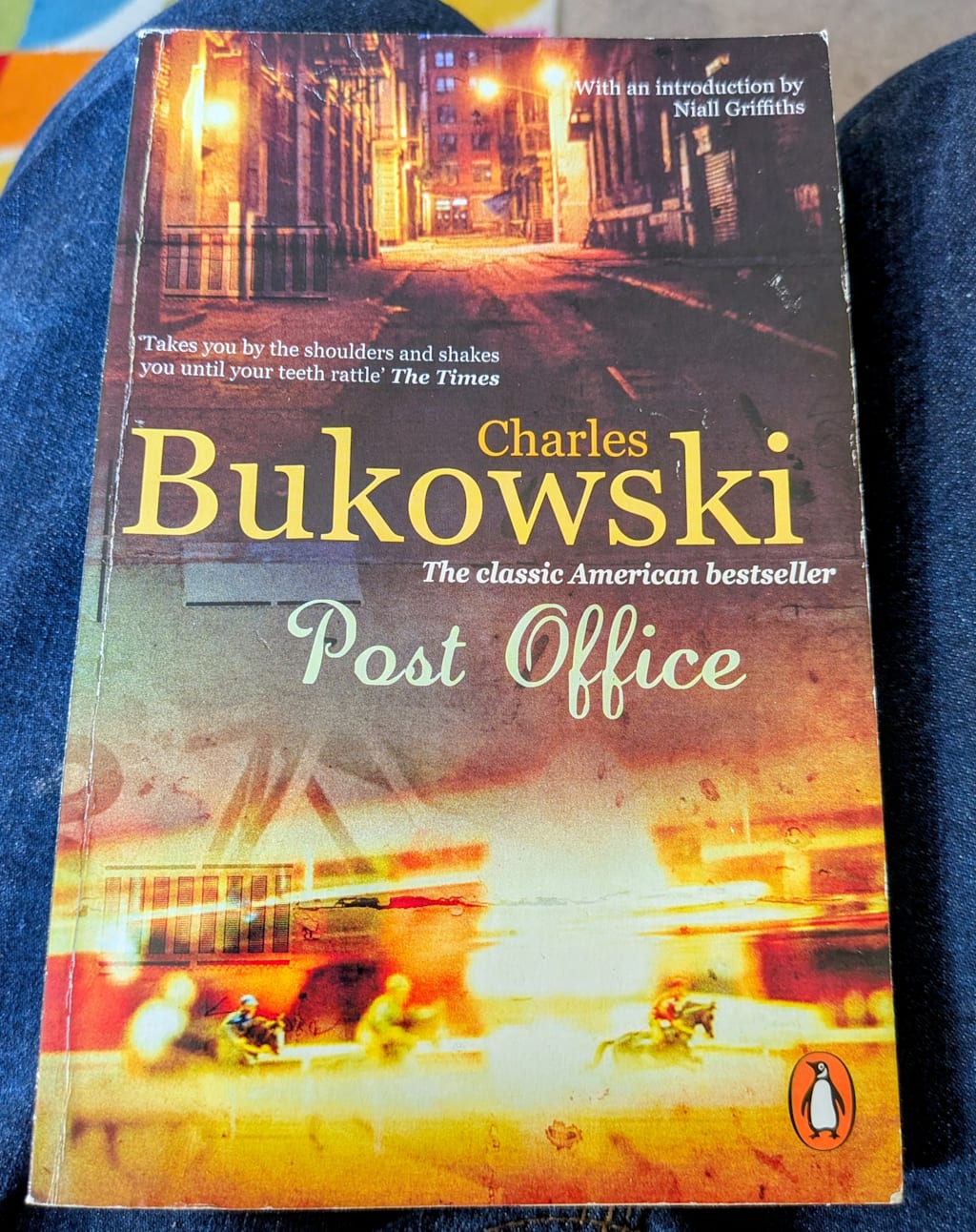
Post Office by Charles Bukowski – Review by Paul Stewart
Book Review.

Last year I really wanted to read more. I did read more than previous years, listening to a lot of autobiographies (I'm not a huge fan of audiobooks, but I love autobiographies read by the author. It gives greater depth and meaning to their anecdotes) and reading a lot of talented writers on Vocal.
This year was going to be so different, but the first six months dragged out quite spectacularly because of grief, other setbacks, and not really giving reading much attention outside of casual stuff online and Vocal pieces. But enough with the negativity. I have six months to do better than last year and, seeing as I can only really estimate how many books I read, all I need to do is hit a nice, square 20 and I'll consider that a win.
The Actual Review
That's a rather meandering introduction to one of the most celebrated, yet also one of the most divisive writers of the last century: Charles Bukowski and his bestselling novel Post Office. We'll ignore the fact I started it towards the end of last year and only finished it now.
"Well, as the boys said, you had to work somewhere. So they accepted what there was. This was the wisdom of the slave."
Henry Chinaski
This book has it all.
Don't you hate it when people say that?
It's not even technically true. Post Office has a lot of some things and absolutely none of others, and that's exactly why it's great.
Its total lack of pretension, its refusal to beat you over the head with philosophy, and its brutally honest account of what life can look like are where its charm lies.
I understand why people find Bukowski difficult to read, both from a moral and a technical point of view.
Take Post Office, for instance. Chapter 9 is missing from one section. It's not that I bought a dodgy copy. It simply isn't there. Whether it was intentionally omitted or simply disappeared somewhere during the manuscript's journey to publication has long been part of the book's lore.
I actually have my own theory about why it's missing.
It comes at a crucial point in the narrative. We see Betty heading towards death and then, suddenly, we're at the funeral. We never actually witness her passing.
I wonder if that's deliberate because, while Henry Chinaski—a fictionalised version of Bukowski—is emotionally guarded rather than emotionless. He rarely confronts grief head-on, preferring to drink, joke, or simply carry on. Whether Bukowski intended it or not, the omission feels almost respectful. Rather than turning Betty's death into a dramatic scene, the novel leaves a silence where that moment should be.
There are little moments throughout the novel that I think people often overlook. Chinaski shows genuine kindness towards Betty, who was inspired by Bukowski's real-life partner, Jane Cooney Baker, in those final pages. He wipes her mouth, encourages her to drink water, and becomes angry that the hospital staff don't seem to be doing enough. Those acts don't erase all of his flaws, but neither should his flaws erase those moments of humanity.
"Betty, Betty, Betty. Please, I want you to drink some water, just a sip of water, not too much, just a sip." She didn't respond. I tried for ten minutes. Nothing. More spittle formed at her mouth. I wiped it away. Then I got up and pulled the drop sheet back. I stared at the three women. I walked out and spoke to the nurse at the desk."
Henry Chinaski
Do I always agree with the words and expressions Bukowski uses throughout? No. Even allowing for the fact that the novel was first published in 1971, there are passages that will understandably make modern readers uncomfortable. But I also think it's important to consider the time, the circumstances, and the writer before judging the work too harshly.
Like the novel itself, Post Office begins and ends almost incidentally. There's no grand resolution because life rarely offers one. Along the way it's hilarious, uncomfortable, bleak, frustrating, and surprisingly sad.
From:
"It all began as a mistake."
Henry Chinaski
To:
"In the morning it was morning and I was still alive.
Henry Chinaski
Maybe I'll write a novel, I thought.
And then I did."
Bukowski drew heavily on his own years working for the United States Post Office, and it shows.
You can almost feel the injustice suffered by people who spend years working in bureaucratic, target-driven jobs. I've never worked for the Royal Mail, but I have worked in similar environments, and Bukowski captures that slow erosion of ambition frighteningly well. Chinaski doesn't strike me as a man driven by wealth or status. If anything, he just wants enough money to survive without surrendering his life entirely to work. Even when he's with Joyce and surrounded by money, he jokes about it more than he covets it. He isn't chasing success in the conventional sense; he's chasing the freedom to be left alone.
This, I guess, is a challenging book, both in terms of its writing style and its content. However, I thoroughly enjoyed it. The fact it took me so long to finish shouldn't be taken as an indication of how difficult it is to read, because it really isn't.
There will be people who adore this as much as I did and those who find it meandering and a little low stakes.
For me, though, it was those quiet, almost incidental moments of humanity that lingered long after I'd closed the book. They don't excuse Chinaski's flaws, nor Bukowski's, but they do remind us that people are rarely as simple as we'd like them to be.
About the Creator
Paul Stewart
Award-Winning Writer, Poet, Scottish-Italian, Subversive.
The Accidental Poet - Poetry Collection out now!
Streams and Scratches in My Mind coming soon!
Enjoyed the story? Support the Creator.
Subscribe for free to receive all their stories in your feed. You could also become a paid subscriber, letting them know you appreciate their work.
Comments
There are no comments for this story
Be the first to respond and start the conversation.