
Our Bridge to Forever
One island, One deadline, One love.

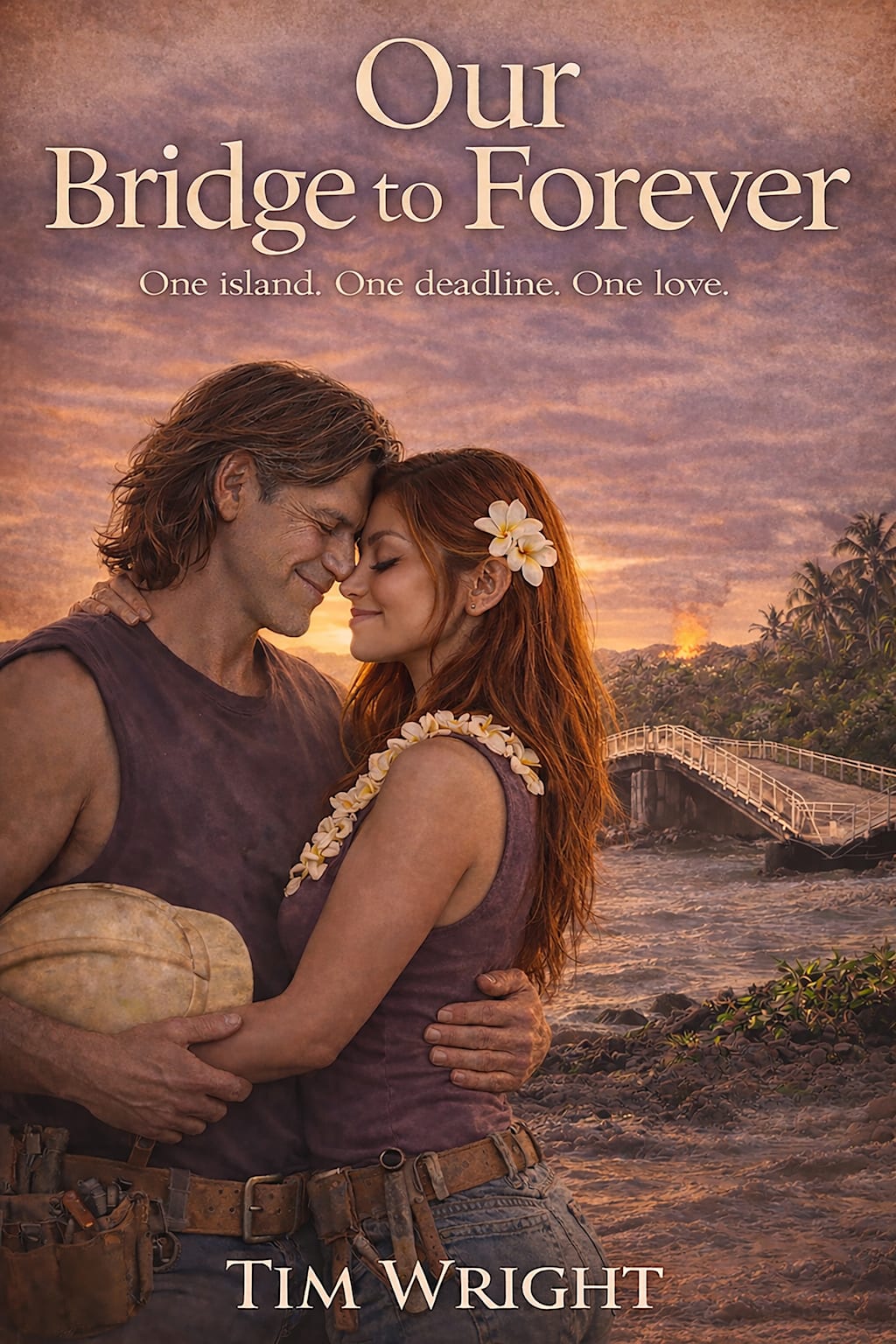
Chapter One — The Night the Storm Brought Her
The rain came in sideways that night.
Not the gentle Hilo kind that drifts through the air like mist, but the hard, pounding kind that rattles roofs, bends trees, and turns the streets into rivers. Mason Loando stood in the doorway of his small workshop near Coconut Island, watching the storm roll in like an angry tide.
He had seen storms his whole life—six generations of bridge builders in his blood meant long days under gray skies—but this one felt different. The wind howled through the ironwood trees, and somewhere in the distance, thunder cracked like splitting timber.
Mason stepped out onto the lanai to pull in a stack of plans before they got soaked.
That’s when he heard it.
A faint sound. Lost in the wind.
A whimper.
He paused, listening.
There it was again—small, desperate.
Mason followed the sound to the edge of the walkway. At first, he saw nothing but sheets of rain and blowing debris. Then a tiny shape moved near the base of his steps—a small dog, shivering, soaked through, its fur plastered to its body.
“Hey, hey… easy now,” Mason said softly, crouching down.
The dog didn’t run. It just looked up at him with wide eyes, trembling so hard its whole body shook.
“You picked the right house tonight,” he murmured.
He scooped the little dog into his arms. It weighed almost nothing.
Inside, Mason grabbed an old, clean towel and wrapped the dog gently. He dried it as best he could, careful and slow, the way his father had taught him to handle anything fragile.
The storm raged outside, louder now. Rain hammered the roof like nails.
Mason sat down in his worn big chair, the dog tucked against his chest. He could feel its heartbeat—fast at first, then slowly beginning to calm.
“Yeah… you’re alright,” he said quietly.
Lightning flashed, filling the room with white light. The thunder that followed shook the windows.
The dog flinched.
Mason pulled it closer.
“It’s okay. I got you.”
Hours passed like that.
The storm didn’t let up. The wind howled through the night, carrying the sound of crashing branches and distant sirens. Mason didn’t sleep. He just sat there, one arm wrapped around the small, trembling animal, the other resting against the chair, keeping steady.
Every so often, he’d whisper to it.
“Hang in there, little one.”
By midnight, the dog had stopped shaking. By two in the morning, it had curled into him, breathing slow and even.
Mason smiled to himself.
“Good. That’s good.”
Just before dawn, the storm began to ease. The rain softened. The wind settled into a tired whisper. The first hint of gray light crept through the clouds.
That’s when he heard the knock.
Three quick taps on the door.
Mason looked down at the dog, still wrapped in the towel, still asleep against him.
Another knock. A little louder this time.
He stood carefully, making sure not to wake it, and walked to the door.
When he opened it, the world outside was wet and quiet, the storm finally spent.
Standing there—barefoot, soaked, strands of dark reddish hair clinging to her face—was a woman.
Her eyes searched past him, wide with worry.
“I’m sorry,” she said, breathless. “Have you seen a small dog? She ran off during the storm—”
Mason stepped aside without a word.
Her eyes dropped immediately to the bundle in his arms.
The dog stirred, lifting its head.
For a second, everything went still.
“Oh my—” she whispered, her voice breaking. “That’s her.”
The dog gave a soft bark and wiggled free, jumping gently toward her. She caught it, holding it close, her face pressing into its damp fur.
“I’ve been looking all night,” she said, her voice shaking. “I thought—”
She stopped, unable to finish.
Mason nodded. “She showed up here. Just before the worst of it.”
The woman looked up at him then, really seeing him for the first time.
“Thank you,” she said softly.
He shrugged, a little embarrassed. “Wasn’t gonna leave her out there.”
A small smile touched her face, even through the exhaustion.
“I’m Pualani Silva,” she said. “And this little one is Peanut.”
Mason smiled. “Peanut, yeah? She picked a good place to ride out the storm.”
Pualani looked back up at him, her eyes softer now.
“Looks like she did.”
Mason felt something shift—like the quiet after a storm, when everything feels new.
“I don’t know how to thank you,” she said.
Mason glanced toward the bridge.
“You already did.”
“How’s that?”
He smiled.
“You knocked.”
And just like that, the storm that had torn through the night left behind something neither of them had been looking for and both of them would never forget.
Chapter Two
The Calm After the Storm
By the time Mason stepped outside, the storm had washed itself clean from the sky. The air felt new—cool, damp, and quiet in that way Hilo mornings sometimes are after a hard night.
Pualani stood just beyond the doorway, Peanut tucked safely in her arms.
“Do you live far?” Mason asked.
She shook her head. “Couple blocks. Up past the old banyan tree.”
Mason nodded. “I’ll walk you.”
She started down the path, then hesitated.
“Oh—” she laughed softly, looking down. “I kinda forgot something.”
Mason followed her gaze.
Bare feet. Wet pavement. Bits of gravel and leaves were scattered across the walkway.
“Hold on,” he said.
He stepped back inside and returned with a pair of worn black surf slippers—big ones.
“Here.”
Pualani slipped them on.
They swallowed her feet.
She took one step.
Then another.
The slippers flopped loudly against the ground.
She looked up at him, half amused, half helpless.
“You got anything in a size seven?” she asked.
Mason cracked a smile. “That is my size seven.”
She laughed, the sound light and easy, cutting through what was left of the storm.
“Well… I feel like a clown,” she said, lifting one oversized foot.
“Clown with good traction,” Mason said.
They started walking.
The streets were still slick, puddles reflecting the early morning sky. Fallen leaves clung to the edges of the road. Somewhere in the distance, a rooster called as if nothing had happened.
Pualani moved carefully, the oversized slippers slapping the pavement with every step.
Peanut peeked out from her arms, alert now, ears twitching.
“Sorry about her,” Pualani said. “She hates thunder.”
Mason shrugged. “She did alright. Tough little thing.”
Pualani smiled down at Peanut. “Yeah. She is.”
They walked in a comfortable quiet for a moment.
“So… you live in your shop?” she asked.
“Workshop and a small place next to it,” Mason said. “Been renting by Coconut Island for a project.”
“What kind of work?”
He glanced ahead, toward the shoreline.
“Bridges,” he said. “Or at least… trying to build one.”
Pualani tilted her head. “Trying?”
Mason let out a small breath.
“Coconut Island bridge. Rebuild project.”
Her eyes widened slightly. “That’s you?”
“Part of it,” he said. “Family’s been building them a long time. We got the job to bring that one back.”
They reached the turn toward her street, lined with low cottages and hibiscus hedges still dripping from the rain.
“What’s the holdup?” she asked.
Mason gave a quiet chuckle. “You got time?”
She smiled. “I got a few blocks.”
“Permits,” he said. “Environmental studies. Soil reports. Inspections. Every time we get close, something else pops up.”
“Sounds exhausting.”
“It is,” he admitted. “Deadline’s 2027. Some days feel like we’re chasing it. Other days…” He shrugged. “Feels like it’s chasing us.”
They reached her cottage—a small, cozy place with a tin roof still ticking as it dried.
Pualani stopped and turned to him.
“Well,” she said, “you got me and Peanut home in one piece.”
Mason nodded. “That was the goal.”
She hesitated for just a second.
“Come in,” she said. “At least let me say thank you properly.”
Mason started to shake his head.
“I should—”
“Please,” she said, softer. “I’ve been up all night. I owe you coffee, at least.”
He paused.
Then nodded. “Alright. Coffee sounds good.”
---
Inside, the cottage was warm and smelled faintly of vanilla and cinnamon.
Pualani set Peanut down on a small blanket near the window. The dog curled up immediately, finally at ease.
“You can sit,” she said, moving toward the kitchen.
Mason took a seat at a small wooden table.
“You hungry?” she asked.
“I’m okay.”
She glanced over her shoulder. “That wasn’t really a yes or no.”
He smiled. “Little bit, I guess.”
“Good,” she said. “Because I’m making sweetbread French toast whether you are or not.”
Mason leaned back slightly, watching her move around the kitchen.
“You do this for all the guys who rescue your dog?” he asked.
She grinned. “Only the ones who give me clown shoes.”
A few minutes later, she set a plate in front of him—golden slices of sweetbread French toast, lightly crisp on the edges.
Then came the coffee.
Strong. Hot. Perfect.
Mason took a bite.
He paused.
“That’s really good,” he said.
“Told you.”
They ate in a quiet that didn’t feel awkward.
After a moment, Mason set his fork down.
“I gotta head out soon,” he said. “Work doesn’t really wait.”
Pualani leaned against the counter.
“What’s on the schedule today, bridge builder?”
Mason hesitated.
“I gotta head out to the site. Need to pull some soil samples near the footings. Environmental reports are due in a few days.”
“Sounds important.”
“It is. Without it, everything stalls again.”
She nodded. “So what’s the problem?”
Mason glanced at her.
“I need someone to sit in the kayak while I dive. Keep it steady. Keep an eye out.”
Pualani raised an eyebrow. “You just met me.”
He gave a small shrug. “You seem reliable. Plus…” He nodded toward Peanut. “Your dog already vouched for you.”
She laughed.
Then looked down at the oversized slippers still on her feet.
“I don’t know,” she said. “I’m still recovering from these.”
Mason smirked. “I’ll upgrade you to something closer to your size.”
She considered it.
Then looked back at him.
“What time?”
“ 3 pm, as soon as the tide settles.”
Pualani smiled.
“Alright, Mason, the bridge builder,” she said. “I’m in.”
---
Chapter Three — Coconut Island
By three in the afternoon, the tide had begun to fall.
The water around Coconut Island pulled back just enough to expose the darker shades of reef below the surface. The wind had softened, and the ocean carried that calm, steady rhythm that comes after a storm clears everything out.
Pualani spotted Mason near the shoreline.
The kayak was already loaded—cooler strapped down, waterproof backpacks secured, and a tray holding six glass jars.
He looked up as she approached.
“Can you swim?” Mason asked.
Pualani raised an eyebrow. “BIIF state champion, 200-meter. Captain of the water polo team.”
Mason nodded. “I’ll take that as a yes.”
He handed her a clipboard.
“Here—sign this.”
She glanced down. “What’s this?”
“Let's you work with me as a subcontractor. Basic paperwork to get you paid.”
She looked up at him, half amused.
“Do you always put girls to work the same day you meet them?”
Mason shrugged. “Only the ones willing to wear my clown shoes.”
She laughed and signed.
Mason zipped up his full-body wetsuit.
“Here’s the plan,” he said. “We paddle out to the center column. Tie off the kayak. I’ll dive and collect soil samples. You stack the jars in the tray.”
She looked at the glass jars.
“Are those called Mason jars?”
He smirked. “Funny, Captain Polo.”
They pushed off.
The water was calm now, the kayak gliding easily toward the bridge. Beneath them, the ocean shifted between shades of green and deep blue.
As they reached the center column, Mason secured the line.
“You’ll see a state truck pull up,” he said. “Two inspectors—Damon and Craig. We hand them the samples.”
Pualani tilted her head. “It takes two inspectors to pick up jars?”
Mason chuckled. “You should see how many it takes to change a lightbulb.”
She smiled. “Fair enough.”
He paused, then added, “We’re also getting a visit from a DLNR guy—Terlep.”
“For what?”
Mason glanced at her. “We’ve got a small group of eels living in a cave under the footing.”
Pualani froze. “Wait… what?”
“Five or six,” he said casually. “We’re relocating them.”
She stared at him. “You forgot to mention eels?”
“Minor detail.”
“Don’t expect me to jump in there.”
“Roger that, Captain Polo.”
Mason secured her safely to the center column with a line.
Then he slipped into the water.
One dive.
Two.
Three.
Each time, he surfaced with a jar—dark sand and sediment inside—placing them carefully into the tray. Pualani lined them up like clockwork.
Right on cue, a state truck pulled up.
Two inspectors.
Damon and Craig.
They collected the samples without much conversation—just a few nods and clipboard checks—and were gone as quickly as they arrived.
Twenty minutes later, a small DLNR boat approached.
Terlep stood at the helm.
“Afternoon, Mason,” he called out.
“Perfect timing,” Mason replied.
Terlep handed him a netted box—clear, strong, woven like heavy fishing line.
Mason took a breath and dove.
He disappeared beneath the surface.
Seconds stretched.
Then he resurfaced—air, one quick breath—and went down again.
When he came back up the second time, the box was alive.
Eels twisted and coiled inside, their bodies moving like living ropes.
Pualani leaned back slightly. “Okay… that’s actually crazy.”
Terlep helped Mason transfer the eels into a holding tank on the boat.
“All good,” Terlep said. “Let’s get them moved.”
Mason paddled the kayak back to the boat ramp.
“Next step,” he said, stepping out. “We’re heading out about a mile.”
Pualani followed him onto the boat.
She watched him move—efficient, focused, calm.
Soil samples. Inspections. Eel relocation.
He said he was a bridge builder.
But he was more than that.
A lot more.
A mile offshore, Terlep slowed the boat.
The water turned a deeper blue.
He handed her a mask and a brand-new snorkel.
“Alright,” he said. “We’re above an artificial reef.”
She looked at him. “You built this?”
“My family did. Started it about sixty years ago. Old bridge materials—cement, structure. Even parts of the old Coconut Island bridge are down there.”
He glanced at her.
“Ready?”
She nodded.
Mason slipped into the water with the eel box.
Two minutes later, he surfaced and reached for her hand.
“Come on.”
She hesitated for half a second.
Then jumped.
The ocean swallowed her.
And everything changed.
Mason held her hand as they drifted just below the surface.
The eels slipped from the box, gliding into the reef, disappearing into crevices like they had always belonged there.
To her left—sea turtles, slow and effortless.
To her right—bursts of yellow fish, then flashes of blue and green.
Below them—life everywhere.
Color.
Movement.
A world she didn’t know existed.
Her eyes widened behind the mask.
Wow.
Wow.
And triple wow.
She turned toward Mason.
Even underwater, she could feel it.
That same quiet shift.
The same one from the doorway.
They surfaced together.
Mason pointed toward the boat.
They raced.
Pualani won.
Of course.
Back on board, Terlep laughed. “Not even close, Mason.”
Mason shook his head. “Rematch.”
“Mahalo, Terlep,” Mason said. “Appreciate it.”
“No problem,” Terlep replied. “Just get me back by five.”
Back at Coconut Island, Mason handed Pualani a towel.
They walked along the shoreline, the late-afternoon sun warming the sand, the ocean calm again, as if the storm had never happened.
“My parents used to bring me here all the time,” Pualani said softly. “I love this place.”
She stopped.
Turned.
And without another word—
kissed him.
Mason froze for just a second.
Then kissed her back.
When they pulled apart, he exhaled.
“Thank God,” he said. “I’m terrible at reading signals. I never know if a girl actually likes me or if I’m just—”
She placed a finger gently against his lips.
“Stop talking.”
Then kissed him again.
Longer this time.
When she pulled back, she smiled.
“For a guy who can’t read signals,” she said, “you’re a really good kisser.”
About the Creator
Tim Wright
Tim Wright is a fourth-generation resident of Hawai'i Island and a freelance photographer. His images have appeared in various publications, from National Geographic to The National Enquirer.
Enjoyed the story? Support the Creator.
Subscribe for free to receive all their stories in your feed. You could also become a paid subscriber, letting them know you appreciate their work.
Comments
There are no comments for this story
Be the first to respond and start the conversation.