
"If I Did It"
Ethical dilemmas around the infamous book



When I teach Ethics of Communication, I always give my students the debate situation below to discuss ethics of public relations:
You are a communications director of a big international publishing house. Your CEO calls you in and says that one of your small relatively independent imprints is about to sign a book contract with someone who had been acquitted of a murder in a criminal court one year earlier and just lost the civil court case with a multi-million-dollar settlement to the victim’s family.
In between the court cases, the person wrote the book titled “If I Did It” and his agent brought it to your imprint. The contract will be for the amount of money a little over the court-ordered restitution to the victim's family and legal costs to the author. The CEO is asking what to do and what the potential implications can be.
Using various ethical perspectives, advise your CEO to publish (Team 1) or not to publish (Team 2) this book.
In several years that I've been running this debate, it is almost invariable that Team 1 will base their arguments on the ideas of free speech (the publisher has the right to publish the most outrageous ideas and it is for readers to decide if they want to buy and read the book, after all we haven't banned Hitler's Mein Kampf) and business considerations (a book like that has a potential of making a lot of money and money does not stink and a small publisher like us should grab this opportunity; being ethical is the luxury of bigger publishers).
Team 2 would always lean into concerns about the victim's family (reliving the loss and trauma through the published book again, and exposure to the public narratives you cannot escape in the digital age) and social responsibility of a publisher concerned with betraying the public interest (publishing what might be considered to be an instruction manual for a killer and giving a platform, attention and time to inhumane ideas and personality of a killer who will inevitably try to explain away his horrible deed and ultimately confess to nothing).
This year's debate was no different: both sides hit all these points and discussed them extensively through various hypothetical examples.
It doesn't take long for one or both teams to bring up OJ Simpson's book as a precedent or example for their arguments, even though I don't mention the author in the original debate assignment and describe the book in most generic terms. My goal for the debate is to discuss the ethics of public relations (i.e. representing the publisher and guiding them to an ethically sound decision) rather than the gruesome murders or OJ's torturous and torturing book that also had an "adventurous" life of its own, being first published and then cancelled and recalled by HarperCollins and ultimately published again, furnished with several chapters written by the Goldman family and most proceeds funding the efforts to stop domestic violence.
When we wrap up the debate, I always sum it up like this: As a public relations counsel, you have to lay out ALL the arguments, both pro and con, to your employer or client, and present them with the analysis of the possible consequences and repercussions of each potential action. It is ultimately up to them, to decide what they want to do. But at least you can be ethical in guiding them through the available options.
Something was different about this year, though: We were debating on the same day - April 10 - that OJ Simpson died. Call this a coincidence, if you will, especially because the news of the death came later, but I find it perplexing.
Also, a new insight came up during the debate: Because a printed book is a lean medium lacking the voice intonation, the meaning of the title can be interpreted differently, depending on where the stress is put:
If I Did It... you would have never known because I would have covered up the murder better (doubting the act of killing itself);
If I Did It... I would have done it differently because I am a much smarter and better killer (doubting he is the killer);
If I Did It... she had it coming as she was an irresponsible mother and a whore (trying to justify the gruesome act);
If I Did It... the gloves would have fit.
Pablo Fenjves, the ghost writer for OJ's book, insisted that it was the third meaning of the title that OJ himself tried to convey.
In any case, since OJ never really confessed or repented, we will probably never know the truth about the double murder. But we will always have the book to continue the debate. And the debate comes down to two dilemmas:
1) To publish or not to publish the book? - As a freedom of speech absolutist, I believe the book absolutely should be there, equipped with the Goldmans' commentary as it is. Banning or not publishing books never resolved anything. But personally, I still would advise the publisher in my original debate question not to publish it: Let it be someone else's liability or act of bravery, depending on how you look at it.
2) To read or not to read it? - That is an individual reader's dilemma. I've read the Goldman's commentary to understand what happened and why the book did get published from their perspective. I don't need to read the entire book because I don't want to get into OJ's mind - have met enough narcissistic abusers in my life to understand how they think. I hope the readers are mature enough to read the book as a case study in ethics and humanity against the backdrop of domestic violence rather than a killer's attempt at telling his story and clearing his name.
PS. I was impressed with the cover design for the first edition of the book: the word "If" in the title is buried in "I" so from afar it reads "I Did It" and there's no mentioning of OJ's name anywhere. I guess we really don't need to know which killer's confessions they are. And the second edition had even more extensive commentary by the Goldman family after the family acquired the rights to the book.
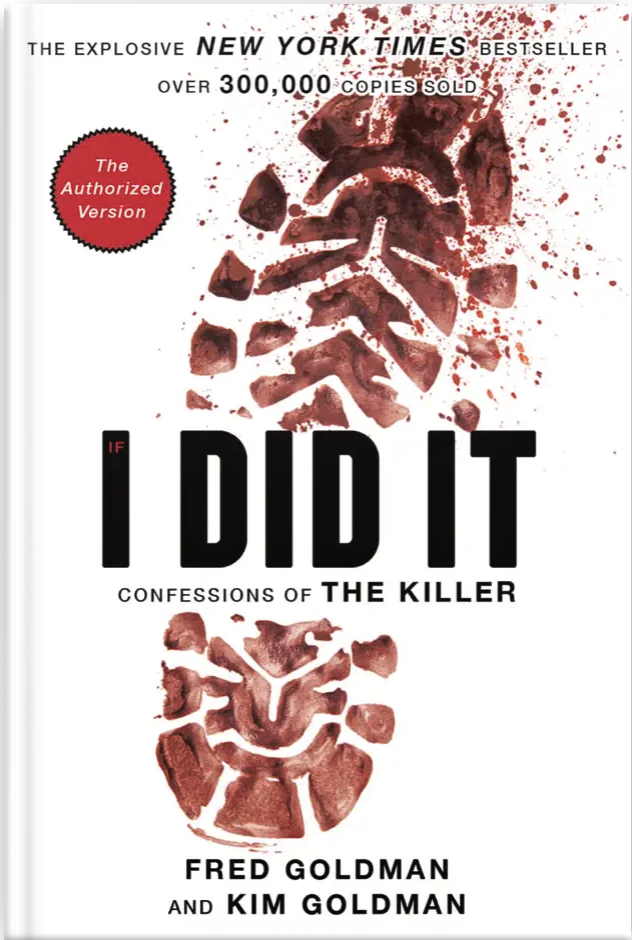
PPS. Based on Judey's comments, I need to make a point in the future debates about how another dilemma may arise for bookstores: To sell or not to sell the book.
About the Creator
Lana V Lynx
Avid reader and occasional writer of satire and short fiction. For my own sanity and security, I write under a pen name. My books: Moscow Calling - 2017 and President & Psychiatrist
@lanalynx.bsky.social
Enjoyed the story? Support the Creator.
Subscribe for free to receive all their stories in your feed. You could also become a paid subscriber, letting them know you appreciate their work.
Comments
There are no comments for this story
Be the first to respond and start the conversation.