
Don’t Ask Bukowski for the Rings
Reading " The Great Zen Marriage"

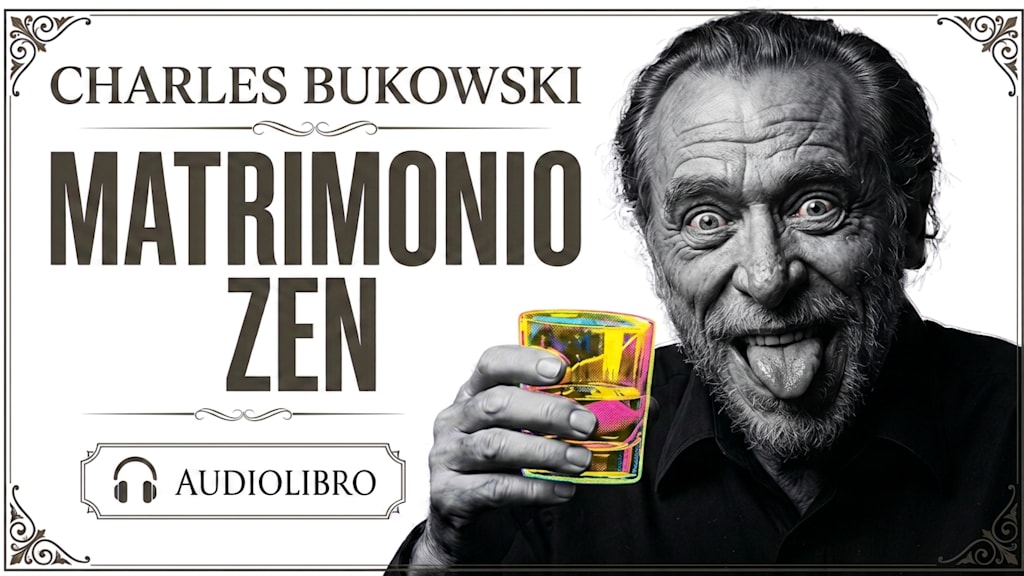
From 1967 on, Bukowski wrote the column “Notes of a Dirty Old Man” for Open City, an underground weekly in Los Angeles, and later for various other counterculture papers, winning wide approval among a decidedly mass readership; it was the main engine of his later fame. Some of the stories collected in Tales of Ordinary Madness were born on those pages, in prose written for the newspaper reader and therefore direct, almost spoken, with a first-person narrator identifiable with the author himself: a “wise fool” who laid bare the contradictions of American society.
In those same years, the fashion for Zen, which had spread in the 1950s through the works of Alan Watts and the Beat literature of Ginsberg, Kerouac, Burroughs and the rest, had degenerated into a radical chic trend, one that took hold not only among rebellious young people in the counterculture but also among gangsters and common criminals, completely decontextualized and emptied of meaning. Bukowski poked fun at these liminal milieus, where you might meet the worst criminal standing next to a respected university professor, by recounting his own attendance (whether real or invented, we can’t know) at a Zen wedding, as the groom’s best man.
For half the story we watch this alcoholic best man behave in disgusting ways. We are assaulted by foul language and read about aggressive, entirely inappropriate behavior. Yet little by little the author lifts the veil of appearances, showing how much more violent, more vulgar, more nauseating the world around the protagonist actually is. The “normal” people who (understandably) see him as the villain are in fact concealing a violence endemic to society itself, more unjust and on a far larger scale, until the reader ends up, paradoxically, sympathizing with the madman. In short, that avalanche of bestiality, that madcap sequence of obscene, intrusive, outrageous acts, is not an end in itself.
Given the premises of the story, I find the result absolutely brilliant and explosive in the force of its message. Bukowski doesn’t expect anyone to justify his character; he is content to make a mockery of everyone else. What at first looks like a jumble of senseless antics falls into place within a mosaic that gradually emerges in all its hallucinatory credibility, evolving from the grotesque to the philosophical, to political and social satire.
The story opens with Bukowski riding in the back seat of his own car (he can’t drive because his license has been revoked for drunkenness), wedged in like cargo among the other goods. He is the ‘trained monkey’, the famous writer, the public figure invited to serve as a decoy, as best man. The company is described rather hastily and collectively, without much detail: ex-cons, cripples, dandies, people who live by their wits and by dodges and schemes. Even when he mentions the university professor at the party, he describes him as someone who, unlike the narrator, is no fish out of water. Indirect, but crystal clear. The groom has never worked a day in his life and the girl supports him, and their house is full of obscene photos on the walls, so it is hard not to think of the groom as a pimp, a protector of his wife.
At least three of the guests flatter him as a great writer, including an eleven-year-old boy who, apparently, is allowed to read his stories. He is plainly a caricature, but the Zen master has been warned that he is unreliable and shouldn’t be counted on. They aren’t friends, in short; the people who invited him are very gamblers, and the part of Bukowsky is clearly that of the clown in a world that takes itself far too seriously. The trouble is that he decides to play for real, all the way: he loads up on booze and goes further. Much further, he slips out of the company’s hands and they abandon him on the sidewalk thirty steps from his own door, where two policemen pick him up. I won’t go into the details, but the message is plain: the monkey is tolerated as long as he does his act, but only within the limits set by the trainer.
I won’t go into the details of how Bukowski describes the reaction of the law when it finds him drunk thirty steps from his own front door, how he is treated, physically too, or the conditions of the other prisoners inside the police station. It is a small gem, because, without claiming himself to be a saint, he shows how much worse the world outside is, seen from that vantage point. Rereading the story today requires this caveat, or a contemporary reader, unaccustomed to it, might drop it within the first three pages, since the story is built on purpose to be unpleasant, even nauseating: we are faced with a buffoon who insists on throwing in our faces reality as we ourselves are ashamed to describe it, and this can at times be disturbing. In the unbearable obscenity of this story, Bukowski reminds us who we are and what kind of society we really live in.
About the Creator
Federico Berti
Writer, composer, actor. Internationally known as a performer, one‑man band, and audiobook narrator. Expert in the art of memory.
Enjoyed the story? Support the Creator.
Subscribe for free to receive all their stories in your feed.
Comments
There are no comments for this story
Be the first to respond and start the conversation.