
10 Poets I NEED to Read after Finishing A Little History of Poetry
Novel by John Carey

History, despite its wrenching pain, / Cannot be unlived, and if faced with courage, / Need not be lived again. Maya Angelou
I can’t recall what it was that first drew me to poetry. I don’t think I read a poem until college, and by then, my brain was so fried from substance abuse that I could hardly understand prose, let alone poetry.
Poetry has this reputation of being challenging, and that deterred me for many years from picking up my first collection outside of a school syllabus. I thought as if I’d have to be some kind of poetic paleontologist uncovering the poet’s intent under layers of difficult symbolism. But this I have grown to realize is not (always) the case.
Poetry can open our minds in ways prose cannot. This is because we crave originality and authenticity. Poetry comes from the poet’s heart and reaches out to touch ours. Words are powerful that way. And Poets are able to craft words in orders we’ve never imagined before, which only further unlocks our understanding of the world around us.
As I got older and healthier, I began craving beautiful language. I turned to poetry and have been in awe of the medium ever since. Ever since I took a chance on Han Kang’s White Book, poetry has become a staple.
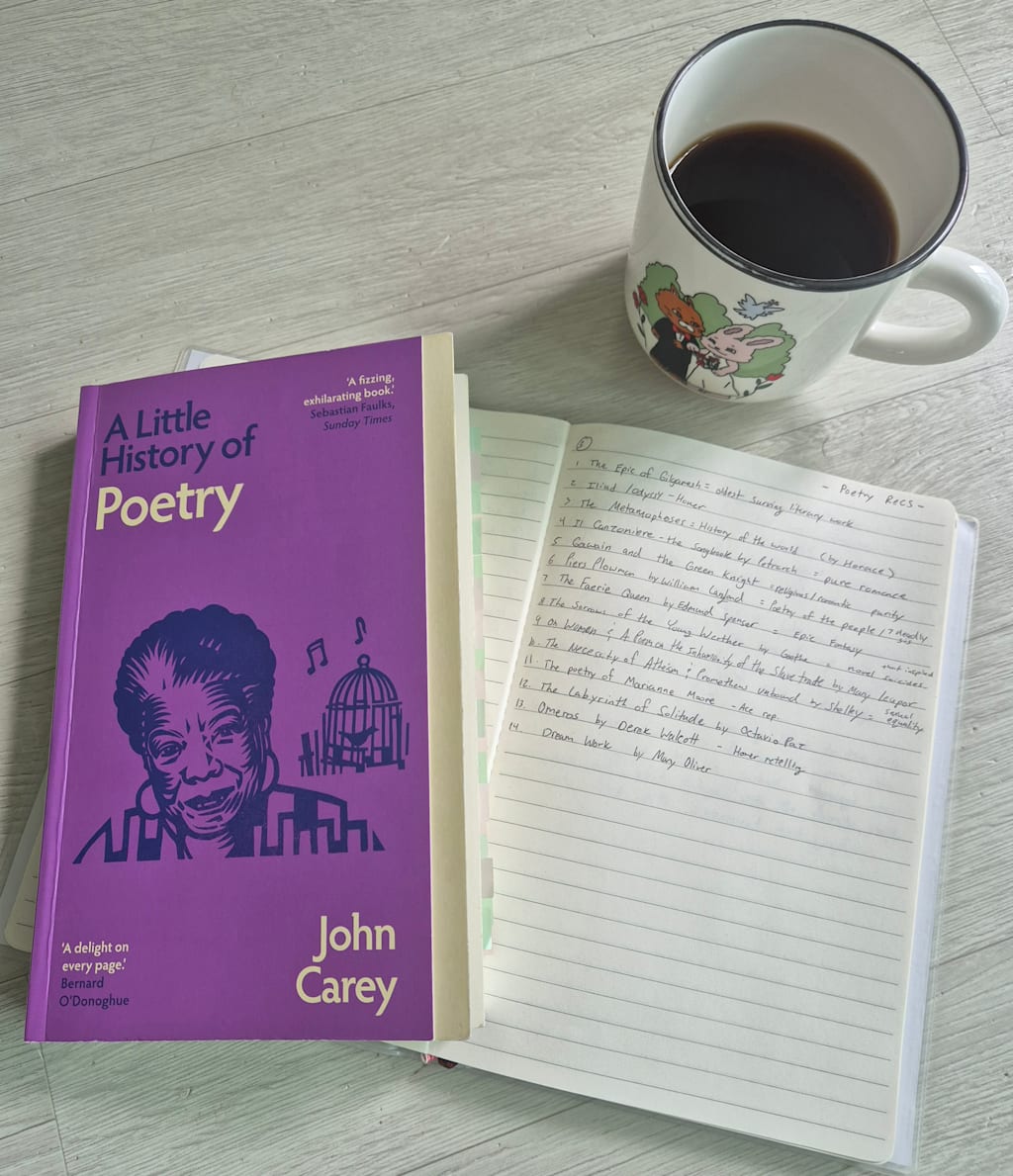
I decided to pick up the Oxford professor John Carey’s novel A Little History of Poetry. And nearly every chapter had a collection or a stand-alone poem that called to me.
Listed below are the top ten books I’m most eager to check out.
1. The Epic of Gilgamesh
If you’ve never heard of this story, you are in for a wild ride. Homer, as well as many other folklore, epics, and religious texts, took inspiration from this tale. It is the oldest surviving work of literature. It is part queer love story, part creation story, and part epic fantasy, complete with magical creatures and heroic feats. Needless to say, after reading Carey’s description of the tale, I went to my local bookstore and found a copy for myself.
Truly oh Gilgamish he is born in the fields like thee. The mountains have reared him.
2. The Metamorphoses by Horace
This historical poem, stretching across 15 books, covers everything from man’s creation to the fall of the Roman Empire. The Metamorphoses is described by readers as being both grand and grotesque, but its key theme is a harrowing beauty of love. It talks of Greek Gods and their cunning. It discusses boys and nymphs uniting to become the bisexual goddess Hermaphroditus. Though 15 books would be quite the commitment, I am utterly intrigued by this epic poem.
As long as there is something left to fear, / There is room on us for wounds, but when the worst, / Has happened, fear is trampled underfoot. / We are at last secure.
3. Il Canzoniere (The Songbook) by Petrarch
Dedicated to his lover who died of the Black Death, Petrarch honors her memory chastely in this collection. He describes missing her as the world becoming ‘a waste land to me of bitter and savage creatures’. Carey warns that the text can feel tedious to modern readers, yet I feel drawn to the soft but consuming love story.
Where’er you tread, the blushing flowers shall rise, / And all things flourish where you turn your eyes.
4. Piers Plowman by William Langland
This is one I am most excited to read next, as I feel it greatly reflects my aggravation with capitalistic greed and overconsumption. Langland goes into grave detail, condemning the church’s corruption and the wealthy elites’ ridiculous airs. The seven deadly sins arrive as characters in the poem, and join the narrator on his mission to liberate the working class.
And poor people, thy prisoners, Lord, in the pit of miscief, / Comfort thy creatures, that much can suffer, / Through dearth, through drought, all their days here,
5. The Faerie Queen by Edmund Spenser
This is England’s first and only national epic, written in honor of Queen Elizabeth. The story tells of the protestant knight Orlando and his forbidden love for the pagan princess, Angelica. As Orlando goes mad with love, the story unravels in fantastical sequences, depicting fairies, angels, and shape-shifters. For historical context, I think it would be very interesting, but Spenser’s unique imagination is what is drawing me in.
And is there care in heaven? And is there love / In heavenly spirits for these creatures base / That may compassion of their evils move?
6. The Sorrows of a Young Werther by Goethe
My apologies for sneaking a novel onto this list, but it is poetic in craft, so let’s let it slide. The story tells a seemingly simple story of an unrequited love that leads to Werther shooting himself in the head. After the publication of this novel, ‘Werther fever’ spread throughout Germany. Many young men dressed up as the main character before committing suicide to replicate the book’s ending. I am particularly drawn to the melancholy and heartbreak surrounding this story, and I’m dying (not literally) to know what inspired such intense emotional responses.
“I sometimes cannot understand how she can love another, how she dares love another, when I love nothing in this world so completely, so devotedly.”
7. On Women & A Poem on the Inhumanity of the Slave Trade by Mary Leapor
Many women in history were barred from proper education, and yet many women persevered and became renowned poets, not just in a historical lens, but popular in their lifetimes! Leapor was a human rights advocate and abolitionist. Her morality and compassion come through as pure strength in her poetry, which are often calls to action. She does not have a singular epic or novel like the other poets on this list, but her work is just as sweeping.
The damsels view her with malignant eyes, / The men are vexed to find a nymph so wise.
8. Prometheus Unbound by Shelley
Married to Frankenstein’s Mary Shelley, Percy paved his own path in the literary landscape with his humanist poetry. He cared greatly about sexual liberation and feminism. “Can man be free if woman isn’t?” His pamphlet ‘The Necessity of Atheism’ got him kicked out of Oxford. His poem Prometheus Unbound highlights is opposition to organized religion and the discrimination it breeds. As an atheist, I think seeing outspoken work like this is really interesting, considering poetry throughout its Western canon relied heavily on Christian symbols.
One came forth of gentle worth, / Smiling on the sanguine earth. / His words outlived him, like swift poison / Withering up truth, peace and pity.
9. The Poetry of Marianne Moore
It is often theorised that Moore was asexual or aromantic, as all her poems on romance and sex were ironic or pessimistic. After the death of her mother, she moved back to Manhattan and became known as a beloved Greenwich Village eccentric. She wore untraditional clothes, fed pigeons, and won nearly every literary prize in America. The fact that I had never heard of this fascinating woman greatly upset me. I can’t wait to dive into her catalogue of work.
Men are monopolists / of stars, garters, buttons / and other shining baubles— / unfit to be the guardians of another person’s happiness.
10. Omeros by Derek Walcott
Walcott grew up in St. Lucia, one of the Caribbean islands. He believed that great things could be created when cultures come together. His masterpiece, Omeros, is a loose retelling of The Iliad. In it, he shares the story of a farmer whose lover runs away with a taxi driver. Walcott keeps the themes of The Iliad alive while changing the symbols to highlight the brutality of the American South. Despite the tragedy, Omeros is said to be hopeful with an optimistic conclusion.
Why not see Helen / as the sun saw her, with no Homeric shadow, / swinging her plastic sandals on the beach alone, / as fresh as the sea wind?
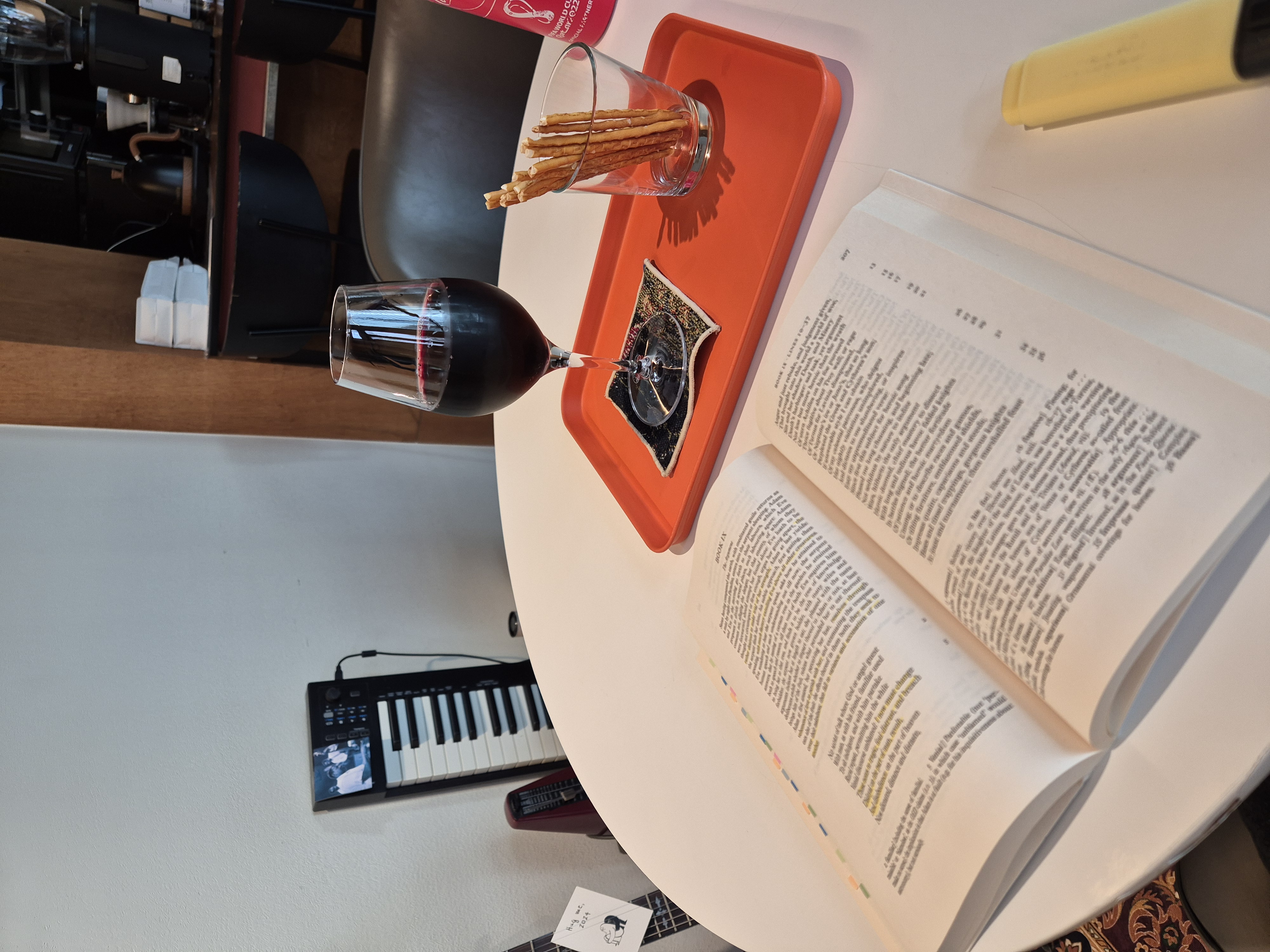
“Some believe that the sound of poetry, its beat and rhythm, relates to our earliest experiences in the echo-chamber of the womb.” Carey pg.6
My favorite modern poets include Saul Williams, Claudia Rankine, Ocean Vuong, Mary Oliver, and, of course, Maya Angelou. And my favorite classical poets are Walt Whitman, Henry David Thoreau, Homer, and my beloved Oscar Wilde. I do believe this list will inspire some new favorites.
I was thrilled when the book mentioned some of these artists’ work. It was interesting to get more insight into what inspired their writing. I also felt a huge ego boost whenever there was a poem mentioned that I had read before. (My head grew three sizes while reading the chapter on Paradise Lost by John Milton)
I would highly recommend John Carey’s A Little History of Poetry if you are a history or literary nerd like me. Carey’s writing was often blunt (he let you know whenever there was a writer he disagreed with), but also wholesome. I could tell just how much he adores and cares about poetry. I felt very reassured by his expertise.
I wouldn’t say the book is perfect. A more accurate title would have been: A Little History of Western Poetry, as it focuses heavily on European and American writers. In fact, there were only two chapters on Eastern Poets and none whatsoever on African. So that was a bit disappointing. Still, I think if you’re interested in famous poets from the West, it is still very much worth your time.
I hope you felt inspired to pick up some poetry after reading this article. If you are a poetry lover, what is a line from a poem you think about often? Mine is from Whitman’s Leaves of Grass:
“All this I swallow, it tastes good, I like it well, it becomes mine, I am the man, I suffered, I was here.”
About the Creator
Enjoyed the story? Support the Creator.
Subscribe for free to receive all their stories in your feed. You could also become a paid subscriber, letting them know you appreciate their work.
Comments
There are no comments for this story
Be the first to respond and start the conversation.