
Your Skin Doesn’t Know Where to Thicken
Calluses aren’t proof your body is making smart choices. They’re local stress responses that can protect, fail, or make the problem worse.
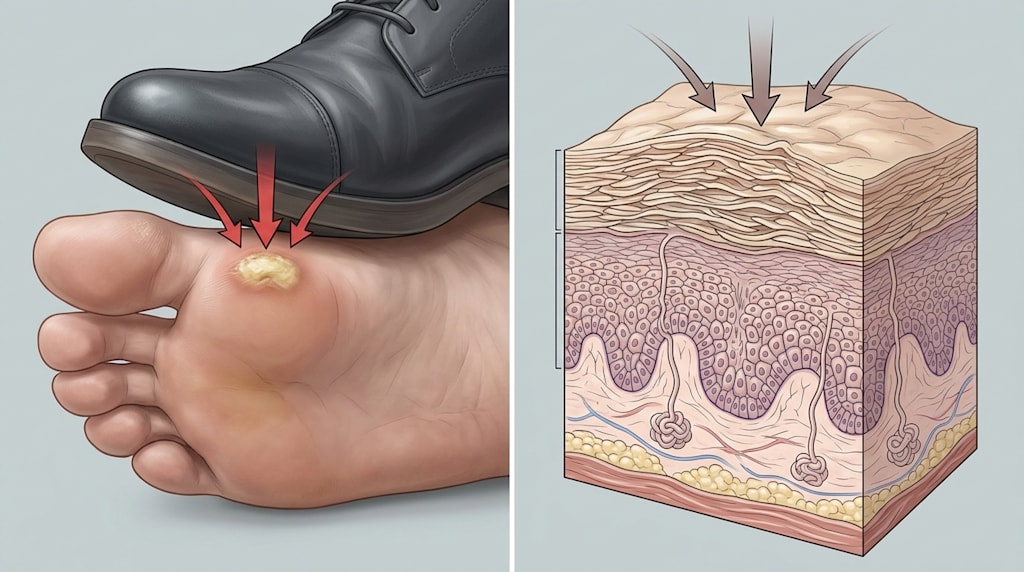
Someone looks at the calluses on their soles and says, “The skin is smart. Where it gets rubbed more, it knows to get thicker.” That sentence turns a result into a purpose. The skin cannot know. A callus is not a designed protective layer. It is what happens when repeated local mechanical stress pushes keratinocyte proliferation and cornification upward. The distinction changes how we sort protection from pathology, and whether a clinic should pare the callus or change the shoe.
Mechanical sensing is not judgment
Skin senses force. Keratinocytes, fibroblasts, and sensory nerve endings respond to pressure, friction, and stretch. Cells turn mechanical signals into biochemical signals through integrins, ion channels, the cytoskeleton, and YAP/TAZ pathways. That is cell biology, not mysticism. Sensing is not judging. Skin does not ask whether pressure is normal. It does not weigh costs. It does not design thickness for the sole. When one site is loaded again and again, local cells get activated again and again, and proliferation and cornification rise.
“Skin knows where it needs to thicken” can work as rhetoric, with quotation marks. Strictly, mechanical stress induces local hyperkeratosis. The first phrasing implies purpose. The second describes mechanism. Purpose language makes calluses sound always useful, always evidence of body intelligence. It hides the dysregulated side.
Compensation does not fix the cause
A callus is compensatory thickening. Compensation responds to abnormal conditions. It does not remove them. Thick stratum corneum on the sole does not stop tight shoes from pinching, abnormal foot mechanics from concentrating stress, or high activity from loading the same spot. It may improve wear resistance for a while. It cannot redistribute load in deeper tissue. It cannot correct deformity or gait. Excessive thickening can compress tissue, cause pain, fissure when dry, worsen uneven loading, and contribute to local deformation.
So a callus is not “orderly adaptation, precise functional construction.” Moderate palmoplantar thickening can protect. Calluses from long labor or normal walking may reduce epidermal wear. That protection is selected after the fact. Moderate stress may produce useful thickening. Abnormal stress uses the same mechanism and feeds pathology. Skin does not separate the cases. It does not say, “This pressure is normal, thicken a little.” It does not say, “This pressure is abnormal, stop.” It is pushed, and proliferation and cornification rise.
At the molecular level, proliferation and differentiation fall out of balance
At the cell level, a callus is not precise construction. One study found that at the most thickened palmoplantar stratum corneum, upper spinous layers had more low-molecular-weight cytokeratins, products of excessive stratum corneum cell proliferation. Keratinocyte proliferation increased. Differentiation was incomplete. Adhesion molecule expression rose [1]. The pattern is imbalance between proliferation and differentiation. Proliferation rises. Terminal differentiation does not synchronize. Adhesion changes. Normal development builds a functionally optimal stratum corneum through a program. A callus does not. It is compensatory thickening under repeated local mechanical stimulation.
Do not push this into “chaos.” A callus is not random accumulation without regulation. Mechanotransduction, cytokines, keratin expression, and adhesion molecules all regulate it. The point is that regulation is local and has no global purpose. It does not optimize whole-foot mechanics. It is short-sighted feedback. More pressure at a site raises proliferation and cornification there. Skin does not check whether the thickening relieves deep load or causes fissure and pain. “Non-purposeful compensation” is more accurate than “blind chaos.” “Not an orderly functional construction” is fair if it means “not built for overall functional optimality.”
Hereditary palmoplantar keratoderma is not an ordinary callus
People cite mouse models of hereditary palmoplantar keratoderma to prove hyperkeratosis is chaotic. The models need separation. One study examined postnatal mouse palmoplantar adaptation to the mechanical environment. Mechanical compression induced transient K16, a stress keratin. Then K9 rose sharply. K9 sequestered YAP1 in the cytoplasm through 14-3-3σ, limiting pro-proliferative signals and maintaining homeostasis. Krt9−/− mice lost K9 function, showed abnormal YAP1 nuclear localization, and developed footpad hyperkeratosis [2]. That is a mouse model of hereditary palmoplantar keratoderma. It differs from ordinary acquired calluses. Human hereditary palmoplantar keratoderma often starts in infancy or childhood, progresses, may include tissue fragility, and needs medical care.
The example shows normal skin has a brake on excessive proliferation. K9–14-3-3σ–YAP1 acts like a brake against unlimited palmoplantar keratinization. In the genetic model the brake fails, so hyperkeratosis follows. Ordinary acquired calluses are closer to a gas pedal pressed repeatedly while the brake still works, but local balance is pushed up. The two are not the same. Hereditary keratoderma is not evidence for ordinary calluses. It does support one claim: keratinocyte proliferation must be limited, or hyperkeratosis becomes pathology. That also means a callus is not “the thicker the better” adaptation. It is a compensatory state after mechanical stress pushes the local proliferation-differentiation balance up.
Clinical handling exposes the problem
Clinical handling exposes the problem in “skin knows it needs to thicken.” Mechanically caused calluses need removal or redistribution of pathogenic force. For sole calluses, use proper shoes, padding, and less activity as conservative care. Remove the force and skin damage usually resolves over time. Pare the callus and leave footwear and foot mechanics alone, and it recurs. In patients with deformity, persistent pain, fissures, ulcers, or sensory loss, especially diabetic foot or reduced sensation, a callus can precede ulceration and needs professional evaluation.
A callus is not proof of good care. Moderate palmoplantar keratinization may protect. Painful, fissured, recurrent calluses are dysregulated compensation. They signal a bad local mechanical environment. They do not show that skin is protecting you wisely. Treating a callus as proof of body wisdom can hide ill-fitting shoes, abnormal gait, excessive activity, and foot deformity.
Conclusion
So “does this count as needing to thicken?” No conscious need. No “skin knows.” A callus is non-purposeful, local compensatory hyperkeratosis after long-term repeated mechanical stress. Skin has no cognitive judgment. It does not assess whether pressure is normal or whether thickening helps. Mechanotransduction pathways activate repeatedly. Keratinocyte proliferation rises. Differentiation is incomplete. Stratum corneum thickens. Moderate keratinization may protect. Abnormal or excessive force can turn the same compensation into pain, fissure, uneven loading, and local tissue damage.
Clinical care removes or redistributes the pathogenic force. A callus is not “skin needing to thicken.” Pare it without changing the shoes, and it returns. The force is still there.
About the Creator
Jin
Writer of reamstories
https://reamstories.com/jin
Enjoyed the story? Support the Creator.
Subscribe for free to receive all their stories in your feed. You could also become a paid subscriber, letting them know you appreciate their work.
Comments
There are no comments for this story
Be the first to respond and start the conversation.