
The Girl Who Fed Nightmares
Every evening, the thing beneath her bed asked for a story.
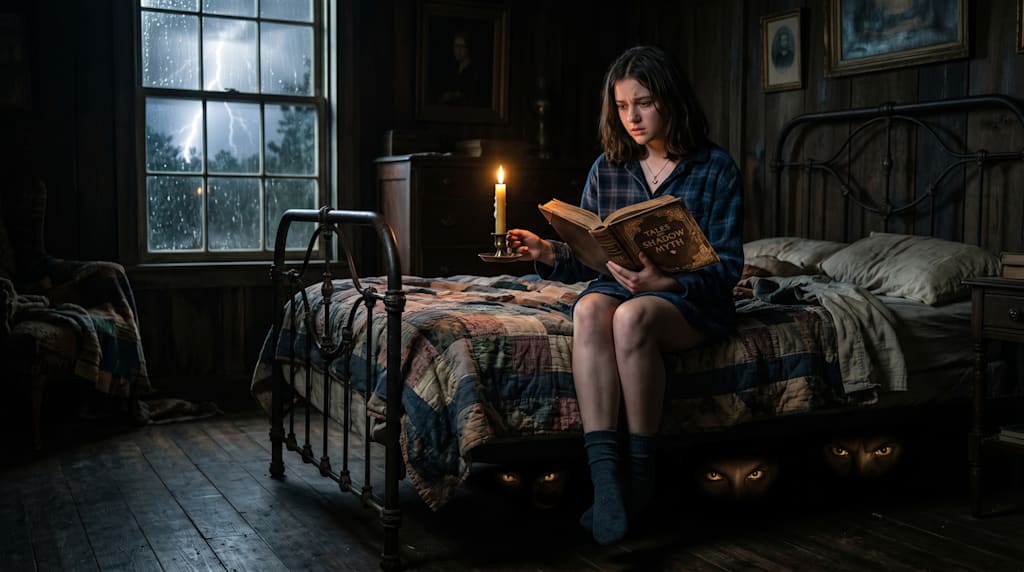
Rain tapped softly against the bedroom window the night Mira first heard the voice beneath her bed.
“Tell me a story.”
At first, she thought it was part of a dream.
She had spent the whole day helping her mother pack away her grandfather’s belongings after his funeral. Dusty books. Rusted keys. Old clocks that no longer ticked. The house itself felt exhausted, as though grief had soaked into the wallpaper.
Mira pulled the blanket tighter around herself.
Then the voice came again.
“Please.”
Not growling.
Not monstrous.
Lonely.
Mira sat upright so fast the mattress creaked.
The room was dark except for flashes of lightning outside. Her grandfather’s old house groaned in the storm, wood sighing beneath the wind.
Slowly, carefully, Mira leaned over the side of the bed.
Nothing waited below except darkness.
But it was wrong somehow.
Too deep.
The shadows beneath the bed looked wider than the room itself.
“Mira,” the voice whispered. “A story for a story.”
Her throat tightened.
“Who are you?”
A pause followed.
Then:
“I don’t remember anymore.”
That answer frightened her more than if it had said demon or ghost.
Mira scrambled backward until her spine hit the wall.
“You’re not real.”
“Neither are nightmares,” the voice replied softly. “Until people feed them.”
Lightning flashed across the room.
For one second, Mira saw two pale eyes blinking beneath the bed.
Human eyes.
Almost.
Then darkness swallowed them again.
She didn’t sleep at all that night.
—
The next morning, sunlight made everything feel stupid.
There were no glowing eyes. No whispering voice. No endless darkness beneath the bed.
Just old wooden floors and stacked moving boxes.
Mira told herself grief was doing strange things to her mind.
Her grandfather had always filled the house with stories. Strange ones. Stories about rivers that remembered names. Forests that swallowed liars. Shadows that followed lonely children home.
“Stories are alive,” he used to say.
Mira had laughed whenever he said it.
Now she wasn’t laughing anymore.
That evening, rain returned.
At exactly midnight, the voice spoke again.
“Please.”
Mira froze beneath her blankets.
“You came back.”
“I never left.”
The shadows beneath the bed seemed to ripple.
Mira grabbed the nearest object she could find: an old hardcover book from one of the unpacked boxes beside her bed.
“What happens if I tell you a story?” she whispered.
“You sleep peacefully.”
“And if I don’t?”
Silence.
Then the thing beneath the bed answered quietly:
“I get hungry.”
A cold shiver crawled up her arms.
Mira opened the book with trembling fingers.
It was one of her grandfather’s journals, filled with handwritten stories and sketches.
She cleared her throat.
“Once,” she began shakily, “there was a fisherman who caught the moon in his net…”
As she read, the room changed.
The storm outside softened.
The darkness beneath the bed became still.
And for the first time since her grandfather died, Mira felt calm.
When she finished, the voice whispered:
“That was beautiful.”
Then silence.
Real silence.
Mira slept deeply that night.
—
It became a ritual after that.
Every midnight, the thing beneath the bed asked for a story.
And every midnight, Mira gave it one.
Sometimes she read fairy tales.
Sometimes myths.
Sometimes stories her grandfather had written himself.
The creature always listened quietly.
Never interrupting.
Never threatening.
But Mira noticed something strange.
The more stories she told, the weaker the nightmares became.
The terrible dreams haunting her since the funeral slowly disappeared.
Her fear faded too.
Curiosity replaced it.
“What are you?” she finally asked one night.
The darkness beneath the bed shifted uneasily.
“A place,” the voice answered.
“That doesn’t make sense.”
“It used to.”
Mira sat cross-legged on the mattress.
“Try.”
For a long while, only rain answered.
Then:
“Long ago, people buried their nightmares somewhere. They needed somewhere dark to place fear, grief, anger, guilt. Humans cannot carry those things forever.” The voice trembled slightly. “I became that place.”
Mira stared downward.
“You eat nightmares?”
“I keep them.”
A beat passed.
“But lately…” the voice whispered, “there have been too many.”
Mira thought about the world outside.
Wars on television. Angry crowds online. Loneliness in schools. People hurting each other for no reason.
Too many nightmares.
“What happens if you can’t hold them anymore?” she asked softly.
The shadows beneath the bed moved violently for the first time.
Lightning exploded outside.
And suddenly the room looked wrong.
The darkness spread across the floor like spilled ink. Faces appeared inside it for brief horrifying moments — screaming mouths, crying eyes, twisted expressions of rage and sorrow.
Mira gasped.
“This,” the creature said painfully.
The shadows quickly shrank back beneath the bed.
The room fell silent again.
“I’m sorry,” it whispered.
Mira’s heart pounded.
For the first time, she realized the creature was not dangerous because it wanted to hurt people.
It was dangerous because it was breaking.
—
Days passed.
Mira stopped going out much.
At school, she barely listened.
All she could think about was the thing beneath her bed growing weaker every night.
One evening, she searched through her grandfather’s attic for answers.
Dust covered everything.
Old maps. Candles. Strange symbols carved into wooden boxes.
Then she found a letter.
Her name written on the front in shaky handwriting.
Mira opened it carefully.
If you are reading this, the letter began, then the Keeper has chosen you.
Her stomach dropped.
Do not fear it. The Keeper only becomes monstrous when abandoned. It survives on stories because stories are how humans survive pain. Every story told with honesty lessens the weight of darkness.
Mira kept reading until her hands trembled.
One day, it will ask something difficult of you.
That night, midnight arrived with terrible silence.
No whisper came.
Mira slowly leaned over the bed.
“Hello?”
Nothing.
Then weakly:
“I’m tired.”
The darkness beneath the bed had shrunk into something tiny.
Two fading eyes stared upward.
“Tell me a story,” it begged softly.
Mira swallowed hard.
“I don’t have any left.”
“Yes you do.”
She frowned.
“What story?”
The Keeper’s voice became almost human.
“Yours.”
Mira froze.
“No.”
“Please.”
Tears burned her eyes unexpectedly.
Because her story was ugly.
It was grief and loneliness and anger at her grandfather for dying.
It was fear.
But slowly, shakily, Mira began speaking.
She told the darkness about the hospital room.
About pretending to be strong at the funeral.
About feeling abandoned.
About being terrified that one day everyone she loved would disappear.
The room listened quietly.
When she finished, tears streamed down her face.
And beneath the bed, the darkness glowed softly like candlelight.
“Thank you,” the Keeper whispered.
For the first time, Mira understood.
Stories were not food.
They were healing.
The shadows beneath the bed slowly dissolved into warm golden light.
The endless darkness vanished.
And somewhere in the old house, her grandfather’s clock finally began ticking again.
Years later, Mira would become a writer famous for strange emotional stories about grief and monsters and lonely things hiding in darkness.
Readers always asked her where she got her ideas.
She only smiled and answered:
“Every nightmare wants someone to listen.”
About the Creator
Enjoyed the story? Support the Creator.
Subscribe for free to receive all their stories in your feed.
Comments
There are no comments for this story
Be the first to respond and start the conversation.