
Rejuran Healer Black Volume per Syringe and per Box
The standard REJURAN presentation described on PharmaResearch's product page contains 2 cc in each syringe and two syringes in each pack.

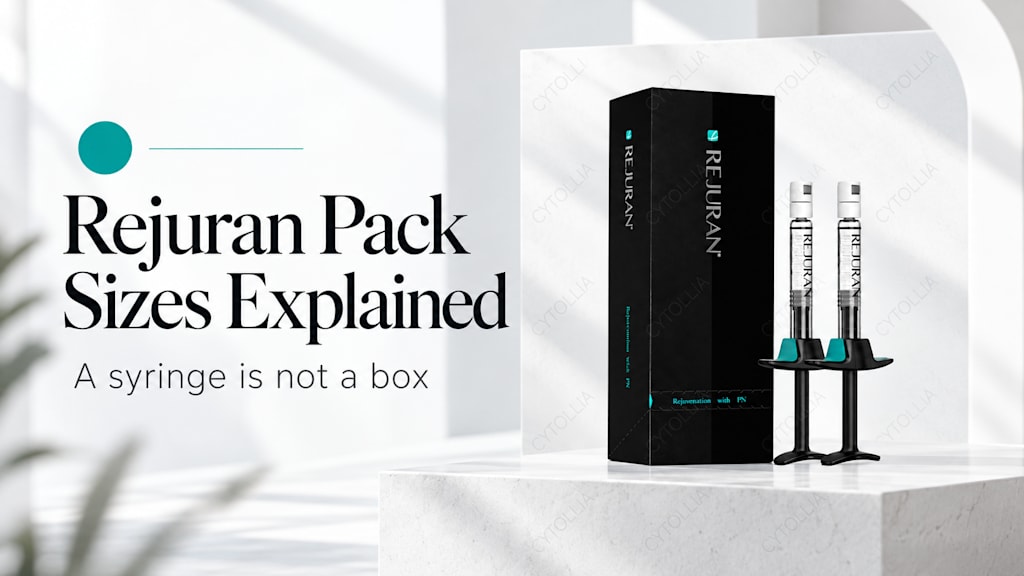
Because 1 cc equals 1 mL, that means 2 mL per syringe and 4 mL per box. The distinction between the syringe and the box is the essential answer to the common question about how much product one unit contains. [1, 2]
The question becomes less straightforward when a seller uses unit to mean either a syringe or a sealed box. Product nicknames, photographs, and other members of the REJURAN range can add to the confusion. The most reliable approach is to pair the volume with its packaging level every time: milliliters per syringe, syringes per box, and total milliliters per box.
Read the three quantities as one specification
The Rejuran Healer Black listing describes a 2 × 2 mL presentation. In this notation, the first number is the syringe count and the second is the volume of each syringe. Multiplying them gives 4 mL in the advertised box. It does not mean that one syringe contains 4 mL.
For an ordering system, the full entry should preserve all three values. Recording only 2 mL loses the box count, while recording only 4 mL loses the individual container size. Both omissions can cause confusion later when a quotation, invoice, or delivery note uses a different commercial unit. A complete description makes the arithmetic transparent to everyone reviewing the order.
Packaging level
Quantity in this presentation
How to record it
One syringe
2 mL
Syringe volume
One sealed box
Two syringes
Syringe count per box
Total contents of one box
4 mL
Two multiplied by 2 mL
Three complete boxes
Six syringes and 12 mL
Stock quantity, not treatment quantity
The last row is inventory arithmetic. It does not imply how many treatments the stock represents or how the contents should be used. Those are different questions. A pack-size explanation is most useful when it stays focused on what has been purchased and avoids converting the number of milliliters into a clinical plan.
Why cc and mL mean the same volume
The abbreviation cc means cubic centimeter. A milliliter is equivalent to one cubic centimeter, so 2 cc and 2 mL describe the same volume. The International System of Units provides the relationship between liters and cubic units. Using mL consistently in a stock system can make records easier to compare while preserving the original label wording in the attached documentation. [2]
Neither notation describes ingredient concentration. A syringe marked 2 mL does not therefore contain a 2% formulation, and the number two does not establish how many milligrams of its principal ingredient are present. Concentration requires its own statement with units. Confusing those measurements can turn a correct package detail into an incorrect formula claim.
Volume also differs from the physical capacity of the syringe barrel. A photograph may show markings beyond the nominal fill volume or leave visible space in the assembly. The labeled product volume is the relevant quantity for the purchasing record. Estimating contents from the apparent size of a pictured syringe is less reliable than reading the product statement.
Confirm the product behind the Black nickname
Black is a useful retail shorthand for the familiar dark presentation, but color alone is not a complete product identifier. A packaging design can change, photographs can be reused, and a distributor may shorten the name. Match the nickname to the actual manufacturer product name and the 2 mL × 2 presentation rather than treating the color as a specification.
PharmaResearch's manufacturer page calls the product REJURAN and identifies its principal ingredient as polynucleotide, or PN. That source establishes the terminology used by the manufacturer for the product reviewed here. A purchasing record can include Healer Black as a searchable seller nickname while retaining the manufacturer name and presentation as the core identity. [1]
The broader REJURAN range includes differently named variants, so a result for one family member should not be assumed to describe all of them. When a quotation uses a suffix or an additional descriptor, compare its label and documentation separately. Do not copy the 2 mL × 2 configuration into every REJURAN entry simply because the brand name is shared.
PN and PDRN wording should not be silently substituted
Retail listings sometimes place PN and PDRN together in titles or descriptions. The manufacturer page for the REJURAN product discussed here specifies PN. That is the term to preserve in an accurate formula record. A search-friendly title that includes PDRN does not by itself demonstrate that the supplied formulation is identical to a different product described under that term.
For a pack-size article, there is no need to infer molecular characteristics from the product name. The practical task is to identify the formula using current manufacturer documentation. If a quotation and a label use different terminology, ask for clarification rather than choosing the more familiar abbreviation. This keeps a packaging question from spreading an unsupported claim about composition.
Similarly, PN content should not be used to infer a syringe's nominal volume. Formula identity and fill volume belong in separate fields. A record that says only PN product, 2 mL lacks the brand and box configuration. A record that says only REJURAN box lacks the individual syringe volume. Neither is sufficiently precise for comparing complete offers.
Understand what the product photograph can establish
The familiar product image shows the dark REJURAN presentation alongside two syringes. That is consistent with the advertised two-syringe configuration, but the written label remains important. A promotional photograph can be a composite, a representative image, or a display of selected components. Counting objects in the image should support the description rather than replace it.
Look for agreement between the manufacturer name, product name, stated volume, and syringe count. If a seller's image shows a different variant from the written description, resolve the mismatch before comparing price. The same principle applies when a box photograph is too small to read. Request a legible label instead of enlarging an indistinct image and guessing at the text.
At receipt, the current supplied packaging matters more than the appearance of the online photograph. Match it to the order and retain the lot and expiry information with the shipment record. A visual resemblance can help identify an item, but it should not be presented as proof of authenticity by itself. Traceable purchasing documentation answers a different and more substantial question.
Compare quotations at the same packaging level
Consider two hypothetical quotations. The first lists one syringe for $80, and the second lists one two-syringe box for $150. The first price is lower as written, but two syringes would cost $160. On a matched quantity basis, the second offer is $10 lower before any other charges. These invented figures illustrate unit normalization, not current market pricing.
The comparison should still confirm that both offers concern the same version and acceptable commercial presentation. Freight, remaining shelf life, and documentation can affect the decision. A price per milliliter can help organize the arithmetic, but it cannot establish product equivalence or clinical value. Those depend on other information that a volume calculation cannot provide.
When requesting a quotation from Cytollia, specify whether the desired quantity is complete boxes or individual syringes and restate the expected 2 mL × 2 presentation. Ask the supplier to use the same unit on the quotation and invoice. This simple wording prevents the most common ambiguity before the order enters the purchasing system.
Keep unopened stock and opened contents distinct
Two separately packaged syringes should be represented as two units within one box, rather than as one undifferentiated 4 mL container. The packaging structure matters when reconciling stock and checking what remains unopened. It also prevents the box total from being mistaken for a single syringe size in an internal catalog or product description.
Container size is not permission to reuse opened contents. CDC guidance on injection safety distinguishes single-dose and multidose containers and emphasizes appropriate handling of single-use products. For the product itself, follow its supplied labeling and the requirements of the clinical setting. Inventory arithmetic should never be used to create a reuse assumption that the documentation does not support. [3]
Frequently asked volume questions
How many cc are in one syringe
For the manufacturer presentation discussed here, one syringe contains 2 cc, equivalent to 2 mL. Keep the product version attached to that answer. A different REJURAN variant should be checked against its own label rather than assumed to share the same configuration.
How many milliliters are in one box
The two-syringe box contains 4 mL in total because each syringe holds 2 mL. State both the individual volume and the count when ordering. Writing only 4 mL can incorrectly suggest that the box contains one larger syringe.
Does 2 mL mean a two percent concentration
No. Milliliters measure volume, while a percentage describes a composition only when its basis is defined. The concentration must be verified separately from the fill volume. A number on the syringe cannot be repurposed as a formula percentage.
Is Black enough to identify the exact product
It is a useful nickname, but it should be paired with the manufacturer name and presentation. Color and retail naming alone are incomplete identifiers. Use the current label to distinguish the product from other variants and from older packaging images.
Can a box price be compared with a syringe price
Yes, after both are converted to the same quantity and the product identity is confirmed. Include any additional charges separately. The comparison should say explicitly whether it is per syringe, per complete box, or per labeled milliliter.
Make the pack description unambiguous
For the REJURAN presentation reviewed here, retain the complete statement: two syringes per box, 2 mL per syringe, 4 mL total. Use it consistently across quotations, product records, and receipt checks. That gives a short volume answer the precision needed for a sound purchasing record.
References
1. PharmaResearch. REJURAN. Manufacturer product information, undated; accessed October 10, 2026.
2. Bureau International des Poids et Mesures. The International System of Units (SI). 9th edition, 2019; version 4.01, June 2026.
3. Centers for Disease Control and Prevention. Preventing Unsafe Injection Practices. March 26, 2024.
About the Creator
Enjoyed the story? Support the Creator.
Subscribe for free to receive all their stories in your feed.
Comments
There are no comments for this story
Be the first to respond and start the conversation.