
My Mother Keeps Forgetting I Died
Every morning, she calls me downstairs for breakfast.
The first thing my mother forgot was my funeral.
Three days after they buried me, she called my phone while sitting in her living room chair beside the window.
“Daniel,” she said cheerfully when the voicemail picked up, “don’t forget dinner tonight. And bring bread home this time. We’re out.”
I listened from the corner of the room while rain tapped gently against the roof.
Dead people, apparently, don’t go very far.
At least not at first.
My mother had always been forgetful in small harmless ways. Misplaced glasses. Burnt toast. Names of actors she’d loved for twenty years.
But after I died, her mind began unraveling like loose thread.
The doctors called it grief mixed with early dementia.
I called it cruelty.
Because every morning she remembered me differently.
Some mornings I was ten years old again, asleep upstairs before school.
Some mornings I was thirty and “working too hard.”
And some mornings — the worst mornings — she remembered everything.
Those were the days she screamed.
Today seemed like a good day.
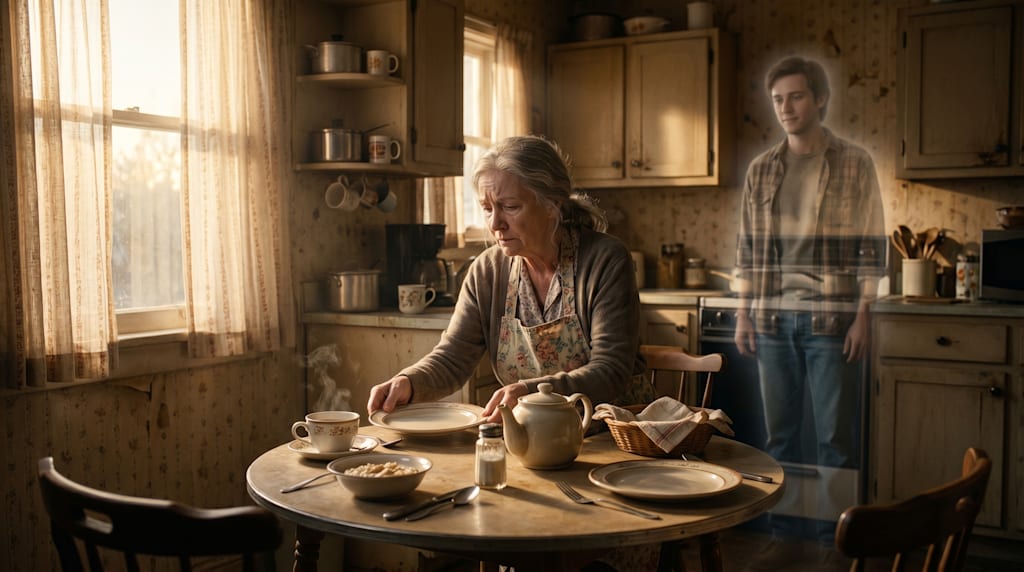
Sunlight spilled warmly through the kitchen curtains while she hummed to herself making eggs.
“For heaven’s sake, Danny,” she called upstairs, “you’ll be late for work.”
I stood beside the refrigerator watching her crack eggs into the pan with shaking hands.
She looked smaller now.
Grief shrinks people.
The house smelled the same as always: coffee, dust, old books, lavender soap.
Home.
She placed two plates on the table.
Still two.
Always two.
Then she smiled toward the empty staircase.
“Hurry up before it gets cold.”
I wanted desperately to answer her.
At first, after dying, I tried constantly.
I shouted.
Cried.
Broke things.
Nothing worked.
The living can’t hear the dead unless something inside them is already broken.
And my mother was beginning to break.
That afternoon she sat on the porch knitting while neighborhood children rode bicycles down the street.
She looked peaceful for once.
Then Mrs. Harper from next door approached carefully with a casserole dish.
People carried food to grieving houses like offerings to some ancient god.
“Afternoon, Elaine,” Mrs. Harper said gently.
My mother smiled.
“Oh hello! Danny should be home soon if you’d like to stay.”
The woman’s expression fell instantly.
That awful silence appeared.
The kind people use when truth feels dangerous.
Mrs. Harper swallowed hard. “Elaine…”
My mother frowned.
“What?”
The older woman hesitated.
Then softly:
“Danny passed away in February.”
I felt the entire porch change.
Like cold wind entering through an open door.
My mother blinked slowly.
For several seconds her face remained empty.
Then realization crashed into her all at once.
The knitting needles slipped from her hands.
“No,” she whispered.
Mrs. Harper immediately regretted it.
“You buried him,” she continued quietly. “Remember?”
“No.”
“Yes.”
“No!”
My mother stood so quickly the chair toppled backward.
“He was just here!”
Tears filled her eyes instantly — violent, terrified tears.
“He ate breakfast this morning—”
Mrs. Harper grabbed her shoulders gently.
“Elaine…”
And there it was.
That unbearable moment.
The exact second a grieving parent remembers their child is dead.
I would rather relive the accident a thousand times than watch that moment again.
My mother collapsed into sobs.
Not graceful crying.
Not cinematic grief.
Real grief.
Ugly grief.
The kind that twists the body apart.
I knelt beside her helplessly while she cried into her hands.
“I forgot again,” she whispered brokenly.
Mrs. Harper held her tightly.
“It’s alright.”
But it wasn’t.
Nothing about it was alright.
That night my mother wandered the house after midnight carrying old photo albums.
She stopped in my bedroom doorway for a long time.
The room remained untouched since the accident.
Soccer trophies.
Posters.
College books stacked crookedly near the desk.
A half-finished cup still sitting beside the window because she couldn’t bear washing it.
Parents turn bedrooms into museums after loss.
My mother sat slowly on the bed.
“You should yell at me,” she whispered into the darkness.
I sat beside her carefully.
“You should hate me.”
Her voice cracked.
“Forgetting you.”
I wanted to tell her she hadn’t forgotten me.
Not really.
Grief simply damaged the roads leading to memory.
Some paths vanished.
Others repeated endlessly.
But love remained underneath all of it.
She opened an old photo album with trembling fingers.
Pictures fluttered softly onto the blanket.
Birthday cakes.
School concerts.
Beach trips.
Tiny ordinary moments suddenly transformed sacred because they could never happen again.
Then she reached one photo and froze.
It was from my seventh birthday.
I wore a pirate hat made from newspaper while grinning with missing front teeth.
On the back, in her handwriting:
Danny laughing after pretending the cake was treasure.
My mother touched the photo carefully.
And suddenly—
She smiled.
Not because she forgot.
Because she remembered.
Not the hospital.
Not the funeral.
Not the phone call from police during rain.
Just me.
Alive.
Happy.
Real.
“I loved you so much,” she whispered.
For the first time since dying, something inside me loosened.
The room grew warmer somehow.
Softer.
My mother yawned quietly and lay down across the bed beside the photographs.
Within minutes, she fell asleep.
Outside, summer insects hummed gently in the darkness.
I sat beside her until dawn.
By morning, she would probably forget again.
She would call me downstairs for breakfast.
She would set out two plates.
And somewhere deep inside herself, she would continue searching every room for the son grief had stolen from her.
But now I understood something.
Love does not disappear when memory fades.
It waits.
Patiently.
Inside routines.
Inside old photographs.
Inside the instinct to place two plates on the table instead of one.
And maybe that’s what haunting really is.
Not ghosts refusing to leave.
But love refusing to disappear.
About the Creator
Enjoyed the story? Support the Creator.
Subscribe for free to receive all their stories in your feed.
Comments
There are no comments for this story
Be the first to respond and start the conversation.