
Best Supplements for Skin Health
Dermatologist-Backed Guide to Skin Supplements That Actually Work (2026)

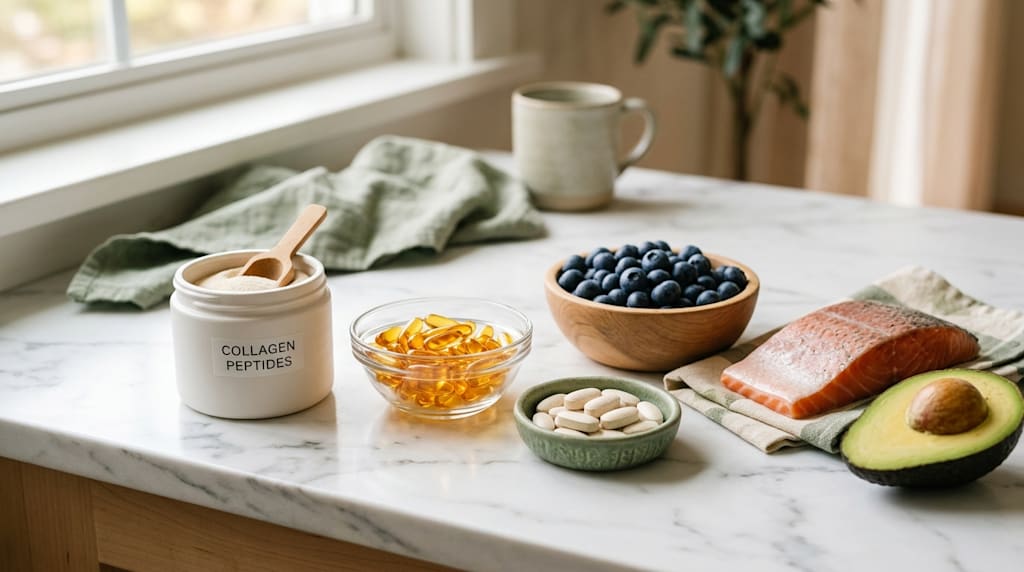
Topical skincare is excellent for surface maintenance. Serums, creams, and sunscreens protect the outermost barrier and hydrate the epidermis. However, if you want long-term structural resilience, deep hydration, and powerful environmental defense, you must look deeper.
Your skin’s elasticity, density, and youthful glow are fundamentally dictated by cellular processes occurring in the dermis—the deeper structural layer driven by the nutrients you ingest.
While many online guides offer generic vitamin lists, true dermal transformation requires an understanding of cellular mechanics, nutrient bioavailability, the Gut-Skin Axis, and the synergistic networks that govern skin health.
1. The Core Structural Builders: Collagen and Its Unsung Cofactors
A resilient skin matrix depends on high-quality structural proteins. Taking collagen alone, however, is often inefficient. To maximize its impact, your body requires specific biochemical cofactors to process and organize these proteins effectively.
+-----------------------------------------------------------------------+
|                       THE COLLAGEN SYNTHESIS TRINITY                 |
|                                                                       |
|   [ Hydrolyzed Peptides ]  --->  Raw structural building blocks      |
|   [ Vitamin C ]            --->  Essential enzyme activation          |
|   [ Copper ]               --->  Lysyl Oxidase cross-linking (Strength)|
+-----------------------------------------------------------------------+
Hydrolyzed Collagen Peptides: The Bioavailable Blueprint
Standard collagen and gelatin molecules are too large for optimal absorption in the digestive tract. When selecting a supplement, prioritize Hydrolyzed Collagen Peptides (specifically Low-Molecular-Weight Peptides or Tripeptides).
These smaller amino acid chains cross the intestinal barrier efficiently and are recognized by dermal fibroblasts—the primary collagen-producing cells—as signals to jump-start synthesis, targeting Type I and Type III collagen to improve skin elasticity and reduce fine lines.
The Non-Negotiable Role of Copper
A common gap in skincare advice is the total omission of essential mineral cofactors. You cannot form a stable, resilient collagen matrix without Copper.
Copper acts as an essential cofactor for lysyl oxidase, an enzyme responsible for cross-linking collagen and elastin fibers into a strong, interlocking web. This cross-linking provides your skin with its structural integrity and "snap-back" bounce.
Key Takeaway: Supplementing high doses of Vitamin C and Hydrolyzed Collagen without adequate Copper is like delivering lumber to a construction site without nails—the framework simply cannot hold.
Silica: The Matrix Strengthener
Complementing these elements is Silica, a trace mineral that stabilizes the connective tissue matrix and supports glycosaminoglycans (GAGs)—the water-binding molecules responsible for deep cellular hydration.
2. The Master Antioxidant Network: Synergistic Cellular Protection
Antioxidants do not work in isolation. To optimize skin health and combat photoaging, your supplement routine must leverage the body's natural Antioxidant Recycling Network.
[ Free Radical Damage ] ---> Neutralized by [ Vitamin E ]
                                               |
                                     (Oxidized / Inactive)
                                               |
  [ Regenerated Vitamin E ] <--- Restored by [ Vitamin C ]
                                               |
                                     (Oxidized / Inactive)
                                               |
  [ Regenerated Vitamin C ] <--- Restored by [ CoQ10 / PQQ ]
The Synergistic Recycling Loop
When Vitamin E neutralizes a harmful free radical generated by UV rays or pollution, it becomes oxidized and temporarily inactive. Vitamin C then steps in, sacrificing itself to regenerate Vitamin E back into its active protective form.
Simultaneously, intracellular energizers like CoQ10 and PQQ (Pyrroloquinoline Quinone) protect mitochondrial powerhouses and work to recycle Vitamin C. This self-sustaining loop maintains continuous defense within your skin cells.
Essential Vitamins for Radiant Skin
To maintain peak luminosity and barrier protection, focus on bioavailable forms:
Vitamin C (L-Ascorbic Acid / Liposomal): Essential for bright skin and collagen synthesis.
Vitamin E (Mixed Tocopherols): The primary lipid-soluble guardian of cell membranes.
Vitamin A (Retinoids / Bioavailable Beta-Carotene): Drives cellular turnover and smooths surface texture.
3. The Gut-Skin Axis: Why Your Microbiome Dictates Your Complexion
Systemic inflammation originating in the digestive tract frequently manifests on the skin as compromised barrier function, persistent redness, adult acne, and accelerated collagen breakdown. This critical connection is known as the Gut-Skin Axis.
+-------------------------------------------------------------------------+
|                          THE GUT-SKIN AXIS MECHANISM                    |
|                                                                         |
|  Gut Dysbiosis  -->  LPS Endotoxins Leak  -->  Systemic Inflammation     |
|                                                      |                  |
|  Compromised Skin Barrier  <-- Collagen Matrix Decay <-- Structural Stress|
+-------------------------------------------------------------------------+
Managing Systemic Inflammation
If your gut microbiome is imbalanced (dysbiosis), it can release inflammatory compounds like lipopolysaccharides (LPS) into circulation. These endotoxins trigger systemic immune responses that active enzymes (matrix metalloproteinases) that break down collagen and impair ceramide production.
Clinically Validated Probiotic Strains
Rather than taking generic probiotics, target specific, clinically studied strains that support skin immunity:
Lactobacillus johnsonii (Strain La1): Research shows this strain helps mitigate UV-induced immune suppression and accelerates skin recovery following environmental stress.
Lactobacillus paracasei (Strain NCC 2461): Studies indicate this strain modulates skin sensitivity, reinforces barrier function, and helps maintain optimal hydration levels.
Frequently Asked Questions: Internal Skincare & Aesthetics
What is the best supplement for overall skin health?
There is no single magic pill. The most effective protocol utilizes a three-pronged strategy:
Hydrolyzed Collagen Peptides (with Copper): Restructures the dermal matrix.
Stabilized Vitamin C: Drives enzymatic collagen synthesis and provides antioxidant protection.
Omega-3 Fatty Acids (EPA/DHA): Reinforces lipid barrier function and moderates systemic inflammation.
What are 5 superfoods for glowing skin?
In addition to targeted supplementation, incorporating nutrient-dense whole foods provides synergistic cofactors:
Wild-Caught Salmon: High in bioavailable protein and omega-3 fatty acids for lipid layer support.
Blueberries: Rich in anthocyanins and polyphenols that combat oxidative stress.
Avocados: Packed with healthy monounsaturated fats (oleic acid) and Vitamin E to lock in hydration.
Dark Leafy Greens (Spinach, Kale): High in Vitamin C, carotenoids, and Vitamin K for microcirculation.
Walnuts: Provide essential plant-based ALA omega-3s, zinc, and copper for structural support.
What vitamin deficiency causes sagging skin?
A severe or chronic depletion of Vitamin C is strongly linked to loss of elasticity and sagging. Because Vitamin C is the compulsory cofactor for prolyl and lysyl hydroxylase (the enzymes responsible for stabilizing collagen molecules), its absence causes newly formed collagen to be structurally weak and prone to rapid degradation.
Can you rebuild collagen in your face naturally?
Yes. While topical products primarily support the outer epidermis, internal targeted nutrition directly feeds the deeper dermal layer where active fibroblasts live. Consistently supplying low-molecular-weight collagen peptides, bioavailable Vitamin C, and copper delivers the exact biochemical signals needed to stimulate new Type I and Type III collagen synthesis.
Why has recommendations around fish oil changed recently?
The shift in guidance is not because Omega-3 fatty acids (EPA/DHA) are ineffective, but due to issues with oil oxidation. Polyunsaturated fats in low-quality fish oils easily oxidize when exposed to heat, light, or air. Consuming oxidized (rancid) oils introduces inflammatory free radicals into the body. To avoid this, choose stabilized triglyceride-form (rTG) fish oils that are third-party tested for purity and freshness.
Who should exercise caution with high-dose Omega-3 supplements?
Individuals taking blood thinners (anticoagulants or antiplatelets like warfarin or aspirin) or those with bleeding disorders should consult a physician before using high-dose Omega-3 supplements, as EPA and DHA possess mild anti-platelet properties. High-dose supplementation is typically paused two weeks prior to elective surgical procedures.
Achieving resilient, glowing skin requires more than surface-level care. By addressing cellular mechanics, optimizing collagen cofactors, supporting the master antioxidant network, and nurturing the gut-skin axis, you can effectively rebuild and maintain your skin's structural integrity from the inside out.
About the Creator
Edward Smith
I write on ANYTHING & EVERYTHING from fictional stories,Health,Relationship etc.Need Me or my service?Email [email protected].Please Buy me a coffee here Ko-fi.com/dralex & Get ONLY The Best Health Supplement here https://lnk.bio/dralexx
Enjoyed the story? Support the Creator.
Subscribe for free to receive all their stories in your feed.
Comments
There are no comments for this story
Be the first to respond and start the conversation.