
Why We Recognize a Song Before We Remember Its Name
What ultra-short audio clues reveal about music memory, familiarity, and the strange gap between recognition and recall.
What ultra-short audio clues reveal about music memory, familiarity, and the strange gap between recognition and recall.
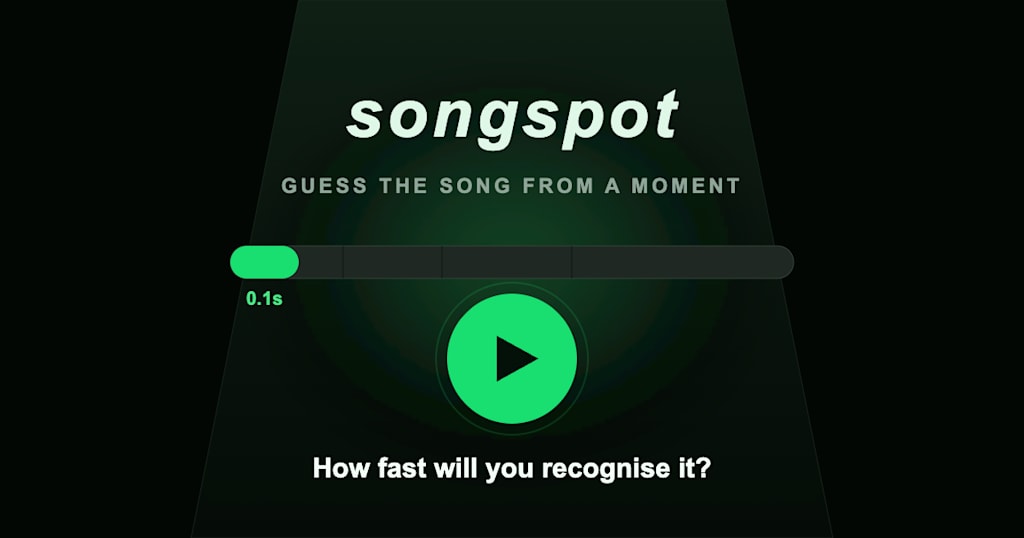
I recently noticed something strange while experimenting with Songspot, a music guessing game that begins with only 0.1 seconds of audio.
Sometimes that tiny fragment is enough to trigger an immediate reaction:
“I know this song.”
But then something frustrating happens.
You cannot remember the title.
You may recognize the artist. You may know exactly what the next few seconds sound like. You may even remember when and where you first heard the track.
But its name refuses to appear.
That small gap between recognizing music and actually recalling its title turns out to be one of the most interesting things about music memory.
Your Brain Recognizes More Than Melody
When we think about remembering a song, we usually think about the obvious things.
Lyrics.
Melody.
The chorus.
Maybe a famous guitar riff.
But a recording contains far more information than that.
After listening to the same song repeatedly, your brain may also become familiar with:
the exact sound of the first drum hit
a singer’s vocal texture
the attack of a guitar chord
a particular synth tone
the amount of reverb
background ambience
production effects
the rhythm of the opening
even a tiny sound before the song properly begins
Most people never deliberately memorize these details.
They simply become familiar through repetition.
Eventually, those small details can work like an audio fingerprint.
That is why a tiny fragment can sometimes be enough for your brain to say:
“I have heard this before.”
Recognition Is Faster Than Recall
Recognition and recall sound similar, but they are not the same experience.
Recognition happens when something feels familiar after you encounter it again.
Recall means retrieving the information without being given the full answer.
Music makes the difference easy to notice.
Someone could ask:
“What was that song you listened to constantly five years ago?”
You might have no idea.
But play half a second of the recording and suddenly everything comes back.
The information was apparently still somewhere in memory.
It just needed the right trigger.
This is one reason a guess the song game can feel very different from traditional trivia.
You are not simply testing whether you know a fact.
You are testing how quickly sound activates memory.
What Can You Actually Hear in 0.1 Seconds?
Very little.
A tenth of a second is so short that you usually cannot hear a complete lyric or melody.
Sometimes all you receive is a transient — the very beginning of a sound.
Yet that can still contain information.
A drum has a particular character.
A vocalist has a recognizable texture.
A guitar may have a distinctive tone.
A recording may have production qualities strongly associated with a certain artist or era.
At 0.1 seconds, you are not really analyzing the music.
You are reacting to it.
That makes the first clue feel almost instinctive.
Then 0.5 Seconds Changes Everything
Half a second still sounds tiny.
But compared with 0.1 seconds, it provides much more information.
Now an instrument may become obvious.
The beginning of a rhythm may appear.
A vocal sound may last long enough to identify the singer.
A chord may start to take shape.
You might not know the exact song yet, but your brain has more clues to work with.
Two Seconds Is Where Memory Starts Catching Up
Two seconds can feel completely different.
Suddenly there may be enough information for an actual hypothesis.
Instead of thinking:
“This sounds familiar.”
you begin thinking:
“Wait… is this that song by…?”
This is the moment recognition begins turning into recall.
A name appears.
Then disappears.
Then another possibility comes to mind.
You may mentally hear the next part of the song before the audio even plays.
That is a good sign that the recording is already deeply stored in memory.
Eight and Fifteen Seconds Add Context
At eight seconds, familiar songs often become much easier to identify.
You may hear:
a recognizable vocal phrase
part of the melody
a distinctive rhythm
a famous instrumental section
By fifteen seconds, there is considerably more context.
The interesting part is that difficulty remains personal.
A fifteen-second clip from an unfamiliar genre can still be much harder than a 0.1-second clip from your favorite artist.
Your Listening History Becomes the Difficulty Setting
There is no universal definition of an easy song.
A track that feels obvious to you may be completely unknown to someone else.
Someone who listened to 2000s pop every day may recognize songs from that period almost instantly.
A rock fan may react strongly to guitar tones.
A hip-hop listener might recognize a beat or production style.
Someone interested in music production may hear details most casual listeners ignore.
Your own listening history becomes part of the challenge.
This is also why exploring different music quizzes and song challenges can reveal surprisingly specific strengths.
You may think you know music broadly, only to discover that you are much better at identifying one decade, genre, or style than another.
Everyone Hears a Different Clue
One of my favorite parts of music recognition is asking someone how they knew the answer.
Imagine three people hearing exactly the same tiny clip.
Two people have no idea.
The third immediately names the song.
Everyone asks:
“How did you know that?”
And the answer might be:
“The drum sounded familiar.”
Or:
“I recognized the singer’s breath.”
Or:
“That guitar tone gave it away.”
The clue that matters to one listener may be completely meaningless to another.
We may be hearing the same recording, but we are not necessarily listening to the same details.
Music Can Unlock More Than the Song
Music memory also has an emotional dimension.
A tiny sound can bring back much more than a title.
A particular recording may remind you of:
a specific year
a school
a road trip
a person
a game
a movie
a place
a period of your life
Sometimes the memory arrives almost instantly.
You hear the beginning of a track and suddenly remember an entire situation you had not thought about in years.
That may be another reason music recognition can happen so quickly.
Your brain is not always searching only for the name of a song.
It may be connecting the sound to a much larger network of memories.
Short Audio Changes How You Listen
After spending time with extremely short clues, I started paying more attention to song intros.
What is actually happening in the first second?
What is the first instrument?
How long does it take before the vocal begins?
Does the song start with silence?
Is there a distinctive sound effect?
Would I recognize this recording if everything except the first tenth of a second disappeared?
Songs I had heard hundreds of times suddenly became more interesting.
The details were always there.
I simply had no reason to notice them.
Try the Experiment Yourself
Think of one of your favorite songs.
A track you know so well that you could probably hear the next section in your head.
Now imagine only being allowed to hear:
0.1 seconds.
Would you recognize it?
What about:
0.5 seconds?
2 seconds?
8 seconds?
15 seconds?
If you want to find out, you can test your music memory with Songspot and resist the temptation to immediately reveal the longer clue.
Give your brain a few seconds first.
Ask yourself:
Does this feel familiar?
Do I know the artist?
Can I remember the title?
What specific sound am I recognizing?
Some songs may require fifteen seconds.
Others may only need one tiny fragment.
And when you finally identify a track from almost nothing, the most interesting question may not be whether your answer was correct.
It may be:
What did your brain recognize before you even knew you recognized it?
About the Creator
Enjoyed the story? Support the Creator.
Subscribe for free to receive all their stories in your feed.
Comments
There are no comments for this story
Be the first to respond and start the conversation.