
TH3ION — Korakotheletros
Harsh EBM as an oracle of air and ash — ten instrumental rites under the will of the raven, where dream, death and prophecy speak with a single black voice.
The raven does not foretell. The raven wills. What it speaks has already been decided — and you were only ever the last to hear it.
Korakotheletros: the will of the raven, the prophetic intent. Not a record about glimpsing a fate, but about a fate that arrives already chosen and breathed into the sleeper's ear. Ten instrumental movements of harsh EBM, cut with cinematic, neo-noir depth — an oracle that takes no questions and delivers verdicts.
The Children of Night
The rite opens in the oldest house there is. Hesiod set the genealogy down long ago: Night bore Sleep and Death as twin brothers, and the tribe of Dreams alongside them. So the first two movements — the dreams, and then Death itself — are not two subjects but two siblings standing at the same door. To dream is to rehearse the crossing; to die is to dream and not come back. Everything on this record passes between those two.
Thanatos
The album's pilot, and its one vision in motion, is Thanatos. Not the scythe and the grin of later centuries — the Greek figure is quieter and far worse: the soft-handed brother of Sleep, who never hunts and never hurries, because he does not need to. In its film the ravens gather and the sky detonates; a priestess in lace and leather turns her ritual dance, intercut in strobing monochrome with temples, with reliefs where older bodies are caught mid-frenzy, with the black cloud rising and spreading over everything. She does not flee the bird. She receives it.
The Black Breath
Air governs this rite — and here air is not sky, not lightness. It is the eruption column: the blast, the ash cloud, the raven-coloured plume that climbs and opens like a wing across the world and turns noon into night. It is the earth's breath made visible and made poison: sulphur carried up into the air we take in. There is an old secret folded into the name TH3ION — in Greek, theion means the divine, and theion also means sulphur. Godhead and brimstone, written with the very same letters. This record is where that double word becomes a breath you cannot refuse. At Delphi the ancients told of vapours rising from a cleft beneath the priestess, and of a woman who inhaled them and spoke with a voice that was not her own: prophecy has always been something you breathe. And in the land of remorse, where Ernesto De Martino found the bitten of Salento dancing their venom out, the cure itself came through the air — sound is only air made to tremble, and it entered the body and drew the poison up. Air brings the god. Air brings the antidote. Air is how the invisible gets in.
What Watches from the Blur
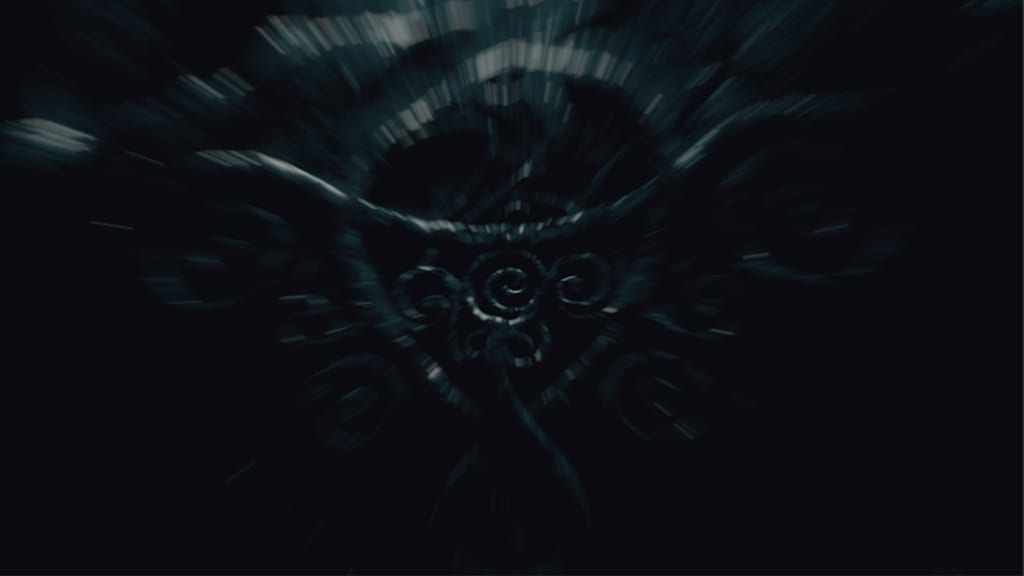
Look before you listen. The cover is almost lightless: a blue-black vortex, everything smeared and dragged toward a centre, as though the image itself were being pulled through. And there, at the vanishing point, a mark resolves out of the dark — the raven, coiled into a sigil, spirals set where eyes should be. Not a portrait of a bird but an archaic magic sign, the kind once cut where two worlds touch, to call a power through and hold it in place. It is the rite's true name, set down before a note sounds. Keep looking. The blur is not the image losing focus. It is the image approaching.
The Bird Made Black by Truth
The raven is Apollo's, and Apollo's ravens are never innocent. The old story tells of the bird that flew to the god with news he did not want, and was scorched from white to black for the crime of being right: the messenger blackened by the truth it carried. That is the creature presiding here — prophecy as something that costs, sight as a stain that does not wash out. And it belongs to Apollo: the lucid god, the god of measure and light. But the Orphics knew what the pilgrims at Delphi never noticed — that Apollo holds that sanctuary only through the bright months and hands it to Dionysus for the dark ones, and that under the two names a single power is breathing. Reason and delirium are not opponents. They are one god, turned. So this record does what should be impossible: it thinks and it raves in the same instant. Pure thought is set to work, cold as marble — and at that exact moment the body is taken. Here, lucidity is the possession.
Dream, and the Will Inside It
The deepest movement is the will applied to the dream: the sleeper who wakes inside the sleep and finds that desire is the only law still standing. Georges Bataille understood the erotic and the sacred as one transgression seen from two faces; the dream is where that turns literal, where the veil goes and what is wanted simply is. The priestess of these visions is herself an oneiros, a dream handed a body — the woman of now and the maenad of three thousand years ago, one continuity, one hunger, carried across the centuries and still not spent.
The Knot
At the end come the things said — the legomena, which in the old mysteries were spoken to initiates and to no one else; then the summoning, the dead answering from below; and last the knot, the intertwining, where all of it is bound into a single figure that cannot be picked apart again. Eliade's eternal return is the law here as everywhere: nothing is destroyed, everything comes back wearing another face. The raven has already spoken. It only remains for you to catch up.
Korakotheletros is not a set of tracks. It is a verdict, and an invitation to hear it. Breathe in. Let the black wing cross you.
The bird has decided. Surrender.
— TH3ION
About the Creator
TH3ION
TH3ION, born in Salento — land of Tarantism. Harsh EBM reinventing chthonic myth as a dark erotic rite, fusing primordial ritual with fractured modernity: a neo-noir portal where ancient ecstasy is reborn amid marble ruins and fatal beauty.
Enjoyed the story? Support the Creator.
Subscribe for free to receive all their stories in your feed.
Comments
There are no comments for this story
Be the first to respond and start the conversation.