
TH3ION — Kentrokathros
Harsh EBM as a rite of purification — ten instrumental movements where the venom that bites becomes the fire that heals, from the sands of Salento down to the underworld.
Kentron: the sting. Katharsis: the cleansing. Poison and cure meet at a single point — and that point is the centre of you.
Kentrokathros burns. It is the work the manifesto foretold when it spoke of the sting that purifies — and here that promise opens into a full liturgy: ten instrumental movements of harsh EBM, cut with cinematic, neo-noir depth, that do not describe a rite so much as carry it out.
The Land of Remorse
Salento again — the bitten ground. Ernesto De Martino called it la terra del rimorso, the land of remorse, where the tarantula's bite, the morso, could be undone only by days of music and dance until the poison had burned itself out. TH3ION takes that ancient pharmacology and runs current through it. What De Martino recorded as cure, and what Mircea Eliade would name an archaic technique of ecstasy, returns here as body-music: the beat as venom and antidote in one pulse, dissolving profane time, holding open the threshold where the sacred bleeds into the profane.
Pharmakeute — the Poisoner-Priestess
The album's pilot, and its first vision in motion, is Pharmakeute: she who handles the pharmakon, the Greek word that means, impossibly, both poison and remedy. Plato set the paradox loose; Derrida never let it close. She is the sorceress who prepares the draught that wounds in order to heal. The track is among the album's most ferocious — industrial, hammering, threaded with latent ethnic textures that surface like something remembered rather than played.
Ammos — Sand, and the Gate of Trial
If Pharmakeute is the rite's heart, Ammos is its gate. The project's trailer and its shortest breath — mechanical, industrial, weighted with metal — Ammos means sand: primordial matter, the hourglass, the desert where the seeker is stripped before being remade. Its imagery sets the grammar of everything to follow: Greek temples and erotic bas-reliefs scattered along the shoreline, alternating with a veiled woman in lace and leather who turns a ritual dance inside an abandoned seaside house, its walls marked with minimal Mediterranean geometries that soothe and unsettle in the same glance. She is no dancer. She is a priestess, and the sea behind her is older than all of us.
The Sign on the Black
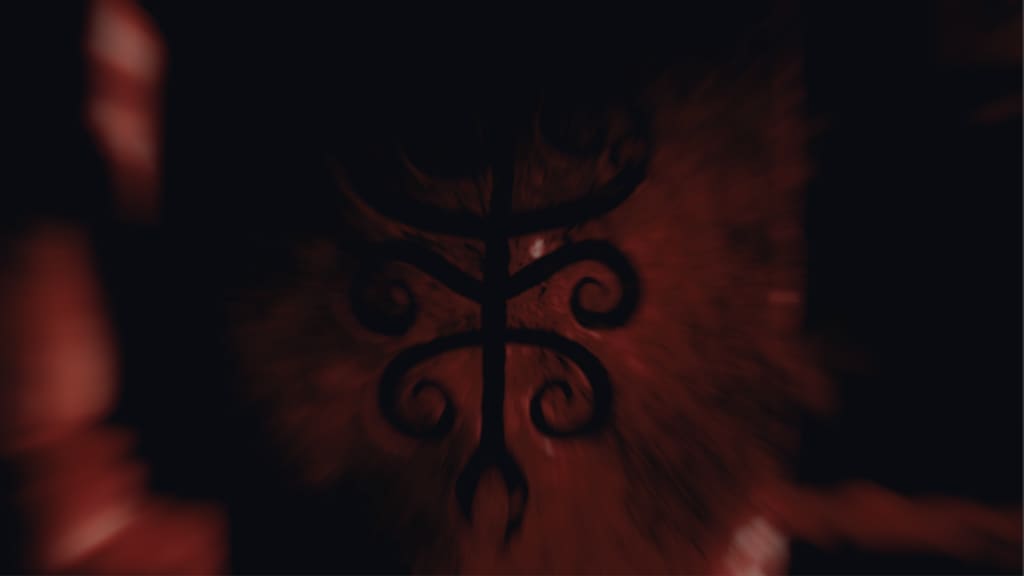
Look at the cover before you listen. Out of the dark and the blood-red rises a single black mark: the scorpion, drawn not as a creature but as a sigil — an archaic magic sign, the kind once scratched into thresholds to summon a power and to bind it. It is the album's true name, written before a single sound. It recurs through the film of Pharmakeute, watching from the edges, and it asks only one thing of you: that you cross it. The sting is already promised.
The Mountain that Burns
Fire governs this descent, and TH3ION lets it speak in its oldest voice — the volcano. Not warmth but eruption: the mountain that opens its throat, the red light beneath the skin of the world, combustion as the purest cleansing there is. The visions strobe in monochrome — femmes fatales in leather and lace turning through sanctums of black leather and marble, intercut with temples, with archaic reliefs of Bacchic rite, with maenads dancing possessed, the volcano breathing fire behind them all. This is what Nietzsche named the Dionysian: the intoxication that unmakes the self so that something vaster can pour through. Eros runs the same molten current; Georges Bataille knew the erotic and the sacred to be one transgression seen from two faces. The woman of now and the maenad of three thousand years ago are not two figures. They are one continuity — the sacerdotal body, carrying the same fire across the ages.
The Descent
The ten movements trace a single arc, from raw matter toward an infernal cleansing — sand and stone giving way to the poisoner's craft, to erotic frenzy and a mind set alight, to the secret company gathered in the dark, and at last to the catharsis that names the album, and the deeper one that closes it: the purification won only by passing through one's own underworld. Eliade's eternal return is the law of the record. Nothing is destroyed. Everything comes back transfigured. No one leaves the circle as they entered it.
Kentrokathros is not a set of tracks. It is a fire to walk into. Let the scorpion find your centre. What the venom takes, it returns as light.
The sting purifies. Surrender.
— TH3ION
About the Creator
TH3ION
TH3ION, born in Salento — land of Tarantism. Harsh EBM reinventing chthonic myth as a dark erotic rite, fusing primordial ritual with fractured modernity: a neo-noir portal where ancient ecstasy is reborn amid marble ruins and fatal beauty.
Enjoyed the story? Support the Creator.
Subscribe for free to receive all their stories in your feed.
Comments
There are no comments for this story
Be the first to respond and start the conversation.