
Redefining Creativity in 2026: How AI Music Generation Is Changing Who Gets to Make Music
AI Music Generation
Redefining Creativity in 2026: How AI Music Generation Is Changing Who Gets to Make Music
The idea of creating music once required years of training, access to instruments, and often collaboration with skilled producers. In 2026, that model is rapidly evolving. Artificial intelligence is not just assisting musicians—it is fundamentally reshaping how music is conceived, produced, and shared. What was once a specialized craft is becoming a widely accessible form of expression, opening the door for a new wave of creators.
AI music generation is no longer a novelty. It has matured into a powerful ecosystem that blends machine learning, user intent, and creative exploration. From generating full compositions to producing an AI cover of a favorite song or crafting original rap verses using an AI Rap Creator, the tools now available reflect a broader transformation across the creative industries.
The Shift Toward “Everyone Is a Composer”
One of the most significant changes brought by AI music technology is the democratization of creation. Traditionally, composing music required knowledge of theory, structure, and instrumentation. Today, AI systems can interpret simple prompts—text, mood descriptions, or even humming—and translate them into structured musical pieces.
This shift reduces the entry barrier dramatically. A person without formal training can now experiment with melody, harmony, and rhythm in ways that were previously inaccessible. Instead of spending years learning an instrument, users can focus on expressing ideas, emotions, or narratives, letting AI handle the technical execution.
This doesn’t eliminate the role of skilled musicians. Rather, it redefines their position. Professionals now use AI tools to accelerate workflows, test variations, or explore unconventional compositions. Meanwhile, beginners gain the confidence to participate in music creation, often for the first time.
The result is a more inclusive creative landscape where expertise and accessibility coexist.
AI Covers and the Evolution of Musical Identity
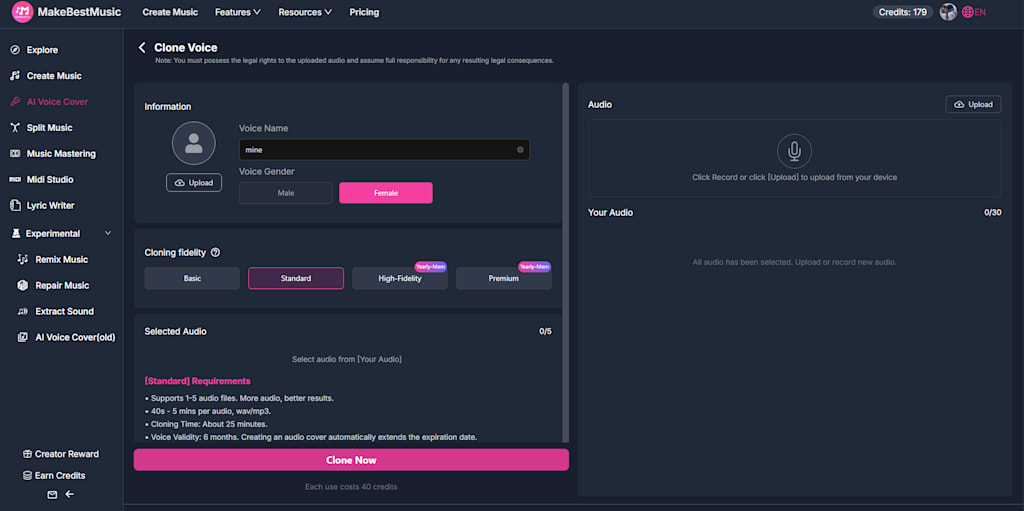
The rise of the AI cover has sparked both excitement and debate. These systems can replicate vocal styles, tonal qualities, and even emotional nuances associated with specific singers. Users can take an existing song and reinterpret it through a different vocal style, generating entirely new listening experiences.
This trend challenges traditional notions of authorship and identity in music. If a song can be performed in countless synthetic voices, what defines the “original” version? Is it the composition itself, the performance, or the emotional connection listeners form?
At the same time, AI covers are expanding creative possibilities. Independent creators can experiment with stylistic reinterpretations without needing access to professional vocalists. Fans can engage with music in more interactive ways, reimagining songs through different genres or tones.
However, this evolution also raises important ethical questions. The use of voice models inspired by real artists touches on issues of consent, ownership, and fair compensation. As the technology advances, regulatory frameworks and industry standards are likely to evolve alongside it.
AI Rap Creators and the Changing Nature of Lyricism
Rap has always been a genre deeply rooted in personal expression, storytelling, and cultural context. The introduction of AI Rap Creator tools adds a new layer to this tradition. These systems can generate lyrics based on themes, emotions, or stylistic cues, often mimicking the cadence and rhyme structures found in contemporary rap.
For aspiring artists, this provides a starting point. Writers experiencing creative blocks can use AI-generated verses as inspiration or scaffolding. Others may use these tools to explore different lyrical styles or experiment with multilingual rap.
Yet, the role of authenticity remains central. Rap audiences often value originality and lived experience. AI-generated lyrics, while technically impressive, may lack the depth that comes from personal narrative. As a result, many creators treat AI as a collaborator rather than a replacement—something that enhances creativity rather than defining it.
This collaborative dynamic reflects a broader trend across AI-generated content: the blending of human intent with machine-generated possibilities.
Industry Trends in 2026: Integration and Expansion
By 2026, AI music generation is no longer confined to standalone tools. It is increasingly integrated into larger creative workflows, spanning industries such as film, gaming, marketing, and social media.
1. Content Personalization at Scale
AI-generated music enables highly personalized experiences. Streaming platforms and content creators can generate soundtracks tailored to individual preferences, moods, or activities. Instead of selecting from a fixed library, users can experience music that adapts in real time.
This has implications for everything from fitness apps to immersive gaming environments, where dynamic soundtracks enhance engagement.
2. Faster Production Cycles
In industries where speed matters, such as advertising and digital media, AI music tools are reducing production timelines. What once required days or weeks of composition and editing can now be achieved in minutes. This allows creators to iterate quickly and respond to trends in real time.
### 3. Hybrid Creative Roles
The rise of AI music tools is giving birth to new creative roles. Instead of traditional composers alone, we now see “AI music curators” or “prompt designers” who specialize in guiding AI systems to produce desired outcomes. These roles combine artistic intuition with an understanding of how AI models interpret input.
### 4. Expansion of User-Generated Content
Platforms that rely on user-generated content are benefiting from AI music generation. Creators can easily add original soundtracks to videos, podcasts, or social media posts, enhancing production quality without requiring advanced skills.
This trend is particularly visible in short-form content, where music plays a critical role in capturing attention.
Creativity vs. Automation: A False Dichotomy?
A common concern surrounding AI music generation is whether it diminishes human creativity. If machines can compose music, does that make human effort less valuable?
In practice, the relationship is more nuanced. AI excels at pattern recognition and replication, drawing from vast datasets to generate coherent outputs. Human creativity, on the other hand, is often driven by emotion, context, and lived experience.
Rather than replacing creativity, AI shifts its focus. Creators spend less time on technical execution and more time on conceptual development—deciding what kind of music to create, what story to tell, and how to evoke specific emotions.
This shift can lead to more experimentation. When the cost of failure is low, creators are more willing to try unconventional ideas. AI becomes a sandbox for exploration, where boundaries are constantly pushed.
Ethical and Legal Considerations
As AI music generation becomes more widespread, ethical and legal challenges are becoming increasingly prominent.
Ownership and Copyright
Who owns an AI-generated song? The user who provided the input, the developers who built the model, or the dataset that trained it? These questions are still being debated, and different jurisdictions may adopt varying approaches.
Data Usage
AI models are trained on large datasets that often include existing music. Ensuring that this data is used responsibly—and that original creators are fairly recognized—is a critical issue for the industry.
Authenticity and Transparency
As AI-generated music becomes indistinguishable from human-created content, transparency becomes important. Audiences may want to know whether a piece of music was created by a human, an AI, or a combination of both.
Clear labeling and ethical guidelines could help maintain trust between creators and listeners.
The Emotional Dimension of AI Music
Despite its technical nature, music is ultimately about emotion. One of the most intriguing aspects of AI music generation is its ability to evoke feelings, even when the creator is a machine.
This raises interesting questions about the nature of emotional expression. Can a song generated by AI carry the same emotional weight as one written from personal experience? The answer may depend less on the origin of the music and more on how it is received by listeners.
In many cases, listeners form emotional connections based on context, memory, and interpretation. If an AI-generated song resonates with someone, its origin may become secondary to the experience it provides.
AI Music as a Medium for Storytelling
Beyond entertainment, AI music is increasingly being used as a storytelling tool. Individuals can transform personal experiences into songs, creating unique audio narratives that reflect their lives.
This is particularly relevant in contexts such as:
* Personal milestones (birthdays, anniversaries)
* Educational content
* Social media storytelling
* Independent filmmaking
By lowering the technical barrier, AI allows more people to explore storytelling through music. It becomes a medium not just for professional artists, but for anyone with a story to tell.
Looking Ahead: The Future of AI Music Creation
The trajectory of AI music generation suggests continued growth and integration. Future developments may include:
* More advanced voice synthesis with greater emotional nuance
* Real-time collaboration between humans and AI during live performances
* Improved customization based on user preferences and feedback
* Greater alignment between AI outputs and cultural or contextual understanding
At the same time, the industry will need to address ongoing challenges related to ethics, regulation, and artistic identity.
Conclusion
AI music generation in 2026 represents more than a technological advancement—it reflects a shift in how creativity is defined and who gets to participate in it. From AI cover experiments to the emergence of AI Rap Creator tools, the boundaries of music creation are expanding in ways that were once unimaginable.
Rather than replacing human creativity, AI is reshaping it, offering new tools, new possibilities, and new questions. As the technology continues to evolve, the most important factor will not be what AI can do, but how people choose to use it.
In this new landscape, music is no longer limited by technical skill or access to resources. It becomes a more universal language—one that anyone can speak, with the help of intelligent systems that turn ideas into sound.
About the Creator
Enjoyed the story? Support the Creator.
Subscribe for free to receive all their stories in your feed.
Comments
There are no comments for this story
Be the first to respond and start the conversation.