
'Mirror to the Sky' – For Those Who Wish to Seek
Reflect It All

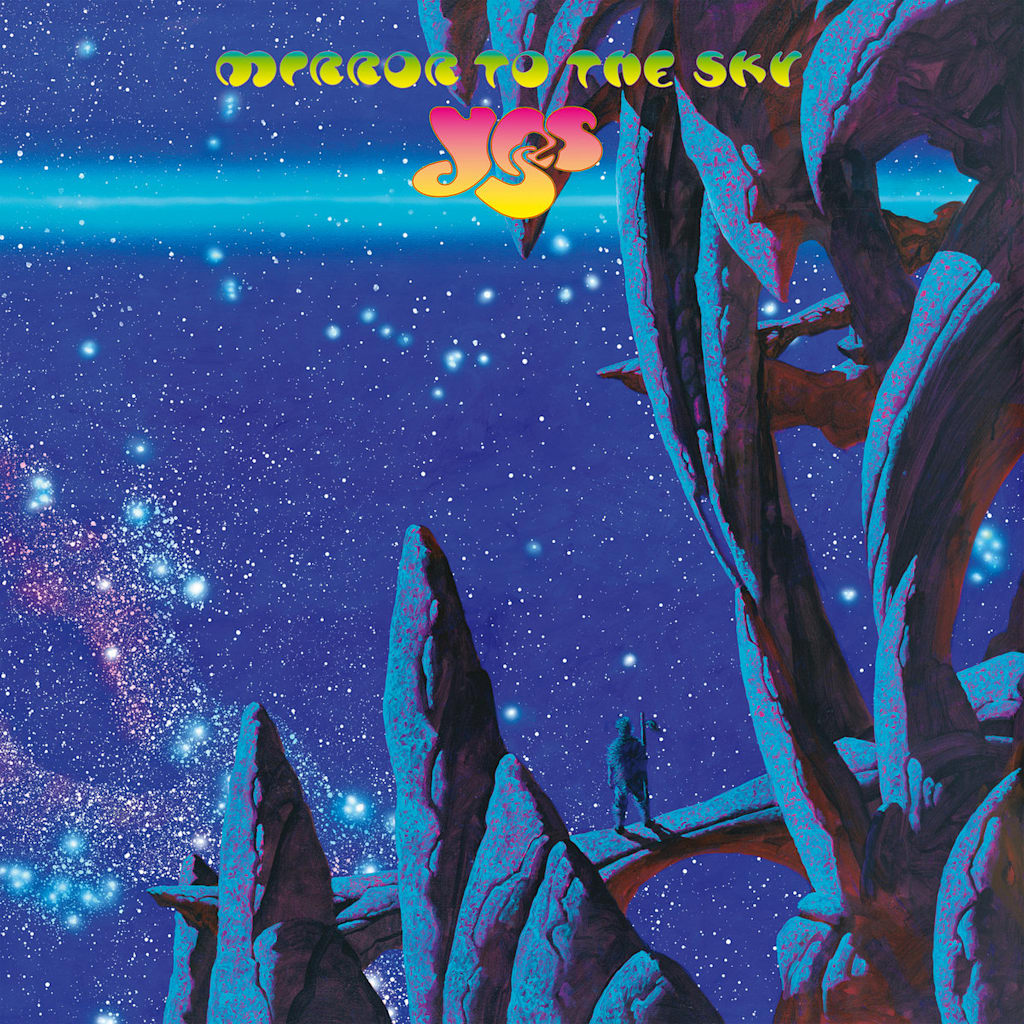
After the band Yes released the album The Quest in October 2021, their first new full-length studio album since 2014's Heaven & Earth, fans now had an idea of what the 2020s iteration of Yes were capable of composing. Some like myself really enjoyed much of the music, while others were mixed on it or flat out did not like it. Whether one was all in or not, there was the curiosity of where they could go if they made another new album.
During early development of the next album, Yes fans were concerned for the band's longtime drummer Alan White, who had first joined the band in 1972 and never stopped being in the band apart from the brief break-up in the early 1980s. He had been going through health issues, and it was announced that he would be sitting out 2022's tour celebrating the 50th anniversary of the Close to the Edge album. Unfortunately, he passed away on May 26, 2022, after a brief illness. His loss was heavy on the fans. A tribute concert was held in honor of Alan in Seattle that October, which included friends, collaborators, and Yes members past and present, whether it be via in-person performance or video message, heartfelt either way. And there is a documentary about Alan in the works from One Take LLC which is said to include footage from this concert.
Yes continued on, with Jay Schellen, who had been assisting Alan on drums since 2016, taking on the role in full. He had contributed percussion on The Quest, but would now take on all of the drumming duties for the new album Mirror to the Sky, released May 19, 2023. Continuing onto this album were Steve Howe on guitar (and in the producer role once again), Billy Sherwood on bass, Jon Davison on vocals, and Geoff Downes on keyboards. Also returning for this album were Curtis Schwartz on engineering and mixing duties, and Paul K. Joyce providing orchestral arrangements on certain songs, performed by the FAMES Orchestra. And, of course, Roger Dean would once again provide the album artwork, reflecting the title perfectly with a large body of water reflecting the night sky, which itself works nicely with the lyrics of the album.
There was certainly a lot of continuity between The Quest and Mirror to the Sky. In the opinion of this reviewer, having listened to the songs on these albums together on shuffle, there is perhaps more sonic and musical continuity between these two albums than on any prior pair of Yes albums. So, how does Mirror to the Sky compare to its predecessor The Quest?
1. “Cut from the Stars”
The opening track, “Cut from the Stars,” begins with what sounds like violins, very different from much of what we are used to with Yes music openings. It is a reminder that Yes continues to be adventurous, trying new things. I really appreciate that Paul K. Joyce was brought in to work on this sort of stuff for this album and the one before. Then the bass comes in, as do the other instruments from the band members. The lyrics bring our attention to outer space. I admit I am a bit perplexed by the words “International dark sky park,” as it does not sound like this line is put together organically. The chorus is very catchy, however, and I find myself repeating, “Envision, envision,” aloud when listening to this song.
The mention of “Dog Star” is an educational opportunity, as looking it up revealed it to be the colloquial name for the bright star Sirius. If Yes classics like “Future Times” can throw in a mention of Dantalion, then why not? The words “Distant thunder” catch my attention as well, reminding me of the lyrics to the song “Children of Light,” which began as a Jon & Vangelis song titled “Distant Thunder,” before being reworked for ABWH, and eventually being reworked and released under Yes’ 1997 album Keys to Ascension 2.
Amidst all this, the instrumentation succeeds at providing a spacey feel, even sounding similar to the feel of “Universal Garden” from 1997's Open Your Eyes. There are memorable bass and keyboard sounds, especially during the bridge and during the outro. I know a common complaint is that Downes does not sound as present on this album, but he really does shine toward the end of this song. And we get echoing notes that make for a nice ending. This track would be performed live throughout the Classic Tales of Yes Tour from 2023 to 2024.
2. “All Connected”
The keyboard notes at the beginning of “All Connected” immediately provide an enigmatic vibe, though this subsides quickly as Steve Howe comes in with his steel. This provides a classic Yes feel, though not in such a way where it feels like the band is holding on for dear life to the past. It does have a nostalgic yet adventurous feel. The complexity of this instrumental intro is the type of stuff I live for.
Then we get some vocal scat singing that reminds me of the beginning of “Fortune Seller” from Open Your Eyes. If anything, this album thus far reminds me more of ‘90s Yes than ‘70s Yes. Davison then comes in singing, “Always true pathways,” with the Yes choir then singing, “Open doorways,” and Davison concluding the statement with, “Right of ways for everyone.” The opening words do bring “To Be Over” from 1974's Relayer to mind. But the song, of course, goes its own path, with the song adding, “Tell me how can we break down walls any other way?” This question reminds me of how people may use physical conflict as a solution to problems, when one can wonder whether there is some other way. “Upon us equal shines the sun” reminds us that the universe doesn’t revolve around just one person.
As the music continues, I am again appreciating how prominent Sherwood’s bass is, as are the vocal harmonies. “All for the tragic karmachromatic” sounds very catchy. I get so hyped up when the music changes as the words, “Know together we stand strong,” are sung. The music there has a very “Bring Me to the Power” feel. (Another track from Keys 2.) Howe here is doing interesting things with his guitar. Yes truly shines with its twists and turns.
Whenever I connect a device in my daily life, I cannot help but think of this song. That’s how much it has stuck. I even get a kick out of when the band sings an elongated “Oh” in harmony, with Schellen’s drumming doing a wonderful job between these pauses. “We are contrast in harmony” could refer to the vocal harmonies, but in a big picture sense, it is like saying that people can get along while still being different and unique. Perhaps a cheesy sentiment to some, but it is one that I wish could be put into practice some more, and it is telegraphed well here.
This track was performed live only once by the band in Lititz, Pennsylvania, on September 19, 2023. It is a shame that it was dropped from the set afterward, as I am always clamoring for more new Yes music to be represented in the live setting, and this is a lovely track.
3. “Luminosity”
“Luminosity” is a bit of a softer song, though there is some grandiose, majestic drumming at the start. The Yes choir takes some time to harmonize for a bit, a practice that I very much appreciate. Davison’s singing on this song brings to mind wandering minstrel in medieval times. The simile, “Like the stars we are luminous,” fits well with the broad themes of the album thus far, reminding us of space as well as the togetherness that we should strive toward. In fact, the build-up toward this line almost makes this song feel as though it is meant to continue from “All Connected” as an ongoing story. And I believe there are harp textures here and there.
I am reminded of Yoda’s line in The Empire Strikes Back: “Luminous beings are we, not this crude matter.” This is such an iconic line that reminds us that we are more than just the physical vessels we inhabit. I also feel a kindred feeling hearing the following lyrics, as I feel like I may have or could have written similar ideas:
Bright lighthouses on the sea
The ocean of humanity
Gazing up wondering if on some distant world
A lonely soul is gazing back
Longing for contact
To stand face-to-face
Someday not so far away
Howe also does some effective work in the outro, with the rest of the musicians then joining him, and leaving us to ponder about the great mysteries of the universe.
4. “Living Out Their Dream”
“Living Out Their Dream” feels like quite a detour from the rest of the material on the main tracklist, which makes it fitting that we get the line, “The race is on to be absurd.” It seems to be a warning to keep our expectations in check. We later get the lines, “Living out their dream / covered in ice cream.” This song, apparently concerned with celebrity relationships, sounds very silly. Some Yes fans may not like me comparing it to the song “Going for the One” for that reason. My reasoning is that it is a similar, silly vibe. There are some interesting guitar moments, reminding me a bit of 1991's Union, particularly the track “Silent Talking.” (I quite like that song, despite how the album was put together being rather controversial.) Notably, this is also the only track on the main tracklist without orchestration.
While not a terrible song, “Living Out Their Dream” is my least favorite song on the main tracklist, as it feels out of place where it is. Though I do appreciate the idea of the band deciding to, for a moment, not take themselves so seriously. We do need to have fun and loosen up now and then, after all. As such, this is a bit of a continuation from "Mystery Tour" on The Quest, in that sense, whether the listener likes it or not.
5. “Mirror to the Sky”
Now we get the title track, which is a 14-minute epic. The opening notes remind me of The Buggles' “Video Killed the Radio Star,” which make it all the more surprising that Downes does not have a writing credit for this one. The moment the mood shifts, this is when we know things are really ramping up.
Again, there are guitar moments that remind me of bits I enjoy on Union, and even the Howe demo “Big Love” from around that era. Schellen’s drumming provides a nice heaviness to all this. We get a nice mix of rock and orchestral interplay comparable to “Dreamtime” from 2001's Magnification throughout this track. The opening stanza provides a more serious tone than what has come before on this album:
Dreams of a sky without fire
Dreams of a sky without fire
An occurrence of chance
This fleeting existence
Are we not leaves in a storm?
I feel like the continued mention of a fireless sky brings back to mind the idea of a world without war. The mood starts feeling a bit more positive once we hear, “You are my mirror to the sky.” Despite this positivity, we hear soon afterward, “Still I dream of a sky without fire.” We get positive moments in life, but we still yearn for more to be solved. While I am very into the vibes of these words, they do get somewhat repetitive, making me wonder whether any other verses could have accompanied the amazing music of this section.
The mood gets a bit haunting when we get this stanza:
What the shadow minds behind the third eye
Spies in vain define
The essence they fail to possess and so resist all
They cannot control
Their forces then despise the very Soul
And Its inseparable ties
To the limitless sacred skies
This right here is the type of lyrical complexity I feel I want more of from the earlier bits of the track. There is also another educational moment here via the use of the lines, “Tikkun olam / Spiritus mundi.” The former is Hebrew for “repairing the world,” and the latter is Latin for “spirit of the world.” These sentiments apparently echo from “future earth,” suggesting that maybe a peaceful Earth is possible, or perhaps that this is a warning to our present time period to change the course now so that the future changes and is more peaceful.
The music quiets down a bit after this, sounding more contemplative, and a bit reminiscent of the Rush song “La Villa Strangiato.” Then the orchestra gets some time to shine, and it really is the best use of the orchestra on this album. Again, this reminds me of how prominent the orchestra on Magnification was toward the end of “Dreamtime.” It is such a satisfying feeling hearing the orchestra do its twists and turns and then wind down in a strong conclusion.
6. “Circles of Time”
The last song on the main tracklist, “Circles of Time,” begins with Davison repeating, “Time circles / Circles of time,” unaccompanied by any music. This is very effective in conveying a feeling of isolation. The strumming of a guitar then comes in as he continues to sing.
This song gets very existential, as we are reminded of the passing of time in our lives as we look at the ticking clock. As someone who feels like every day can get very busy and go by too fast, I feel this song. There are, however, moments of optimism, via the lines, “The sooner I go / The sooner to you I’ll arrive at your door / To be by your loving side,” though I am wondering whether this refers to events during life or beyond life. “As we fly right through the midnight sun” sounds positive, but then is later referred to as “The lonely midnight sun.” Life certainly does ebb and flow as we go through these circles of time. This really does feel like an album-concluding track.
7. “Unknown Place”
Like The Quest, we then get a second disc containing three bonus tracks. At the start of the first bonus track, “Unknown Place,” we get vocal harmonies, followed by adventurous guitar notes. I kind of imagine this taking place amidst ancient ruins. We also get to hear Howe’s voice a bit more. I am reminded once again of "Bring Me to the Power" thanks to the guitar sounds, as well as a little bit of “That, That Is” from the first Keys to Ascension (1996).
This is the track where Downes perhaps shines the most. He does amazing work, with even some organ flavors feeling reminiscent of Tony Kaye's contributions to Yes, or even the epic “Awaken.” I love the cadence with which the penultimate stanza is sung, and then the word “Happiness” is sung in a way that is perhaps unconventional compared to what one would expect. There is also a lot of power in the drumming.
This bonus track is quite a feat, and it puzzles me why this was not included as part of the main track list. I would have had it swap places with “Living Out Their Dream,” as I feel this fits better in that track list placement musically.
8. “One Second Is Enough”
The keys are also notable at the beginning of “One Second Is Enough.” The singing here feels a bit more different. Howe is a bit more audible to my ears than before. We are reminded that “Happiness comes and goes / But we don’t know why.” Perhaps this recurring mention of happiness is why “Unknown Place” was placed (pun intended) before this track. The drumming is very much upfront during the “glory days” section, used well for emphasis. I also hear sounds from the “Bumpy Ride” section of the “Fly from Here” suite. Much like happiness, “One Second Is Enough” comes and goes. The brevity works, as it does not feel like it overstays its welcome. I do admit, however, that this track and the next are amidst my least favorites from this album.
9. “Magic Potion”
The beginning of “Magic Potion” has a bit of a classic rock and roll feel. I initially thought it reminded me of “American Girl” by Tom Petty and the Heartbreakers. But listening to that song again, it is a bit different from how I remembered it. In any case, the mood becomes more mellow as the vocal harmonies come in. The song feels a bit odd compared to what one would perhaps expect from Yes, but some of the staples of complexity are there in the music. Despite there being tracks I enjoy more, I cannot help but smile at the assertion, “It’s a good day to be had by all.”
After all the singing, the guitar makes a majestic, grandiose stand, as if playing to the heavens. One might make this case that this makes the track a fitting ending for the album, though I would argue that "Circles of Time" as a whole is a better ending. In the end, the separation of tracks into the "bonus tracks" category is a bit silly. These could have all fit on the same disc.
Conclusion
Generally, Yes fans who continue to support the band and their newer music in the 2020s seem to prefer Mirror to the Sky over The Quest. Though there are some here and there like myself who, despite enjoying this 2023 album, still prefer The Quest overall. I am perfectly fine being in the minority, as it would have been more awkward had fans generally felt that the newer album was a step down from the preceding one. Mirror to the Sky won back some fan confidence, making it puzzling that more of the album was not performed live. Whether one preferred The Quest or Mirror to the Sky, it still felt like Yes could take things a step further, and fans would see the result of that on the next album, Aurora, three years down the line. But whatever a fan's preference, Mirror to the Sky has amazing moments for those who wish to seek them out and reflect on the music here.
About the Creator
Steven Shinder
Author of fantasy horror comedy novel series Standalones and Stepping Stones, available on Amazon. You can also read excerpts at stevenshinder.com and check out facebook.com/StevenShinderStorytelling.
Enjoyed the story? Support the Creator.
Subscribe for free to receive all their stories in your feed.
Comments
There are no comments for this story
Be the first to respond and start the conversation.