
Michael Bublé Has Been Underrated for Two Decades. This Album Is the Correction.
The Best of Bublé is not just a greatest hits collection. It is a reminder that one of the most genuinely gifted vocalists of his generation has been hiding in plain sight.

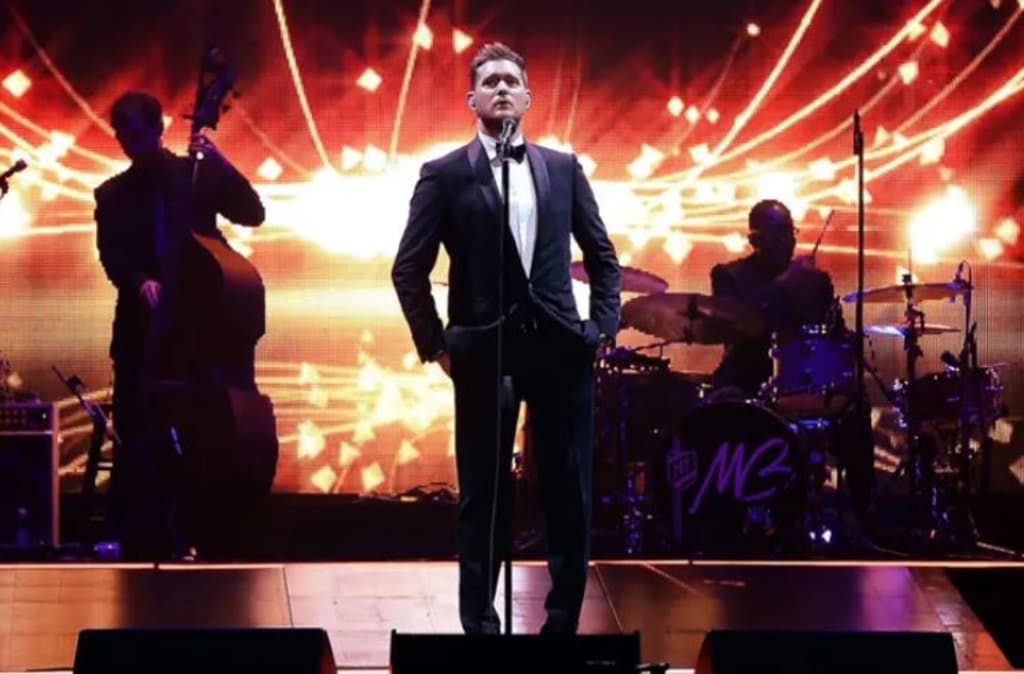
There is a particular kind of artist who gets taken for granted precisely because they are so good at what they do.
Michael Bublé is that artist.
Since the early 2000s, he has been doing something that almost nobody else in contemporary music attempts with any seriousness: taking the Great American Songbook, the jazz standards, the blues classics, and the big band tradition, and making them feel alive and relevant without stripping away what made them great in the first place. He does not modernise these songs by adding drum machines or hip-hop bridges. He honours them and then, through the sheer quality of his voice and his interpretive intelligence, makes them his own.
For most of his career, the critical establishment has treated this as a kind of pleasant irrelevance. Nice voice. Good for dinner parties. Not exactly serious music. Meanwhile, Bublé has been selling out arenas, accumulating Grammy Awards, and building one of the most devoted fanbases in contemporary music, a fanbase that knows something the critics have been slow to acknowledge.
The Best of Bublé is the formal acknowledgement. And it is overdue.
What This Collection Actually Is
Greatest hits albums exist on a spectrum. At one end, there are cynical cash-grabs, a record label packaging an artist's catalogue to generate revenue with minimal effort. At the other end, there are genuine celebration collections that do the work of presenting an artist's career in a way that both rewards longtime fans and serves as a meaningful introduction for newcomers.
The Best of Bublé sits firmly at the second end of that spectrum. It does not simply compile the obvious choices and call it done. It makes an argument about who Bublé is as an artist, what his range actually encompasses, and why his body of work deserves to be taken seriously as a coherent artistic statement rather than a series of pleasant background tracks.
The familiar material is here, and it should be. Home, with its aching simplicity and the kind of emotional directness that most singers would oversell and Bublé somehow underplays to devastating effect. Haven't Met You Yet, which remains one of the most infectiously optimistic songs written in the last twenty years. Everything, which is the kind of love song that makes people cry at weddings for reasons they cannot entirely articulate.
These are not throwaway hits. They are songs with genuine emotional architecture, and hearing them collected together makes the case for Bublé's original songwriting more forcefully than any individual track could.
The New Songs That Change the Conversation
What elevates The Best of Bublé beyond a standard greatest hits package are the two previously unreleased tracks, and they are worth discussing in some detail, because they do real work in expanding the picture of who Bublé is.
Don't Blame It On Me is pure joy. There is no other way to describe it. The arrangement surrounds Bublé's voice with lively horns, handclaps, and acoustic guitar in a way that fills the room physically fills it, the way great live music does, and makes it essentially impossible to hear without smiling. It is not a complex song. It does not need to be. It is a song that knows exactly what it wants to do and does it with complete conviction, and that is its own form of artistry.
Quizás, Quizás, Quizás is a different proposition entirely. The song is a Cuban classic, written by Osvaldo Farrés and made famous by Bobby Capó, and Bublé performs it in Spanish, which is, in itself, a statement. It is one thing to command a room in your native language. It is another to step into a song with its own cultural history and linguistic texture and make it feel natural, warm, and genuinely inhabited. Bublé does exactly that. The performance is relaxed in the way that only technically secure singers can afford to be relaxed, and it sits on the album as evidence of a range that his reputation does not always get credit for.
Together, these two new tracks frame the collection differently than a straightforward hits compilation would. They suggest an artist still exploring, still finding new things to do with his instrument, still curious about what else his voice can hold.
The Voice Itself
It is worth spending a moment on what actually makes Bublé special, because it is easy to describe his appeal in vague terms, "smooth," "classic," "timeless," without being specific about the technical and interpretive qualities that produce that effect.
Bublé's voice is controlled in a way that most singers are not. He can inhabit a phrase fully to commit to the emotional content of a lyric without overselling it, which is the mistake that most emotionally expressive singers make. He does not push for the big moment. He lets the song arrive at it, and his voice is there when it does, doing exactly what is needed and nothing more.
This is harder than it sounds. Popular music rewards overselling. The big note, the dramatic run, the moment of obvious technical display, audiences respond to these things, and they train singers to produce them. Bublé's instinct runs in the opposite direction. He is a storyteller first, and the voice is in service of the story rather than the other way around.
His bossa nova interpretations demonstrate this most clearly. The genre requires a particular kind of ease, a sense that the music is simply happening rather than being performed, and Bublé finds that ease naturally. The listener goes on a journey without quite noticing they have been taken anywhere.
The One Thing Missing
There is an absence on The Best of Bublé that is difficult to ignore, particularly given the season in which it arrives.
Michael Bublé is, by any reasonable measure, the King of Christmas music in the modern era, a title second only to Mariah Carey, and genuinely contested. His Christmas album, released in 2011, has become one of the best-selling holiday albums in history. It has charted in multiple countries every December for over a decade. It is the soundtrack to Christmas shopping in malls across the world. You have heard it, almost certainly, whether you sought it out or not.
None of it is here.
The absence is curious. A truly comprehensive portrait of Bublé's career and his hold on contemporary popular culture cannot be complete without acknowledging what he has done for the holiday music canon. His Christmas recordings are not a side project or a seasonal gimmick; they are a central part of his cultural legacy, as significant in their way as any of his original material.
Perhaps the licensing is complicated. Perhaps a separate Christmas collection is planned. Perhaps the decision was made to keep this focused on his non-holiday work, on the principle that the two audiences are meaningfully different.
Whatever the reason, the gap is felt.
The Verdict
The Best of Bublé is not a perfect document of its subject. But it is a beautiful and necessary one, a collection that makes the argument for taking Michael Bublé seriously as an artist, presented with the care and intelligence that argument deserves.
For longtime fans, it is a gift. For newcomers, it is the best possible introduction to a voice that has been doing something genuinely special for two decades, largely without the critical recognition it merits.
Put it on. Pour something worth drinking. Let Bublé do what he has always done.
You will remember why you loved these songs in the first place.
About the Creator
Mark Lim
Hi I am mark an automotive student and a car, tech and food enthusiast ! Im gonna try and post daily & hope you enjoy what I write and do share my page with people you know. I would gladly appreciate it! Cheers
Enjoyed the story? Support the Creator.
Subscribe for free to receive all their stories in your feed.
Comments
There are no comments for this story
Be the first to respond and start the conversation.