
Mario Mattia’s "Metamorphosis" - A Piano Improvisation That Refuses to Go Home
On "Metamorphosis", Mario Mattia leaves tonality behind and follows an improvisation wherever it wants to go.

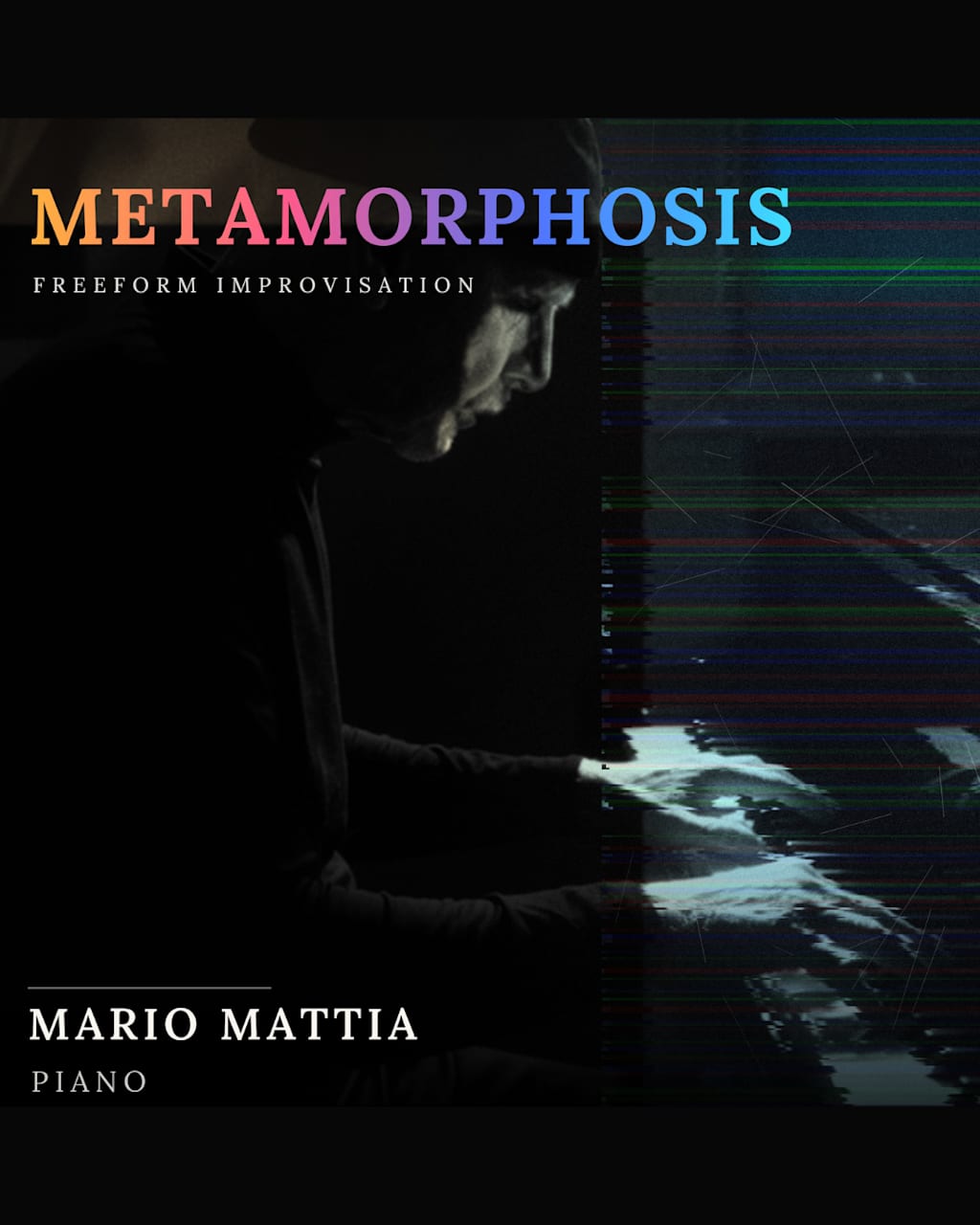
There is something inherently revealing about listening to an improvisation. Unlike a conventional composition, there is no sense that the musician knows exactly where the music is going. Even when a performance develops its own internal logic, there remains the possibility of surprise; a note, a harmony or a sudden shift in direction can alter everything that follows. In the hands of American improvisational pianist Mario Mattia, it is this very uncertainty that becomes the substance of the music.
Metamorphosis - Freeform Piano Improvisation, premiering on September 3rd takes that idea and pushes it further. Across just over seven minutes, Mattia explores a musical journey that does something surprisingly rare: it changes its identity without ever attempting to return to where it began.
Listen here:
The opening is inviting. There is lyricism here, a sense of tonal familiarity and melodic searching that gives the listener something recognisable to hold onto. But there is also a distinct restlessness beneath the surface. Mattia seems to be testing the boundaries or the limits, gradually loosening the harmonic gravity that initially holds it together.
And then the transformation begins.
What makes "Metamorphosis" compelling is that Mattia treats this transition as organic and almost inevitable. Familiar harmonic relationships begin to lose their authority. Phrases become more fragmented, gestures become sharper and more angular. The piano increasingly sounds less an instrument tracing a predetermined route and more a space in which ideas are being explored as they happen. Eventually here, tonality is no longer the point of reference.
The title of the piece then is particularly apt. "Metamorphosis" isn't simply a piece that develops; it is a piece that becomes something else.
There is no return to the opening material, no comforting recapitulation waiting at the end to reassure us that the journey has brought us safely back home. When the intensity eventually recedes, the effect is not one of resolution. Something has changed, and the music refuses to pretend otherwise.
“Metamorphosis is a one-way journey from tonal lyricism into increasingly non-tonal territory - with no return to where it began,” Mattia explains. “That irreversible transformation is the heart of the improvisation.”
And importantly, Mattia doesn't seem interested in making that journey unnecessarily comfortable.
There is a physical quality to the playing as the piece progresses. The piano becomes increasingly percussive and fragmented, with moments that seem to hang suspended between order and dissolution. Yet even in its most abstract passages, there is a sense of attentive listening underneath the apparent freedom - a musician responding to what has just happened and allowing that response to determine what comes next.
This then is perhaps the paradox at the centre of free improvisation - that the music may be unplanned, but it is not without intention. Mattia's background helps explain the breadth of the musical territory he is willing to explore. His influences span classical music, jazz, progressive rock, modernism as well as ambient traditions. From Bach to Bartók, Ella Fitzgerald to Keith Jarrett, and from King Crimson to Brian Eno.
"Metamorphosis" exists somewhere beneath the surface of all of these influences perhaps, contributing to a musical vocabulary that is capable of moving between lyricism, dissonance, space and abstraction without announcing the transitions. It also asks the listener to stay with it. To persist. Its reward is not immediate familiarity, but discovery.
Mattia himself poses an intriguing question to the listener: where do you feel the music crosses the threshold?
It is a question worth considering, because the precise moment is not necessarily obvious. There is no single dramatic rupture. Instead, the tonal world gradually becomes less certain until, at some point we realise we are somewhere entirely different.
Towards the end, the listener is not brought back to any beginning. The opening is therefore a memory, and the music that remains feels like evidence of everything that has happened in between.
For an improvisational pianist, perhaps that is the ultimate act of trust: to create something without knowing where it will lead, and then have the courage to let it remain changed. Mario Mattia's "Metamorphosis" offers the chance to hear what happens when the music leaves home behind.
About Mario Mattia
Mario Mattia is an improvisational pianist and graduate of the New England Conservatory whose work is rooted in spontaneity, deep listening and emotional presence. Drawing on a lifetime immersed in classical, jazz, progressive rock, non-tonal modernism and ambient traditions, his musical language reflects a wide constellation of influences - from Johann Sebastian Bach and Béla Bartók to Ella Fitzgerald and Keith Jarrett, and from King Crimson to Brian Eno. These diverse lineages converge in a practice that is entirely unplanned and shaped in real time.
For more than two decades, Mattia has devoted himself to refining a uniquely personal improvisational voice: intimate, exploratory and unconcerned with the bounds of genre. He begins each performance without predetermined themes, structures or titles. Each piece unfolds spontaneously, guided by intuition, emotional presence and attentive listening. Improvisation, for Mattia, is not simply performance. It is an active engagement with the present moment, an exercise in creating meaning, structure and expression in real time.
Early in his career, Mattia founded and directed the progressive rock ensemble Möbius, scored documentary films for public broadcasting and worked extensively as a teacher of piano and music theory. These formative experiences in long-form structure, ensemble leadership and musical architecture continue to inform his present work, in which improvisation has become his central artistic language and primary mode of expression.
Mattia’s growing catalog is organized into four primary aesthetic lanes: extended structural improvisations, non-tonal architectures, contemplative works and meditations on loss. Each reflects the full architectural range of his practice. This framework allows the listener to engage directly with specific dimensions of his work, from large-scale formal explorations to more intimate, reflective pieces.
His releases include Approaching Hyperion, a pair of electronically mediated laments shaped by grief and reflection, created in Mattia’s electronic studio - a parallel and occasional extension of his primary work in solo piano improvisation. Project 45, by contrast, is a fourteen minute uninterrupted piano improvisation that unfolds from stillness into turbulence and back again. Alongside these works, Mattia maintains an extensive archive of documented performances, some accompanied by transcripts, emphasizing long-term artistic developments and sustained listening.
Working from his rural woodland studio, Mattia records with close microphone placement and a meticulously tuned and voiced piano to capture each and every harmonic nuance. Through his spontaneous, unedited performances, he invites listeners into deeply immersive sound environments grounded in presence and discovery.
Singular, unrepeatable encounters between sound, silence and the unfolding moment, where the music itself becomes both a mirror of consciousness and an expression of the self.
Connect with Mario Mattia on his Website
About the Creator
Whitney Miller
🌎 Adventurous & Musical
Stories shaped by places, music & life
Poetry, fiction, memoir & lived experience
Written without A.I.
© Whitney Miller
Enjoyed the story? Support the Creator.
Subscribe for free to receive all their stories in your feed.
Comments
There are no comments for this story
Be the first to respond and start the conversation.