
How Animated Music Videos Are Made: From Artist Avatar to Final Render
A practical guide to concept development, digital doubles, motion capture, animation, real-time production, and choosing the right creative team.
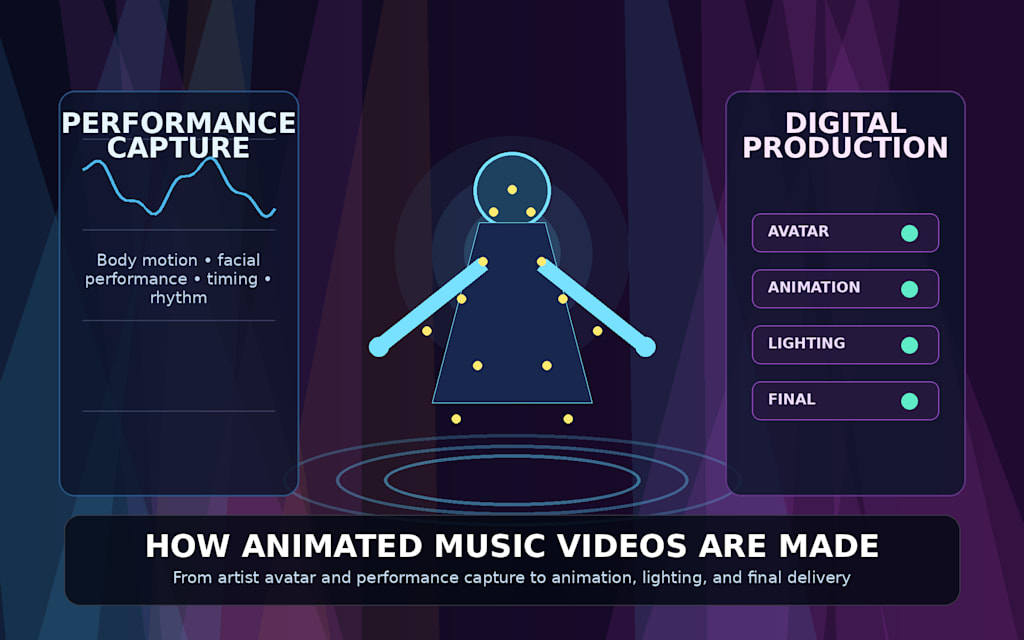
Music videos have always borrowed from cinema, fashion, choreography, graphic design, and visual effects. Animation expands that creative vocabulary even further. An artist can perform in a world that does not exist, appear as a digital double, transform between identities, or build an entire campaign around a character that can return in future releases.
The appeal is obvious, but the production process is often misunderstood. An animated music video is not simply a live-action edit with a filter applied. It can involve concept development, character modeling, rigging, performance capture, lip-sync, animation, virtual cinematography, effects, lighting, rendering, and multiple rounds of creative review.
Choosing an animated music video company therefore begins with a question that is bigger than style: can the team translate the music into a coherent production pipeline, preserve the artist’s identity, and deliver assets that work across the final video and any future campaign needs?
What Animated Music Video Production Actually Includes
Animated music video production is the coordinated process of turning a song, artist identity, and visual concept into a finished animated film. Depending on the creative direction, the work may be fully 3D, fully 2D, motion-design-led, photorealistic, stylized, or a hybrid of filmed footage and computer-generated imagery.
The visible result may last only three or four minutes, but the production team is solving several problems at once. The artist needs to remain recognizable. The performance needs to feel connected to the music. The camera must support the visual rhythm. The animation must communicate emotion. The technical pipeline must also survive revisions without losing consistency.
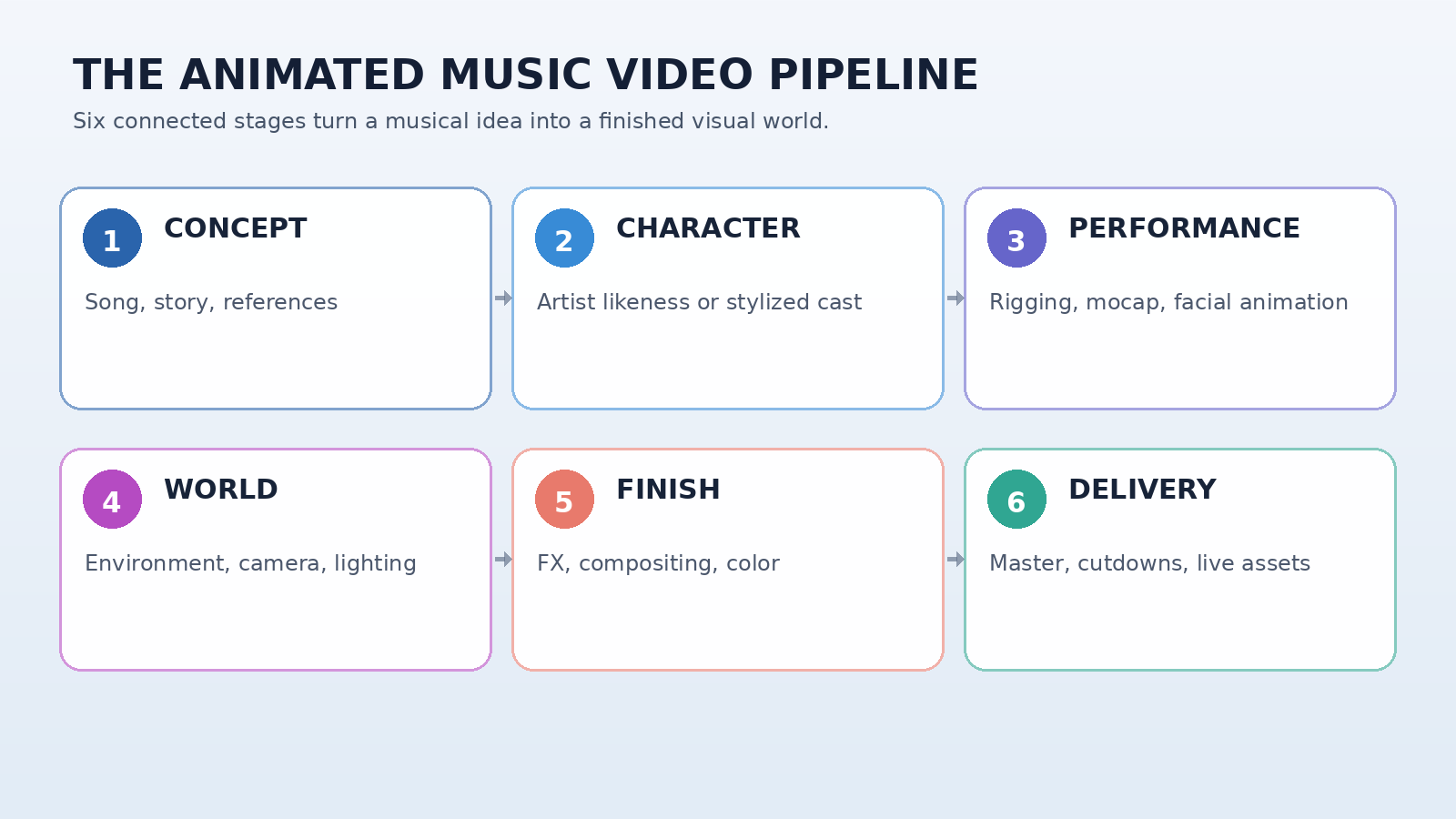
A useful way to understand the process is as six connected stages: concept, character, performance, world building, finishing, and delivery. Skipping one stage usually creates problems later. A strong character with no movement plan feels lifeless. Beautiful animation without a clear edit becomes visually busy. An ambitious world with no rendering strategy can miss the release date.
Start With the Song, Not the Software
The first production decision should not be which software to use. It should be what the listener is meant to feel and remember. A slow, intimate track may call for subtle facial performance and long camera moves. A high-energy song may need graphic cuts, dance-driven animation, or a world that changes with the beat. A narrative song may benefit from recurring symbols and a clear visual arc.
A practical concept phase answers four questions. What is the emotional center of the song? How visible should the artist be? What visual idea can sustain the full running time? Which assets may need to live beyond the music video, such as album artwork, social cutdowns, a virtual concert, stage visuals, or a game-engine character?
This phase normally produces a treatment, reference board, style frames, character notes, and a rough timing plan. An animatic or previsualization can then test whether the concept works against the actual track before expensive character and environment work begins.
The strongest concepts are usually simple enough to explain in one sentence, but rich enough to evolve across several scenes. That clarity helps artists, labels, directors, and production teams make decisions using the same creative reference.
Choose the Right Visual Language
There is no universally best animation style. The right approach depends on the artist, the song, the audience, the schedule, and the intended life of the assets.
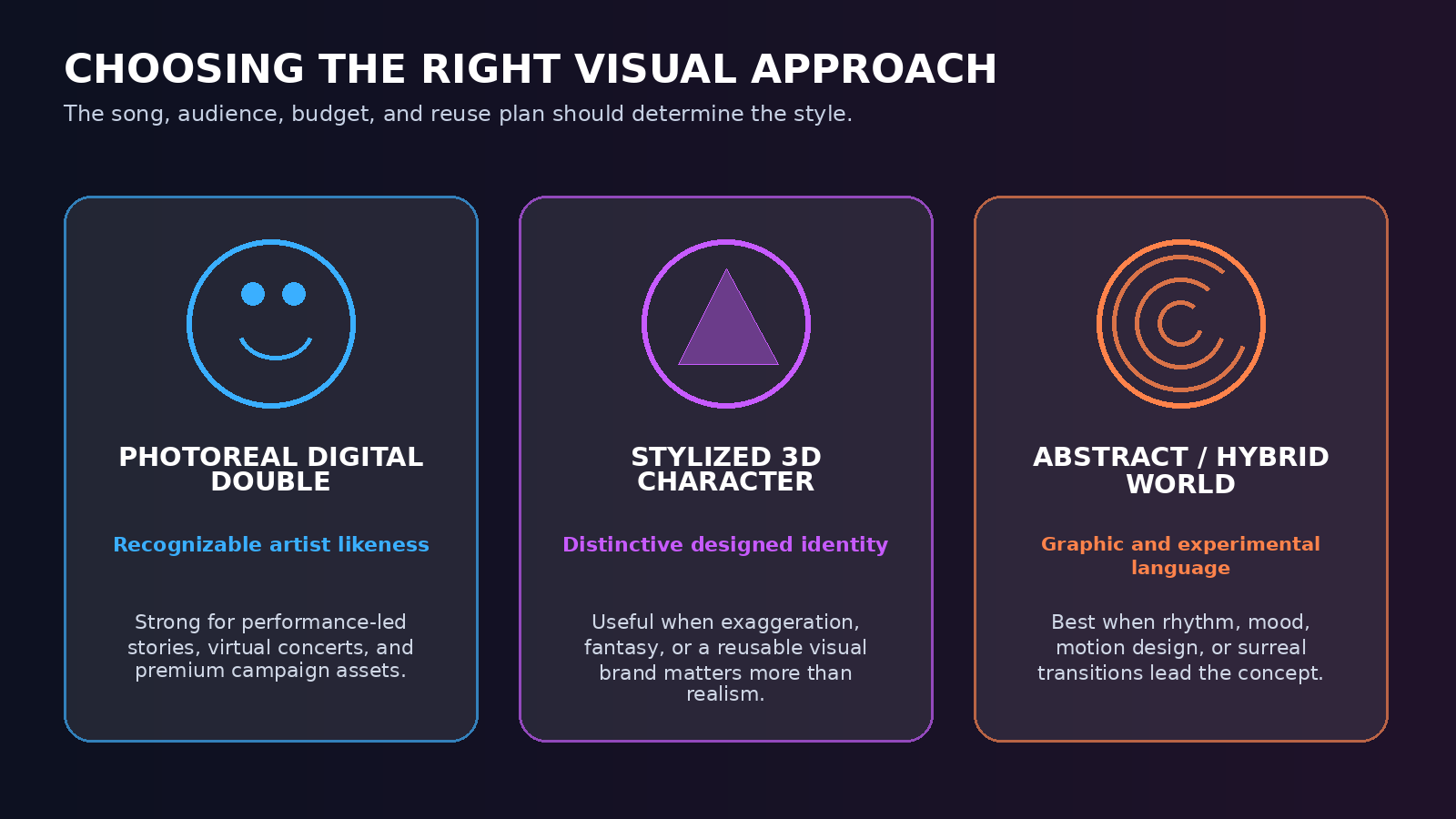
A photoreal digital double is useful when recognition and performance are central. The artist can appear in impossible environments while retaining a strong connection to their real identity. A stylized 3D character offers more freedom. Proportions, movement, clothing, and environments can be exaggerated without asking the audience to judge every frame against reality. An abstract or hybrid approach can focus on color, rhythm, typography, fluid simulation, or surreal transformations.
The reuse plan matters too. A photoreal avatar built for one video may later support tour visuals or a virtual performance, but only if the asset was modeled, rigged, and optimized with those uses in mind. A stylized character may become a recurring visual identity across album cycles, social content, merchandise, and live screens.
Build the Artist or Character for Performance
When the artist appears as a digital character, the production team needs more than a good-looking model. The asset must be built for the shots, expressions, motion, and close-ups required by the video.
A photoreal character may begin with 3D scanning or a detailed set of photographs. Artists then clean the geometry, create efficient topology, produce textures, build skin and eye materials, groom hair, and recreate clothing. A stylized character follows a similar logic, but the design decisions are guided by shape language and appeal rather than strict likeness.
Rigging prepares the model to move. A body rig controls joints and deformation. A facial rig supports speech, expression, eye movement, and smaller emotional changes. The rig needs to fit the performance plan. A wide shot of a dancing character does not require the same facial detail as a close-up in which the artist sings directly to camera.
Publicly described music-video work from Mimic Productions shows how different the scope can be. Its music-video page references facial rigging and animation for Kanye West’s interactive “BLKK SKKKN HEAD,” full 3D production for Robin Schulz, and digital avatar work involving artists including J. Balvin, The 1975, Griff, Kojey Radical, and Arca. The common thread is that the character is built around the needs of the performance rather than treated as a static model.
Capture Rhythm, Performance, and Lip-Sync
Music is timing. That makes performance capture especially valuable when body rhythm, dance, or expressive acting drives the video. Motion capture can record a performer’s body movement, while facial capture records expressions and mouth shapes. The resulting data is transferred to the character rig, cleaned, and refined by animators.
Capture is not an automatic final result. Raw motion may contain foot sliding, awkward hand contacts, occlusion errors, or movement that does not suit the proportions of the digital character. Animators correct those issues, sharpen important poses, adjust timing, and make sure the performance reads from the selected camera angle.
Lip-sync also needs more than matching broad mouth movement to the vocal track. Convincing results depend on phoneme timing, jaw motion, cheek behavior, eye focus, breathing, and the emotional intention of the line. The character should not look like it is simply opening and closing its mouth to the beat.
For dance-led work, the team may capture full choreography. For a more graphic video, performance capture may provide only a starting point, followed by deliberate exaggeration or remapping to a nonhuman character. The production method should serve the visual idea, not limit it.
What a Music Video Animator Really Does
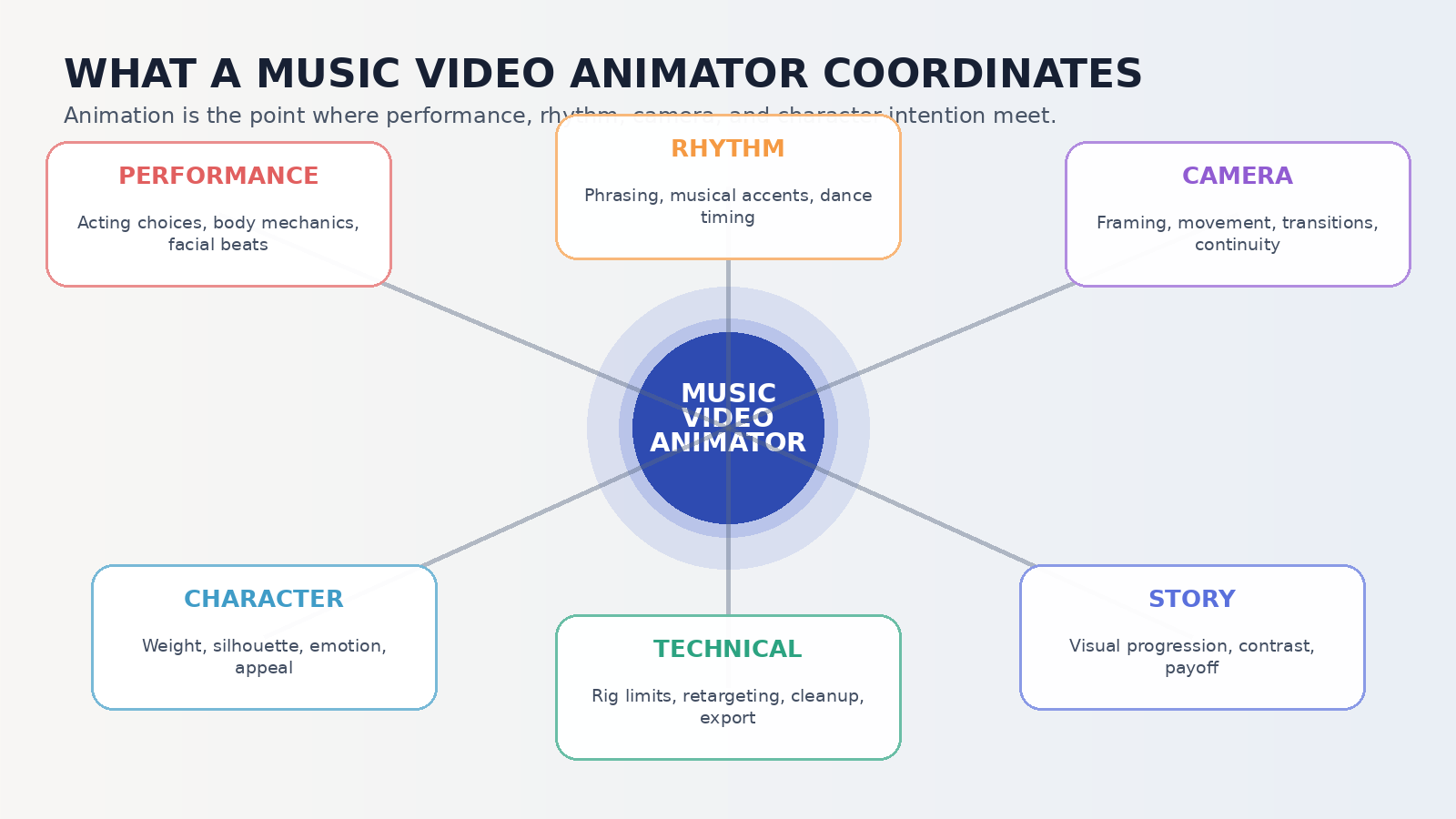
A skilled music video animator works at the intersection of acting, rhythm, character mechanics, story, and technical delivery. The role is not limited to moving a rig from pose to pose. The animator decides how performance reads through the character and how that performance supports the edit.
The animator studies musical phrasing, accents, pauses, and changes in energy. They shape body mechanics so the character has weight. They refine silhouettes so poses remain readable. They coordinate facial emotion with vocal delivery. They also work with camera and lighting teams because the same motion can feel powerful from one angle and weak from another.
Technical judgment is equally important. The animator needs to understand the limits of the rig, preserve clean deformation, avoid intersections with clothing and hair, and deliver animation that survives the next stage of the pipeline. In a real-time workflow, animation may also need to meet engine performance limits and work with live playback systems.
Build the World, Camera, and Lighting Around the Track
A character does not carry the whole video alone. The environment, virtual camera, lighting, and visual effects create the world around the performance.
Environment production may involve detailed 3D locations, graphic stages, simulated materials, abstract geometry, or a sequence of spaces linked through transitions. The camera team then treats the digital scene like a film set. Lens choice, framing, depth, camera speed, and movement all influence how the audience experiences the track.
Lighting shapes mood and directs attention. It also affects whether a digital character feels integrated into the environment. Skin, eyes, hair, reflective clothing, smoke, and atmospheric effects all respond differently to light. The look-development team balances those materials so that the artist remains readable without appearing disconnected from the world.
Editorial planning should continue throughout this stage. Music videos often depend on visual contrast, such as moving from quiet to explosive, minimal to dense, or realistic to surreal. The world and camera plan should create that progression rather than deliver the same visual intensity for the entire song.
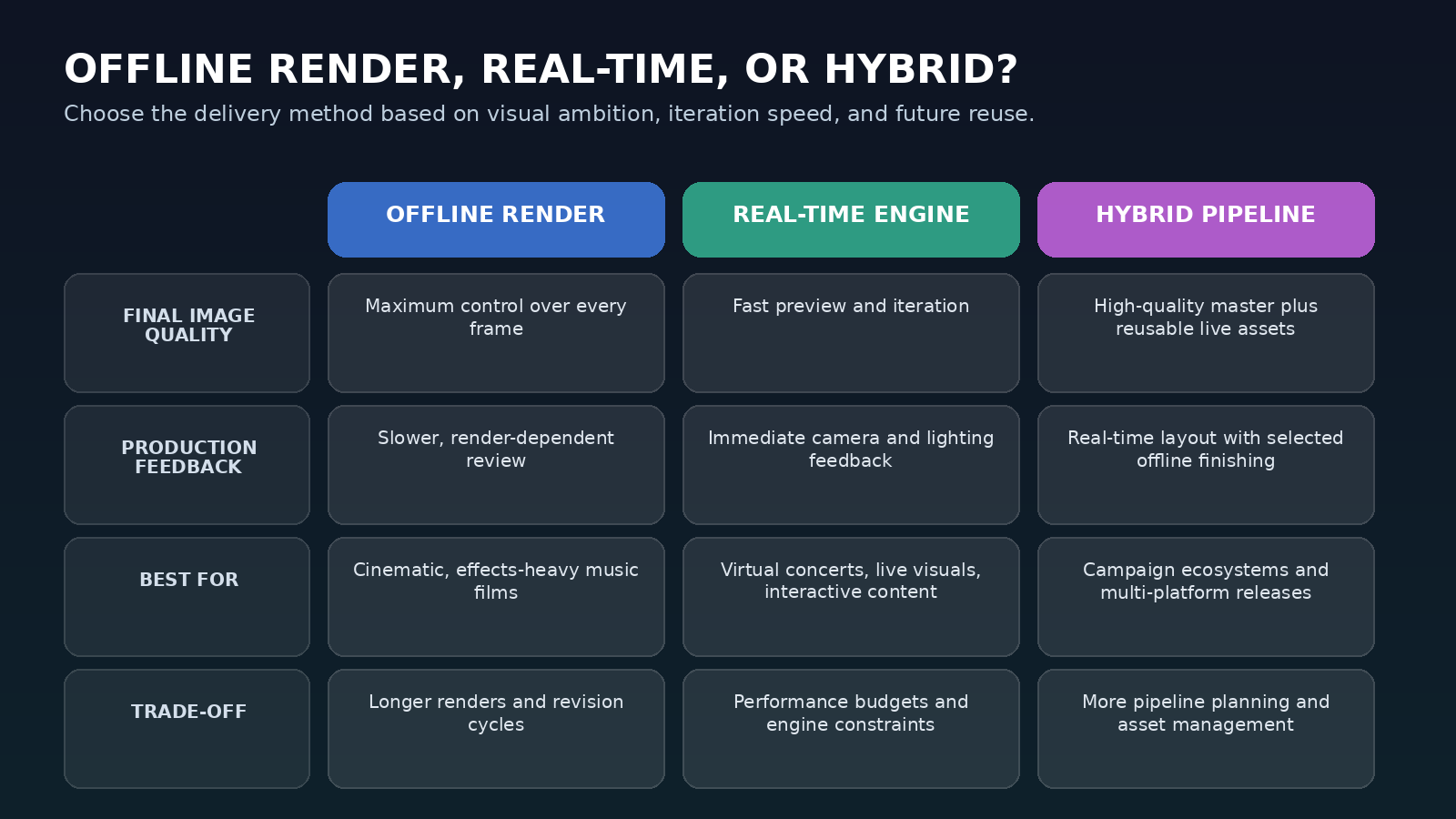
Offline Rendering, Real-Time Production, or a Hybrid Pipeline
The final image can be produced through offline rendering, a real-time engine, or a hybrid of both.
Offline rendering is suited to work that needs maximum control over lighting, simulation, and final image quality. It can support complex effects and highly polished frames, but rendering and revision cycles may be longer.
Real-time engines provide immediate feedback. Directors can adjust the camera, lights, environment, and character performance while seeing the result instantly. The same optimized assets may also support live visuals, virtual concerts, XR experiences, or interactive releases. The trade-off is that the team must work within performance budgets and plan the asset pipeline carefully.
A hybrid workflow uses real-time tools for layout, previsualization, and some final sequences, then applies offline finishing where additional quality or simulation is required. This can provide fast creative iteration while preserving a premium final master.
What Animated Music Video Services Should Cover
When comparing animated music video services, look beyond the final showreel. A capable partner should be able to explain which parts of the pipeline it handles directly, which specialists are involved, and how creative reviews will work from concept through delivery.
A full-service scope may include creative development, storyboarding, character design, 3D scanning, modeling, texturing, facial and body rigging, motion capture, keyframe animation, hair and cloth work, environment production, camera animation, lighting, rendering, compositing, color, and final mastering.
Not every project needs every service. A studio may receive an existing character and provide animation only. Another project may begin with a performer scan and require the full pipeline. The important question is whether responsibilities, handoffs, and approvals are clear.
Ask for examples that resemble the actual challenge. A beautiful environment reel does not prove a team can preserve a musician’s likeness. A strong character sculpt does not prove it can deliver dance animation or lip-sync. A successful partner should show both craft and pipeline understanding.
Plan the Budget and Schedule Around the Hard Parts
Animated music video budgets are shaped by more than running time. Complexity often comes from the number of unique characters, the required realism, facial close-ups, choreography, environment count, simulated hair or clothing, visual effects, revisions, rendering, and final delivery formats.
A clear production brief should identify the final song length, release date, aspect ratios, required cutdowns, artist likeness needs, performance requirements, target style, and possible asset reuse. Decisions made late in production are expensive because they can affect many downstream tasks.
The schedule should also reserve time for approvals. Character likeness, wardrobe, facial performance, and major story moments should be approved early. Waiting until final render to request fundamental design changes can force large parts of the pipeline to be repeated.
A practical approach is to define milestone reviews: treatment, style frames, character look, animatic, performance test, lighting test, first full edit, and final master. Each milestone should answer a specific question and close a category of decisions.
A Production Checklist for Artists and Labels
· Define the emotional idea of the video in one sentence.
· Decide whether the artist appears as live action, a digital double, a stylized character, or not at all.
· Confirm the final master, social cutdowns, vertical versions, and any live or interactive deliverables.
· Choose the visual approach before detailed asset production begins.
· Approve character likeness, wardrobe, and performance requirements early.
· Test lip-sync, motion, camera, and lighting before committing to final sequences.
· Clarify which assets may be reused for tour visuals, virtual concerts, artwork, or future releases.
· Set milestone approvals and identify who has final creative authority.
· Protect enough time for animation polish, rendering, compositing, and final quality control.
Final Thoughts
A successful animated music video is not defined by how much technology it uses. It succeeds when the production choices make the song feel more vivid, memorable, and emotionally specific.
The most effective pipeline begins with a clear idea, then connects character design, performance, animation, camera, lighting, and delivery around that idea. Digital doubles can preserve an artist’s identity. Stylized characters can create a distinctive visual brand. Real-time production can extend assets into live and interactive experiences. Each option is valuable when it supports the music.
For artists and labels, the best production partner is the one that can explain the creative and technical trade-offs early, show how the pipeline will be reviewed, and build assets that remain useful beyond a single final render.
Frequently Asked Questions
- How long does an animated music video take to produce?
The schedule depends on style, character count, animation complexity, approvals, and rendering. A focused stylized project can move faster than a photoreal production with scanning, facial performance, dance capture, simulated clothing, and multiple environments. The most reliable estimate comes after the treatment and asset scope are defined.
2. Does an artist need to visit a studio?
Not always. A character can sometimes be created from approved reference imagery, and some performance work can be captured remotely or through stand-in performers. A studio visit is valuable when high-fidelity scanning, facial capture, body motion capture, or precise likeness is central to the concept.
3. Can the same avatar be used after the music video?
Yes, provided reuse is planned from the beginning. The character may be optimized for social content, virtual concerts, live stage visuals, interactive experiences, promotional stills, or future releases. Reuse affects modeling, rigging, performance, and delivery decisions, so it should be included in the initial brief.
4. Is motion capture required?
No. Some projects use full performance capture, some use keyframe animation, and many combine both. Motion capture is helpful for realistic body movement, dance, and fast performance iteration. Keyframe animation provides greater control for stylized, exaggerated, or physically impossible movement.
5. What should be included in the final delivery?
The final package may include the master video, alternate aspect ratios, clean versions, social cutdowns, still frames, subtitles, and selected reusable 3D assets. The exact deliverables should be agreed before production because they affect framing, rendering, and licensing.
About the Author
Mimic Productions is a Berlin-based 3D studio specializing in character creation, scanning, motion capture, animation, and real-time production for music, film, games, and immersive media.
About the Creator
Enjoyed the story? Support the Creator.
Subscribe for free to receive all their stories in your feed.
Comments
There are no comments for this story
Be the first to respond and start the conversation.