
Father Dionysios Tabakis Addresses Homophobia Controversy and Golden Dawn Appearance
The Greek Orthodox priest and drone-metal guitarist says his beliefs reflect church teaching while emphasizing love, acceptance, and personal freedom

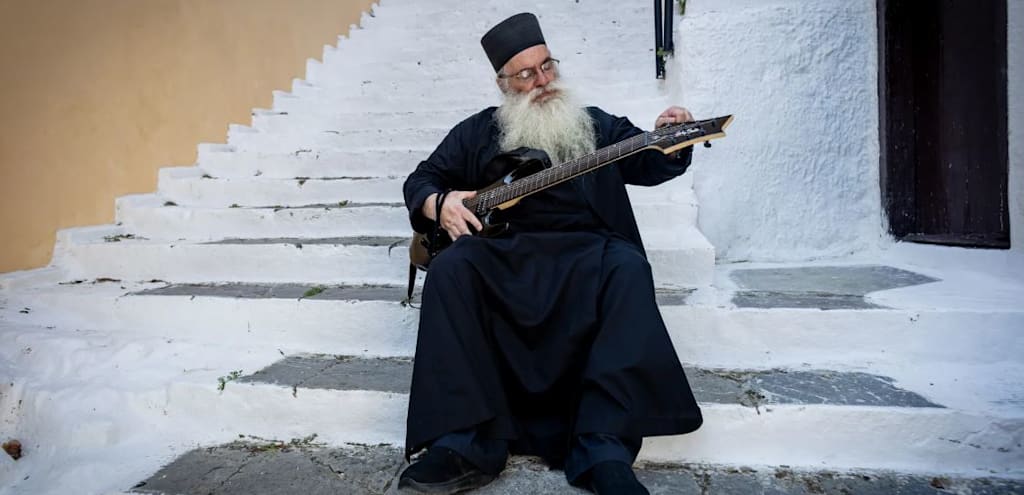
Father Dionysios Tabakis, the Greek Orthodox priest who gained niche attention this year for performing drone metal on guitar, has issued a public statement addressing two controversies surrounding his religious views and past activities.
The statement follows the circulation of religious blog posts that use explicitly homophobic language. It also responds to the resurfacing of a 2013 video showing Tabakis performing an agiasmos, or sanctification ceremony, at the opening of an office connected to Golden Dawn, the Greek neo-Nazi organization.
Tabakis’ statement, dated August 25, was issued as questions grew around his relationship to the views expressed in the blog posts. Two entries published in 2024 on a WordPress site whose name translates from Greek as “The Doors The Doors” refer to gay people as “Sodomites” and describe same-sex marriage, which was legalized by the Greek Parliament that year, as a “sodomitic monstrosity.”
In his response, Tabakis does not directly address the wording or authorship of those posts. Instead, he explains his position on homosexuality through his understanding of Orthodox Christian teaching.
“My view on homosexuality is the same as that of the Orthodox Church for 2000 years, nothing more, nothing less,” he writes. “We owe homosexual people love and acceptance because many have at times experienced great rejection from their environment, especially from their families.”
Tabakis describes himself as someone who prefers to express his beliefs openly, even when doing so makes him unpopular. He connects that attitude to both his religious life and his music, describing himself as independent, unconventional, and spontaneous.
“I don’t like to hide what I believe, but to declare openly what is in my soul,” he writes. “Not wanting to fit into boxes has cost me many times.”
The statement also frames Tabakis’ broader philosophy around unity, empathy, and support for people experiencing hardship. He says he has spent his life helping others and emphasizes that his religious work has not made him wealthy.
“As a Priest for 31 years, I have not acquired even a chicken coop,” he writes, adding that his only possessions are his furniture and musical instruments.
His comments on homosexuality, however, remain rooted in the Orthodox Church’s traditional understanding of sexual morality. Although Tabakis emphasizes acceptance, he appears to describe same-sex attraction as sinful, writing: “It is better to sin with freedom than to be virtuous with oppression.”
He also recalls encounters with gay people who came to him for confession. According to Tabakis, he received them “with acceptance and love.” He describes one occasion involving a brother and sister who were struggling with questions of faith, repentance, and sexuality. After praying with them, he says he embraced the young man and saw how relieved he was to feel “important and accepted.”
The distinction between acceptance and condemnation is central to Tabakis’ statement, but it is also likely to remain controversial. While he presents his position as compassionate, LGBTQ+ critics may view the framing of homosexuality as sinful as incompatible with full equality and affirmation.
The statement also addresses Tabakis’ appearance in a recently resurfaced YouTube video from 2013. In the footage, he performs an agiasmos ceremony at the opening of a Golden Dawn office. Golden Dawn held seats in the Greek Parliament between 2015 and 2019 and was designated a criminal organization in Greece in 2020.
A December 2019 Facebook post from the Argolida Anti-Fascist and Anti-Racist Front directly identifies the priest in the video as Tabakis. The group has criticized the connection between the cleric and the far-right organization.
Tabakis says he was assigned to perform the ceremony by the church authority responsible for the city of Nafplio, where the office was located. According to his explanation, Golden Dawn had requested the blessing through the relevant metropolitan authority, which then sent him to carry out the ceremony as part of his official duties.
He argues that such ceremonies are not exclusive to one political organization. In his account, local priests may be asked to bless the offices or premises of political parties, municipal groups, and other institutions.
“I am against Nationalism because it has only brought blood and wars to humanity,” Tabakis writes. He also refers to his grandparents’ opposition to Hitler and Nazism, saying that he follows their spirit.
In a video posted on August 21, he made a similar argument, stating that he was simply carrying out an assignment given to him by church authorities. He also said he “detests both nationalism and borders.”
Tabakis connects that anti-nationalist position to his unusual guitar setup. “That’s why, on my guitar, I take the frets out so that I can play freely,” he said. His fretless guitar has become part of the image surrounding his drone-metal performances, allowing him to produce sliding, continuous tones that do not conform to the standard divisions of a fretted instrument.
Heat Crimes, the Greek label that released Tabakis’ debut album Paradise Metal earlier this year, offered additional context. In an email, the label explained that agiasmos ceremonies are routinely performed for homes, businesses, schools, public institutions, military facilities, and other premises.
“A politician or political organization inviting a local priest to bless new premises therefore does not, by itself, establish that either the priest or the Church endorses that organization,” Heat Crimes wrote. “The important distinction is between performing a religious blessing and giving a political endorsement.”
That distinction may clarify the institutional context of the ceremony, but it does not erase the political implications of appearing at a Golden Dawn office. Golden Dawn’s subsequent designation as a criminal organization has made images connected to its earlier period as a parliamentary party especially contentious.
Tabakis’ public profile has grown because of the unusual collision between his religious vocation and his music. His performances as a drone-metal guitarist have attracted attention from listeners interested in the contrast between the austere, immersive sound of his music and his identity as an Orthodox priest.
That tension is also visible in his statement. Tabakis presents himself as committed to compassion and spiritual service, while openly defending theological beliefs that many people consider discriminatory. He also rejects nationalism and borders while acknowledging that his values may conflict with those represented within contemporary experimental music culture.
“I see and realize that my path and beliefs as an Orthodox Priest differ significantly from some of the values and cultural positions represented within contemporary experimental music festivals,” he writes.
At the time of publication, Tabakis was scheduled to perform at Philadelphia’s Making Time ∞ festival the following month. He has since withdrawn from the event.
His decision to pull out adds another consequence to the controversy. Experimental music communities often promote openness, inclusion, and freedom from conventional social boundaries, and Tabakis’ comments have raised questions about whether his religious views are compatible with the values of the festivals supporting his work.
Tabakis concludes his statement by saying that he wants to return to his music and a quieter way of life. He writes that he longs for peace, “my hermitism,” and the opportunity to upload music to his channel “with passion and peace.”
The controversy surrounding him is unlikely to disappear simply because he has explained his position. His statement provides context for the Golden Dawn ceremony and makes clear how he understands his views on homosexuality, but it does not resolve the underlying conflict between traditional religious condemnation and contemporary expectations of LGBTQ+ acceptance.
For now, Father Dionysios Tabakis remains a deeply unusual figure at the intersection of religion and experimental music. His public image has been shaped by the contrast between priesthood, drone metal, personal asceticism, and controversial beliefs. His statement attempts to hold those elements together through a language of freedom, compassion, and spiritual conviction but that combination continues to provoke difficult questions about tolerance, responsibility, and the boundaries of artistic communities.
About the Creator
Mark Lim
Hi I am mark an automotive student and a car, tech and food enthusiast ! Im gonna try and post daily & hope you enjoy what I write and do share my page with people you know. I would gladly appreciate it! Cheers
Enjoyed the story? Support the Creator.
Subscribe for free to receive all their stories in your feed.
Comments
There are no comments for this story
Be the first to respond and start the conversation.