
Before History, There Were People
Rose Wollman and Francisco Cortés-Álvarez find an extraordinary musical language for the lives remembered in "Alabanza".

Music has an unusual relationship with memory. A photograph can show us a moment, a book can tell us what happened, but music can somehow recreate the atmosphere surrounding a memory, allowing us to inhabit it for a few minutes rather than simply observe it from a distance.
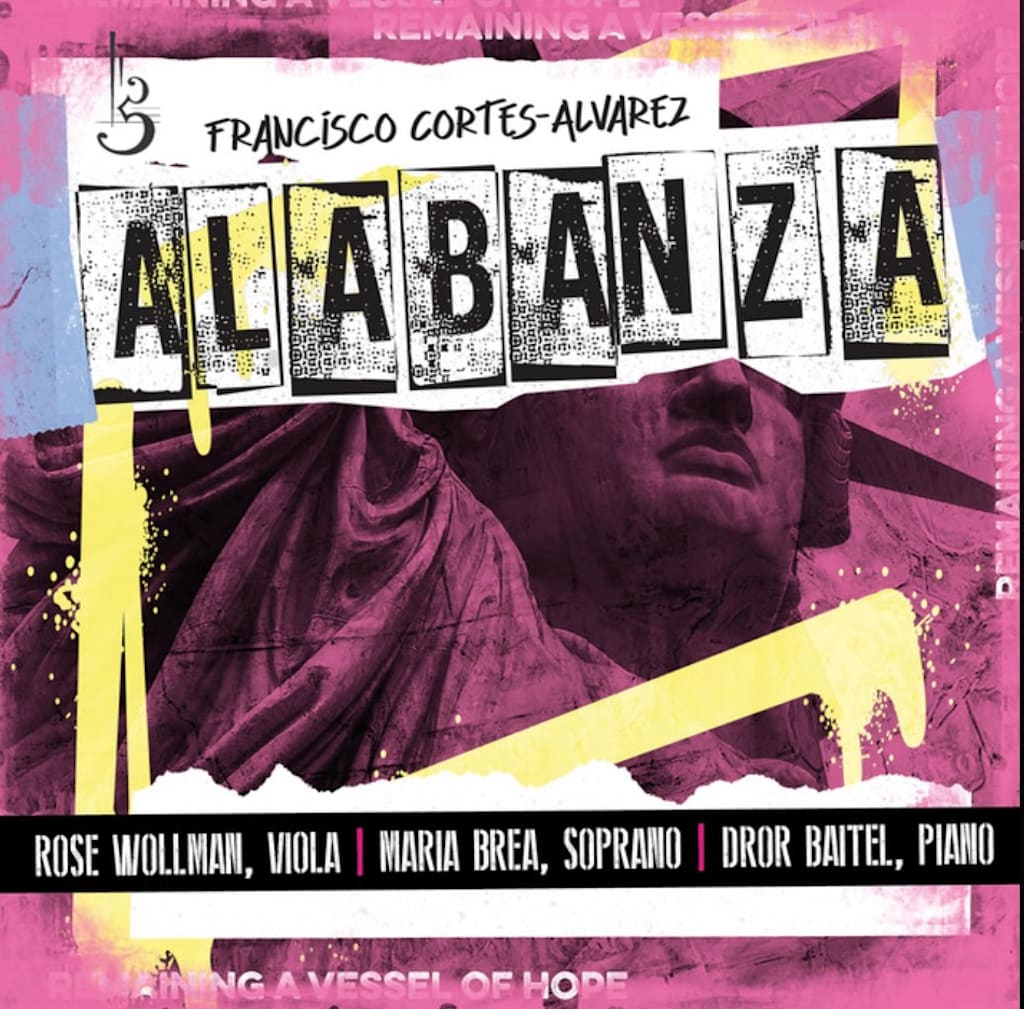
That is certainly the feeling I get from Rose Wollman’s "Alabanza", a remarkable new work by Mexican composer Francisco Cortés-Álvarez, setting Martín Espada’s poem Alabanza: In Praise of Local 100.
The poem tells the story of the Latin American kitchen workers who were working in the World Trade Center on September 11, 2001, but the music does not begin with tragedy. Instead, it begins with life. There is movement, repetition, rhythm and the almost mechanical energy of a busy kitchen, the everyday sounds of people doing their jobs and thinking about the people they love. There is something strangely comforting in this opening, precisely because we know what is coming.
LIsten here:
The piano provides much of that restless motion, while Wollman’s viola and Maria Brea’s soprano weave themselves into the texture, sometimes distinct and sometimes almost indistinguishable from one another. It's less like a traditional song with accompaniment than three distinct voices occupying the same physical space, each adding another layer to the scene. There is colour everywhere, but also a sense that something is lurking beneath the surface.
And then the music changes.
The rhythmic energy that has driven the opening suddenly seems to collapse, leaving behind an eerie stillness. It is one of those moments where you can almost feel the air being taken out of a room. Wollman describes the transition as the music crumbling “from the driving, rhythmic, controlled chaos of the kitchen into a murky, eerie stillness when the ‘thunder’ strikes”, and it is difficult to find a better description of what happens.
From here, Alabanza becomes increasingly disorientating. The soprano seems to float through fragments of the story while the viola finds sounds that are sometimes beautiful, sometimes unsettling and occasionally almost impossible to identify as coming from a conventional classical instrument. The piano adds its own strange punctuation, and together the three instruments create something that feels suspended between chamber music, contemporary composition and sound art.
You can follow Espada’s narrative, certainly, but you can also simply allow the sounds to wash over you. There are moments when the music seems to suggest smoke, dust, machinery, distant voices or the strange silence that follows an enormous noise. Other moments feel almost painfully intimate, particularly when Brea’s voice rises out of the instrumental texture.
The most fascinating aspect of the piece is perhaps the way its rhythms evolve. The opening kitchen becomes a kind of musical heartbeat, busy and repetitive, and later that same pulse returns in a much darker form. A drumbeat of war emerges from the rubble, connecting the individual tragedy of the poem to the much wider consequences that followed. What began as the rhythm of ordinary work has become something far more ominous.
But "Alabanza" doesn't feel like it is trying to manufacture emotion. There is no oversized cinematic climax telling us when we should be devastated. Instead, Cortés-Álvarez allows the music to become stranger and quieter, leaving space for the listener to make their own connections. Perhaps that is why the piece feels so affecting. It gives us the details of ordinary lives before reminding us how quickly those lives can be transformed.
There is also something very poignant about the choice of Espada’s poem in the context of Wollman’s forthcoming Becoming America album. The record brings together five newly commissioned works exploring different experiences of American life, and Alabanza seems an ideal introduction because it focuses on people whose individual stories could so easily disappear beneath the enormous historical narrative of September 11.
Wollman has spoken about wanting the album to explore the diversity of America rather than attempt to define a single American experience, and there is a generosity to that idea. "Alabanza" does something similar on a smaller scale. It takes a story we think we already know and turns the camera towards the people in the background, giving them voices, routines, relationships and memories.
You don't need to know anything about contemporary classical music to connect with it. You don't even need to know the poem before pressing play. The opening rhythm draws you in, the sudden rupture unsettles you, and the strange beauty that follows leaves you somewhere between contemplation and grief.
This is music that leaves far more to the imagination than a film ever could. The viola can sound almost like a human voice, the soprano can become another texture within the arrangement, and the piano can move from percussive machinery to something almost spectral. Together they create a sound world that is difficult to categorise, which seems entirely appropriate for a piece concerned with events that are themselves difficult to comprehend.
"Alabanza" is not an easy listen in the conventional sense, but neither is it inaccessible. Its beauty comes from the spaces between the sounds as much as the sounds themselves, from the contrast between movement and stillness, routine and rupture, memory and silence.
And perhaps most importantly, it remembers that before there was history, there were people simply getting on with their day.
“Alabanza” is out now, with Rose Wollman’s Becoming America following on 15 October via SBOV Music.
About Rose Wollman
An acclaimed violist, composer and passionate advocate for new music, Rose Wollman has built a career around expanding what the viola can do and finding new ways to bring contemporary music to audiences. Hailed as “innovative” and “stylish” by the Chicago Classical Review, she has performed at major venues including Carnegie Hall, Suntory Hall and KKL Switzerland, while commissioning and premiering more than twenty new works for viola.
Her collaborations have included composers and artists such as Pierre Boulez, Augusta Read Thomas, Garth Knox, Don Freund, Atar Arad, Gabriela Ortiz and Mario Lavista. Her recordings include Loop: Ligeti’s Inspiration & Legacy, Partita Party and Breaking Glass Ceilings: Music by Unruly Women. She is Assistant Professor of Viola at Colorado State University and serves on the board of the American Viola Society.
Becoming America is the third release on Wollman’s SBOV Music label, “Sounds Better on Viola”, continuing her commitment to commissioning new work and exploring the possibilities of the viola beyond its traditional boundaries.
Find out more about Rose Wollman on her Website
About the Creator
Whitney Miller
🌎 Adventurous & Musical
Stories shaped by places, music & life
Poetry, fiction, memoir & lived experience
Written without A.I.
© Whitney Miller
Enjoyed the story? Support the Creator.
Subscribe for free to receive all their stories in your feed.
Comments
There are no comments for this story
Be the first to respond and start the conversation.