
Avohee Avoher’s “Caelune” Gives the Piano Room to Get Complicated
Two pianos, an uneasy emotional premise, and a composer exploring what classical technique can say today.


A piano can fill a room without raising its voice. It can also make that same room feel suddenly uncomfortable. That range is part of the instrument’s appeal: familiar enough to invite us in, expressive enough to take us somewhere we weren’t expecting.
Avohee Avoher’s “Caelune” builds its identity around those possibilities. Released September 30 through Avo Records, the instrumental single belongs to his ongoing project, After the Masters – School of Velocity. It places the piano at the center of an artistic idea concerned with tension, attraction, and the difficulty of keeping opposing emotions apart.
The premise gives the release an interesting point of entry, even for people who don’t usually seek out contemporary classical music. You don’t need to identify a chord or recognize a compositional reference to understand the pull between closeness and resistance. Those are ordinary human experiences. Instrumental music simply approaches them without supplying the words.
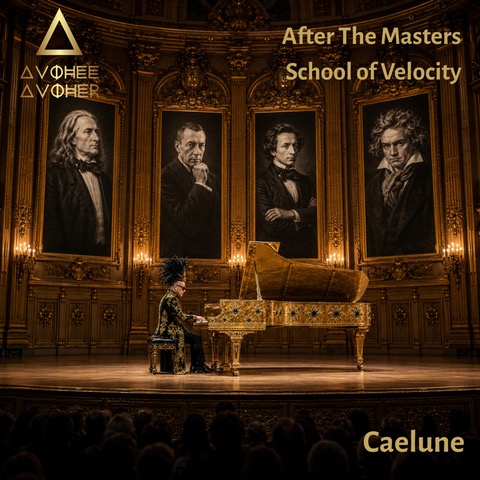
The possibilities of two pianos
“Caelune” is written for two pianos, with Avoher performing both parts, according to Eileen Shapiro’s review for Louder Than War. That arrangement makes the relationship between the instruments particularly intriguing: one musical imagination is responsible for both sides of the exchange.
Two pianos offer more than additional volume. They allow a composer to explore distance, overlap, interruption, and response. One part can establish an idea while another complicates it. Agreement can become friction through a change in emphasis. A returning phrase can acquire a different character because of what now surrounds it.
There’s something recognizably human in that setup. Conversations rarely move in perfect straight lines. We repeat ourselves, misunderstand an intention, soften a position, or become defensive before we understand why. A composition built around interacting voices has room for that kind of uncertainty.
For a listener, this creates an alternative to following a conventional narrative. Instead of asking what happens next, it becomes possible to ask how the relationship is changing. Who seems to be leading? Where does the tension come from? Does a quieter passage suggest comfort, hesitation, or withdrawal?
There doesn’t have to be one correct answer.

What comes after the masters?
The larger project’s name raises a worthwhile question about artistic inheritance. After the Masters suggests a musician working in the presence of an enormous tradition while considering where his own contribution belongs.
That’s a difficult position for any composer. The piano arrives with centuries of expectations attached to it. Audiences bring memories of concert halls, childhood lessons, film scores, and recordings they’ve lived with for years. Even someone who knows little about classical music already has an idea of what a piano means.
Avoher’s project engages with the technical discipline associated with that history. Release materials connect School of Velocity with Carl Czerny’s celebrated piano studies and describe “Caelune” through its contrasts of intensity and delicacy. They also credit Stefan Brown with mastering the recording at Abbey Road Studios in London.
Technique presents its own artistic challenge. Fast playing can attract attention immediately; giving that speed a purpose is a more complicated task. A crowded passage needs a reason to be crowded. Restraint needs conviction, too. Sometimes the most revealing decision available to a musician is to leave space.
That balance makes the project’s premise worth considering. What does technical command make possible emotionally? How can the discipline of practice become something that feels spontaneous, vulnerable, or unresolved?
Those questions reach well beyond classical music.
Leaving something for the listener
One pleasure of instrumental music is the freedom it leaves us. A lyric can name the person, place, or event at the center of a song. Without that direction, listeners bring more of their own lives into the experience.
A musical exchange might suggest an argument to one person and an uneasy reconciliation to another. The same passage can change meaning when heard on a different day. Our circumstances become part of the encounter.
“Caelune” offers a premise suited to that openness: two related voices, emotional friction, and an interest in what happens between extremes. Its appeal begins with the piano’s capacity to hold several feelings at once.
For anyone curious about Avoher’s work, that’s a useful place to begin. Set aside the pressure to understand every technical detail. Follow an idea as it passes between the instruments. Notice when your expectations change.
The piano has plenty of history behind it. There’s still room for a personal encounter.
Listen to “Caelune” by Avohee Avoher on Spotify:
https://open.spotify.com/track/07KiwlBXlIXYB1ZMbH7MfM?si=cb2a391081974e36
About the Creator
Jimmy Stars World
JSW News #EntertainmentNews #BusinessNews
Entertainment & Business News From World-Renowned Blogger Jimmy Star (#46 in the world) and the 5th Most Influential Radio Personality To Follow In Social Media
Enjoyed the story? Support the Creator.
Subscribe for free to receive all their stories in your feed.
Comments
There are no comments for this story
Be the first to respond and start the conversation.