
'Aurora' – Portal to the Other Side
Try to Hear More, More, More


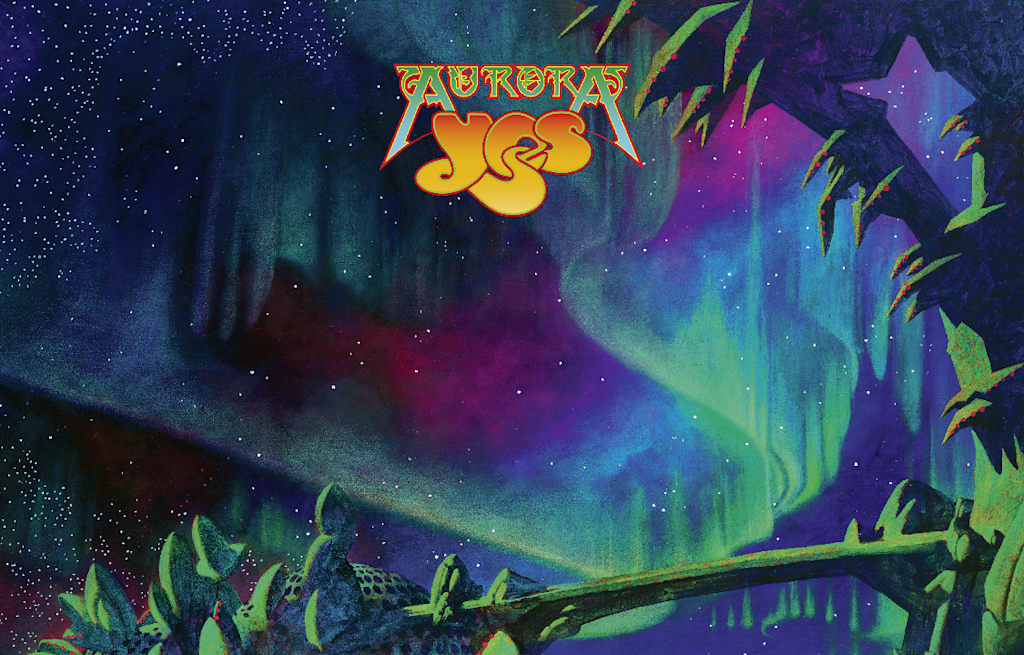
The 2020s have seen the progressive rock band Yes on a trajectory where they refuse to give up on creative endeavors in the studio. 2021's The Quest got the ball rolling on an ongoing studio album workflow after several years of not having recorded a new studio album. In 2023, Mirror to the Sky, for many, one-upped that album and even seemed to win over some skeptics. And now, in 2026, the vibe that this reviewer has picked up across the Yes fandom is that the band's latest album, Aurora, has continued this trend. Capping off a trilogy in the band's eyes, this is an impressive effort from lead vocalist Jon Davison, keyboardist Geoff Downes, guitarist (and producer) Steve Howe, drummer Jay Schellen, and bassist Billy Sherwood. It also continues their collaboration with mixer/engineer Curtis Schwartz and orchestral arranger Paul K. Joyce. And the album cover was done not just by Roger Dean, but also his daughter Freyja Dean. Talent does not fall far from the tree. All of this together brings one into an amazing world this album can bring to mind.
To my ears, Aurora feels like the most bold and experimental Yes album since 1999's The Ladder. That particular album had tracks one might not expect from a Yes album, such as "Lightning Strikes," "Face to Face," and "The Messenger." In the case of Aurora, there is a similar unexpectedness, with big swings on such tracks as "All Hands on Deck" and "Outside the Box," and even some lead vocal surprises on "Countermovement" and "Watching the River Roll." Many prefer the classics for a reason, but I will always applaud a band that is still going for trying something new, and even then, the new material still feels like it is in the spirit of Yes.
So, as I have done with previous Yes studio albums, I will go track by track, expressing how I feel about each one and any observations that come to mind.
1. "Aurora"
The title track begins with menacing piano keys, which have been compared to the opening of "Awaken" from 1977's Going for the One. This is very fitting, given that this track is about awakening and transformation. Then they lighten the mood, and we are greeted by majestic orchestration welcoming the band and the album.
There is a sense of urgency in how Jon Davison sings the lyrics. The mention of a “Harbinger” is may get one curious. And actually, Davison had read Autobiography of a Yogi, a footnote of which is famously associated as the origin of Tales from Topographic Oceans. Also, there is a church organ type sound reminiscent of classic Yes. An instrumental detour provides a bit of heaviness before returning to the lighter feel. The lush positivity is a hallmark of Yes.
2. "Turnaround Situation"
The Hammond organ sound at the beginning feels more like the earlier Yes of the first three albums, which featured Tony Kaye on keys. One could perhaps imagine a song like this being on 1971's The Yes Album. Furthermore, this song was inspired by Jon Davison and Emily getting lost on the way to the studio. An anecdote like this is reminiscent of how “Roundabout” from 1971's Fragile came to be.
I quite like the positive keys that come about when Jon sings about “redemption road.” The instrumental detour reminds me a bit of Rush. The verses “No more trusting treasure maps / Wanderlusting dead end paths” really resonate as a reminder that sometimes you really do need to change direction completely instead of just going with a sunk cost situation. We can turn ourselves around. The closing lyrics kind of surprise me because the song sounded like it was already over. So I am reminded of “Does It Really Happen” from 1980's Drama, in that sense. While I am drawing connections to classic Yes tunes, make no mistake: this album is not just a nostalgia trip, but rather a journey into something new.
3. "Love Lies Dreaming"
The music in the beginning of "Love Lies Dreaming" feels like being put on a journey that has already been happening. As if I have exited one bus and then immediately hopped onto another bus that is traveling elsewhere.
I enjoy the background vocalization during the opening verses. The right mood shift is at play during the verses, “At first it feels like falling / when really you’re only flying through a dream.” Davison sings the counter vocals “Give chase, give chase” and such, leaving me to wonder why Sherwood did not sing those bits. I do not mind Davison's vocals at all, but I do like when an opportunity for a mix of different voices as a collective is seized. That aside, the bass emphasizes the reflective mood. It is easy for the following words to stick: “I’m soaring through a dream where love lies dreaming.”
4. "Countermovement"
Then we get to the epic of the album, the nearly 14-minute "Countermovement." The opening section, "Taro," includes steel and other guitars, making for a very beautiful soundscape.
The next section, "Anytime Soon," surprisingly begins with Howe singing and playing in a western genre style. I even hear a harmonica. I could not find a credit for the harmonica playing, leaving me to wonder whether this is a stock sound effect. I quite like the way Howe sings, “Since I’ve made up my mind not to keep up with these maddening times.” Though I myself am a little mixed on this message. It really can depend on what the “maddening times” are. When it comes to world events, for example, I think it is important to stay informed and to protest, as Yes themselves have done with “Yours Is No Disgrace” and “And You And I,” though I do understand the need for a break to do a mental health check.
Then there is the surprise mandolin bit from “Your Move,” the first section of Yes' hit 1971 song "I've Seen All Good People." This explicit callback brings a smile to my face, and is accompanied by appropriate scat singing. Whoever believes that the current iteration of the band is not having fun clearly has not listened to enough of them.
The next section, "Blink of an Eye," focuses on AI, a topic modern Yes has previously touched on in "Minus the Man" from The Quest. And while Howe is not a co-writer of this section, the lyrics about imitations reminded me of when Facebook pages masqueraded as Howe. Duplicated pages and AI photos are certainly a timely concern. I suppose we cannot hold our breaths about Yes member holograms. Also, Downes rocks on the mellotron. Schellen has also been doing a great job having a presence on the drums, with his booming beats.
There is also a wind sound effect before Howe brings back the melancholic steel in "Freedom’s Edge." The drumming definitely keeps up the pace. We get a final a capella bit, which is in the Yes DNA via 1983's “Leave It” and such. The multiple Davison voices punctuate the idea of duplication and imitations. Perhaps to say his own voice is stronger force than others that might pretend?
5. "Ariadne"
"Ariadne" has orchestration and a mention of sailing that give a Pirates of the Caribbean feel. This song is inspired by Greek mythology, which is fitting given how touching on mythology feels like a staple of prog. The double "wah" sounds add neat textures. After allusions to the minotaur’s labyrinth, we get foreboding music. But then the music takes on a more heroic tone. The soundscape and production feel to me reminiscent of bits of the 1997 Open Your Eyes album. Especially the choir. Very "Universal Garden."
6. "All Hands on Deck"
"All Hands on Deck" feels very off the wall, to the point where I wonder whether the pace of the guitar playing would make it count as math rock. This continues the sailing motif, though the album is not a concept album. This track may be brief, but it is exactly how long it needs to be. This was a last addition to the album, with a kitchen sink approach, and that does make sense once you hear that fact. The chaotic feel suits the track either way.
7. "Outside the Box"
The vocalizing on "Outside the Box" reminds me of “Can I?” from The Ladder and even “Teakbois” from 1989's Anderson Bruford Wakeman Howe. There is some very nice playing from Downes. While he does not play all keyboards present on the album, he himself feels more present and pronounced than on the previous two Yes albums. While this may feel like somewhat of a transitional track, it is a worthy detour.
8. "Emotional Intelligence"
Following the trend of the last couple albums, the main tracklist ends with a very Davison-heavy softer, introspective song. What is different between "Emotional Intelligence" and "Circles of Time" is that there is some drumming that kicks in midway, with the music filling out the soundscape some more. It is not quite as grand as "A Living Island," but "Emotional Intelligence" can still feel calming as a reminder that people need to be more open to hearing one another and realizing how they feel.
9. "Jambustin'"
"Jambustin'" is the first of two "bonus tracks" on this album, though there really is no need for the bonus tracks category here. In any case, this has a fun surfer rock type of feel feel. The title refers to aggressive drivers, as it is a saying Davison heard while in Barbados. It could also apply to other situations frustrating situations. The keyboards sound very industrial. During the section in which verses begin with "Don't," we get, “Don’t kill the whale.” A nice little Easter egg for Yes fans that does not feel cheap. The callbacks on this album are kept to a minimum so that they feel earned.
10. "Watching the River Roll"
For the closing track, "Watching the River Roll," Sherwood was going for a "Wonderous Stories" feel, though I am more reminded of "Nine Voices" and how that closed out The Ladder. It does not sound like a copy and paste of either track. Sherwood singing lead vocals is an interesting turn, and a surprising way to close the album. There is something to be said about the fact that Howe felt the track Sherwood had sent in could be left mostly intact, and that Sherwood was allowed to lead the charge on vocals for the track concluding the album. It really does reinforce the feel that this album is a collective effort and not just a "Howe solo project" like some fans claim.
Conclusion
Aurora was very much worth the three-year wait, with the current band delivering something where they dared to color more outside of the lines while not forgetting the legacy of Yes. If a fan who is very much against post-Anderson Yes listens to this album and is not impressed at all, then they are never going to be impressed by anything from modern Yes, no matter how adventurous the output may turn out to be. While these last three new studio albums are looked at as a trilogy, I would very much welcome this becoming a tetralogy, as I am sure the band could continue making bold explorations with another studio album should they choose to do so.
Want more? Check out the Yesshift episode focused on reviewing Aurora below:
About the Creator
Steven Shinder
Author of fantasy horror comedy novel series Standalones and Stepping Stones, available on Amazon. You can also read excerpts at stevenshinder.com and check out facebook.com/StevenShinderStorytelling.
Enjoyed the story? Support the Creator.
Subscribe for free to receive all their stories in your feed.
Comments
There are no comments for this story
Be the first to respond and start the conversation.