
A Twisted Night
Sebastian Bach hit the notes, but Twisted Sister without Dee Snider failed to summon the magic that once made their performances legendary.

“There's no room for the wannabees
— Twisted Sister, “Stay Hungry”
The has-beens or the bad”
Some bands seem inseparable from members who define them but somehow survive after those members are gone. Queen immediately comes to mind, as it has successfully used the Queen+ format to continue touring the world, most recently with Adam Lambert. Rush surprised its rabid fan base this year by announcing a world tour with Anika Nilles at the rhythmic helm.
It could be argued that Dee Snider was as crucial to Twisted Sister as Freddie Mercury and Neil Peart were to theirs. He was not an original member, but he was at the helm during the band’s most successful years. With towering hair and platform shoes adding to his 6-foot-1 frame, along with over-the-top stage makeup and an outrageous wardrobe, he became the face of Twisted Sister. On the front cover of Stay Hungry, Snider stands alone, clutching a real bone and staring defiantly into the camera.
When health issues forced Snider to retire, most assumed Twisted Sister would follow his lead and cancel plans for a reunion tour. Instead, Jay Jay French and Eddie “Fingers” Ojeda, one of the greatest guitar duos this side of Iron Maiden, announced that the tour would go ahead. Replacing Snider would be Sebastian Bach, the former singer of Skid Row, a band that many fans would love to see reunite with their classic lineup.
While Bach has a reputation for having an outsized personality, much of it stems from his controversial antics offstage. Snider’s image may be built around a flamboyant stage persona, but he is also known as a family man and a genuinely nice guy. Does Bach have what it takes to make fans forget Snider’s absence?
With tickets in hand for Twisted Sister’s performance on the last night of the Washington State Fair, I had a chance to find out.
My introduction to Twisted Sister’s live show was a concert MTV had on heavy rotation. Not yet a full-fledged metalhead, the visuals were an awakening: the over-the-top stage attire and rawness of the music had whipped the fans into a frenzy. For me, it helped define what metal was.
Unfortunately, by the time I finally saw the band live, they were a shell of what I had seen on MTV. The music industry interfered with creative decisions, including forcing Snider’s planned solo album to be released under the Twisted Sister name, despite his desire for the band to take a much-needed break. Twisted Sister was burned out, directionless, frustrated, disillusioned, and on the verge of breaking up.
The makeup was gone. The attitude was diminished. Drummer A.J. Pero had left his band of brothers. The hysteria of the crowd had disappeared.
I have racked my memory, and this is all that comes to mind about that October night at the Felt Forum in New York City:
With the stage prepped but the lights still on, the crowd suddenly erupted. Howard Stern had crossed the back of the stage as he prepared to watch from the side.
At some point during the show, Dee Snider did a flip. It was an impressive act of athleticism.
We lost my younger cousin, and when we finally found her at the end of the event, she was missing one shoe. She was carrying the other in her hand as she said:
“The crowd went this way, I went that way, and when I got up I didn’t have my shoe.
When we looked at the front of the stage, we found a few shoes among the debris, but not hers.
It was certainly an epic night, but nothing from my memories tells me anything about the band’s performance, either good or bad. It isn’t surprising that they threw in the towel shortly afterward.
“Oh, watch out
The kids are back”
— Twisted Sister, “The Kids Are Back”
Picking up the Live at the Astoria DVD, recorded in London in 2004, gave me new hope. Dee was back in full stage wardrobe, and the crowd was notably energized. Perhaps the break had given the band its purpose back. I looked forward to one day giving them another chance.
Snider’s retirement gave me a slight pause before I purchased my tickets, but I was intrigued by the thought of Sebastian Bach taking his place. I had seen him play with Skid Row once, opening for Bon Jovi, and back then he struck me as a talented frontman.
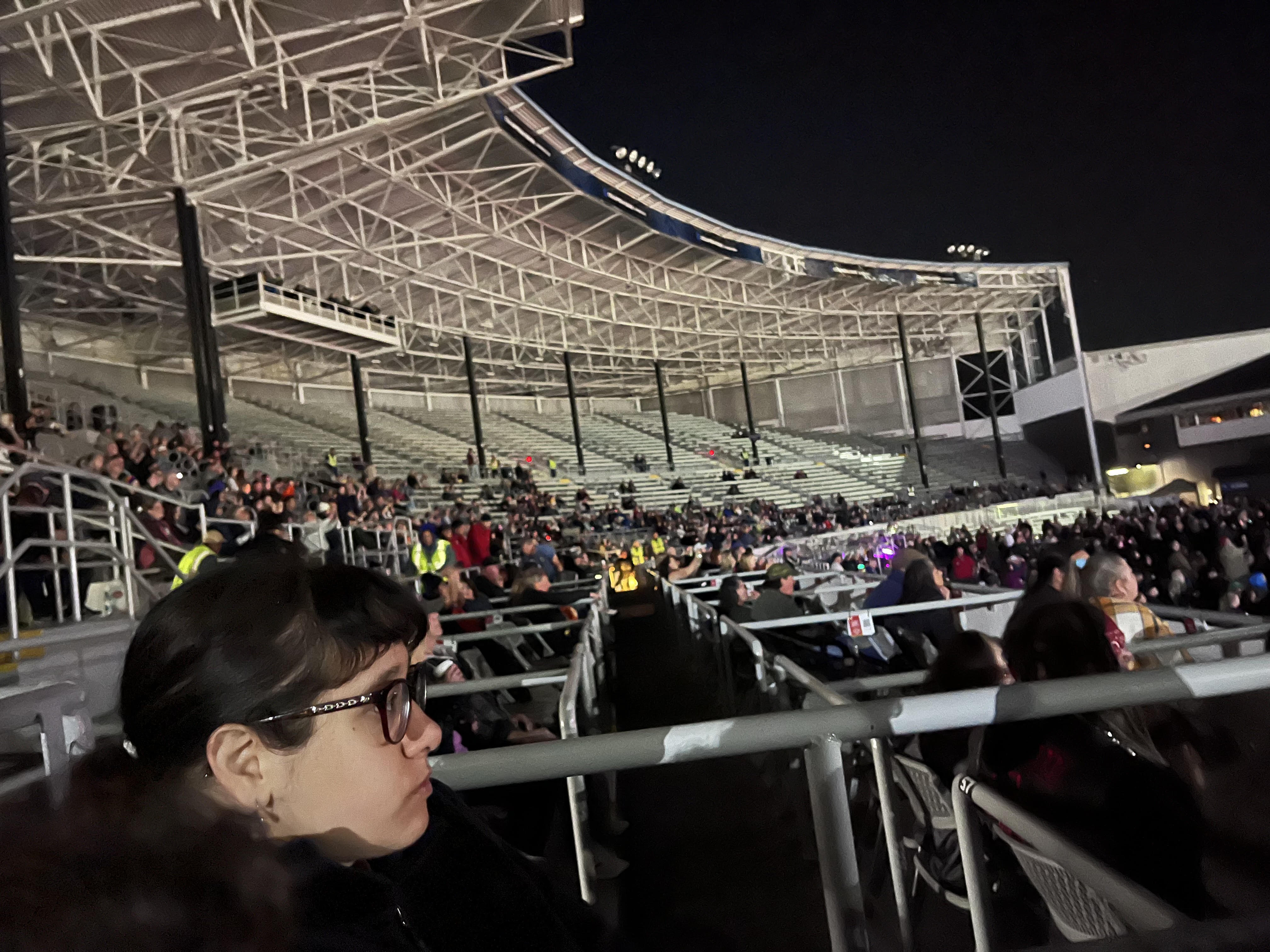
After filling our tummies with fair food, we entered the mostly empty arena. With only a few minutes left before showtime, this seemed to confirm reports that ticket sales for the tour had been slow.
Slaughter’s performance made me regret not waiting a few more weeks before writing my essay on amazing opening acts. Other than “Up All Night” (working the swing shift, this song has a lot of relevance to me), I didn't think I was very familiar with the band, but their performance surprised me. To this drummer’s ears, Mark Slaughter’s voice had aged well, and he seemed to handle the vocal gymnastics he had performed on the band’s recordings with ease.
Of particular note was the performance by drummer Jordan Cannata, who was like Animal from The Muppets come to life. I don’t think there was a point during the set where he wasn’t smiling ear to ear. His hard-hitting drumming was accented by stick flips, twirls, and other theatrics. Even as a drummer, I am often bored by a drum solo, but this was the most entertaining since Tommy Lee was in his heyday.
The opener was a headliner’s worst nightmare, as they set the bar for the evening very high. Unfortunately, Twisted Sister played limbo instead of vaulting over it.
The band sounded fine as they opened their show, but, like the show in New York, there was nothing particularly spectacular about their performance. In the video from the Astoria, they were like caged lions whose prey teased them from right outside their cage. Tonight they were housecats chasing a laser pointer.
There seemed to be surprisingly little interaction between the band members, and stage moves they have used for years were flubbed with their new singer. The two guitarists no longer seemed attached at the hip. The use of video-generated pyrotechnics was cheesy and added to the vibe of this being a tribute tour by a band that once put on legendary performances.
Bach was able to hit most of the right notes, but he lacked the depth of Snider. Dee could tell a story with the inflection of his voice, a talent his replacement could not replicate. It did not help that he frequently appeared to need the assistance of the teleprompter to remember the lyrics.
An experienced and highly qualified frontman, Bach had no problem connecting with the audience, especially those closest to the stage. His choice of an outfit with pants that seemed to pay tribute to Dee Snider’s onstage character without being overly flamboyant was a nice touch. But even a good performance wasn't enough when you are replacing one of the best in the business.
At least they sounded good…until the wheels came off the bus.
In a puzzling omission, I did not hear Bach mention Twisted Sister’s own drummer during a puzzling In Memoriam segment. What could have been a touching tribute instead played like an excuse to play Skid Row’s “I Remember You.”
The inclusion of a Skid Row song in a Twisted Sister show sounded hopelessly out of place. They did nothing to make the song their own. Even with two guitarists on stage, they brought in another guitarist to play the solo.
This was followed by “I Wanna Rock,” one of the band’s biggest commercial successes, but it felt flat near the end of a set drawn from a catalog of songs that are more rooted in punk than pop. It did, however, get the audience back on their feet.
Skid Row’s “Youth Gone Wild” should have been right up Twisted Sister’s alley if they had leaned into the song’s punk-infused attitude. Instead, they sped up the tempo and seemed to rush through it.
Closing with “We’re Not Gonna Take It,” at least sent the audience on a high note, but I suffered from the same basic problem as “I Wanna Rock.” I was surprised that they did not use the video’s intro to bring in the song. This could have served as a nice tip of the hat to Dee Snider.
With this being the last night of the fair, my guess is that the organizers were hoping that this concert would send the yearly event off with a bang. If so, the mostly empty arena and less-than-dazzling performance would indicate that it instead landed with a dud.
Dee Snider retired because he felt he couldn't give the fans the show they deserved. After seeing Twisted Sister without him, I understand why. In metal, there’s no room for the has-beens, and Twisted Sister doesn’t seem to still have the hunger needed to put on the legendary performances it once delivered.
About the Creator
Carl J. Petersen
Carl Petersen is a former Green Party candidate for the LAUSD School Board and a longtime advocate for public education and special needs families. Now based in Washington State, he writes about politics, culture, and family.
Enjoyed the story? Support the Creator.
Subscribe for free to receive all their stories in your feed.
Comments
There are no comments for this story
Be the first to respond and start the conversation.