
A Armor of War Woven With Laughter
Review of La Vita è bella

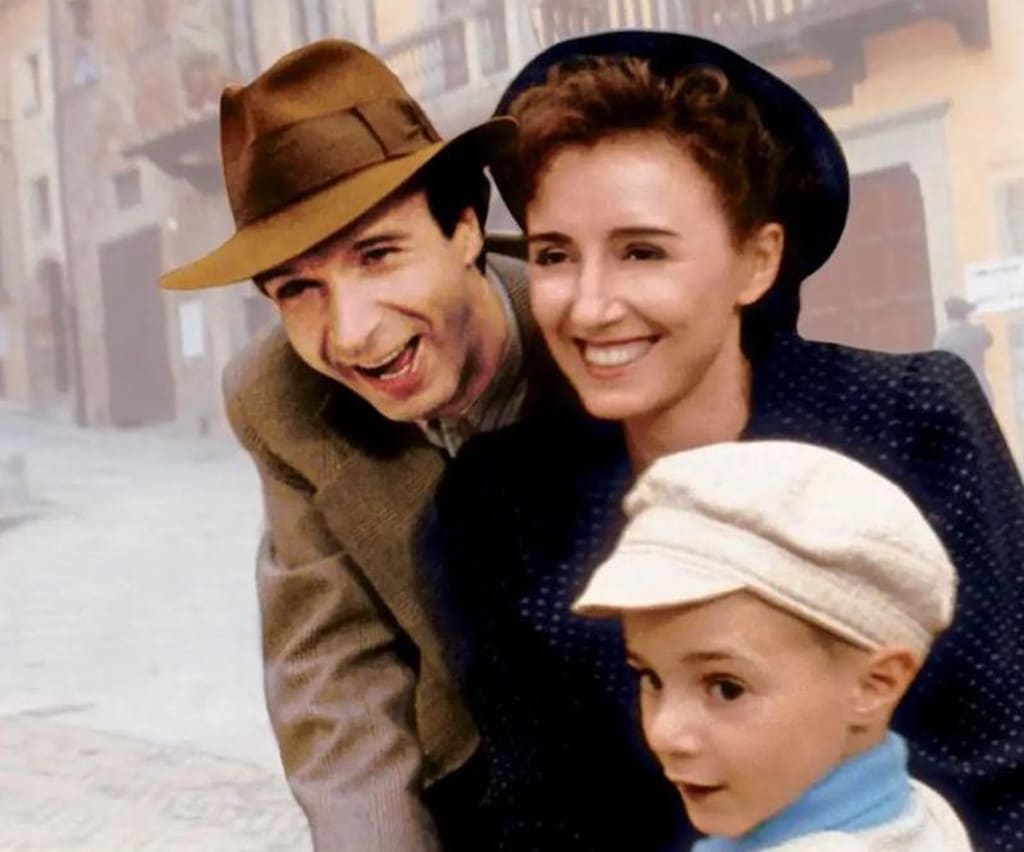
It comes as no surprise that La Vita è bella ranks among the top 6 greatest films in cinema history. This 1997 Italian masterpiece wraps the heaviest weight of war in the softest smile, and uses a “lie” woven with life to interpret the ultimate radiance of paternal love and humanity. It never dwells on the bloodshed of suffering, yet in every moment when viewers laugh through tears, they understand the heavy love and redemption hidden behind the words: Life Is Beautiful.
The story begins in a sunny small town in Italy.
Guido, a warm, witty young Jewish man, rides through the streets and wins Dora’s heart with humor and romance. He has no prominent status, but he turns ordinary days into a fairy tale with romance that makes every gesture feel magical. From his daily greeting “Buongiorno, principessa” (Good morning, princess), to winning her love with theatrical charm, to eloping with her in the rain, Guido proves: happiness is not a gift from fate, but a miracle created with heart.
Yet the iron hoof of war ruthlessly shatters this beauty.
World War II breaks out. Guido, a Jew, and his son Giosuè are forcibly sent to a concentration camp. Although not Jewish, Dora bravely chooses to go with her family. This courage to risk everything for love transcends gender and race, becoming the warmest light in the darkness.
The moment they arrive at the camp, the fairy tale ends abruptly.
Barbed wire, prison uniforms, hunger, violence — this is hell on earth.
To protect his 5‑year‑old son from being destroyed by the cruelty of war, Guido weaves a magnificent lie:
This is not a concentration camp. It is a points-based game.
Whoever earns 1,000 points wins a real tank as a prize.
Thus viewers witness the most touching performance of paternal love in cinema history.
Guido endures forced labor in the camp while acting as the “game host”, turning threats of death into “game missions” with exaggerated gestures. The Nazi gas chambers are called “showers”; harsh labor becomes “earning points”; even his son’s fear is soothed with humor. He carries bricks under the burning sun, yet returns smiling and says: “I earned tons of points today!” Exhausted late at night, he still appears energetic in front of his son.
This strength to bear pain with a smile is the most precious armor a father can give his child.
The most tearful scene is the final choice.
As the Allies approach, the Nazis prepare to flee and massacre all Jews.
Guido hides his son in a metal cabinet, repeating: “Don’t make a sound. Don’t come out. Or we lose.”
He then risks his life to search for his imprisoned wife, only to be caught by Nazi soldiers.
Within his son’s sight, Guido walks with exaggerated, comical steps, as if still playing the game — convincing his boy: “Daddy is playing, we’re going to win.”
Moments later, he is shot dead in an alley. The son watches from inside the cabinet, witnessing the “victory” of the game.
When Allied tanks enter the camp, Giosuè steps out and cheers at the sight of a real tank.
To the child, this is not the end of war — it is the prize for winning the game.
The lie Guido protected with his life preserved Giosuè’s trust in the world and his innocence through the darkest years.
This paternal love never says “I love you”, yet fulfills the promise: “I will protect you with all I have.”
The greatness of La Vita è bella lies in breaking the traditional narrative of war films.
It does not exaggerate war’s cruelty, yet we feel its horror through Guido’s smile. It does not chase attention with intense conflict, but strikes the softest part of the heart with delicate emotion.
Guido’s humor is not escape — it is resistance.
His lie is not deception — it is redemption.
In his own way, he tells his son:
Even in hell, stay optimistic.
Even facing darkness, believe in light.
The film gently tells us: life may be full of suffering, but we can choose to weave a “beautiful” shield for ourselves and our loved ones with love and optimism.
Guido is not a hero. He is just an ordinary father and husband — yet in despair, he shows the brightest side of humanity. He teaches us:
True strength is not fearlessness, but smiling even when afraid.
True love is not sweet words, but guarding someone’s innocence and hope with your life in danger.
Nearly 30 years later, La Vita è bella still moves millions.
Because it speaks not only of paternal love in war, but of how every person chooses to face life’s hardships.
When we meet setbacks, difficulties, and unfairness, we can be like Guido:
use humor to ease anxiety, love to warm others, and optimism to fight despair.
As the film conveys:
Life may not be perfect, but with love, hope, and courage in the heart, we can live our own beautiful life.
Its place among cinema’s top 6 comes not from fancy effects or complex plots, but from emotional power that touches the soul.
It makes us believe:
Even in the darkest hour, the light of humanity lights the way.
Even in the cruelest world, love and optimism create miracles.
May we all, like Guido, in the “concentration camps” of life, weave our own “beautiful lies” for ourselves and those we love, guard the innocence and hope in our hearts, and live the most beautiful life possible.
About the Creator
Enjoyed the story? Support the Creator.
Subscribe for free to receive all their stories in your feed.
Comments
There are no comments for this story
Be the first to respond and start the conversation.