
Why Museums and Cultural Institutions Are Turning Toward The Architecture of Identity
A Monumental Investigation into the Human Condition
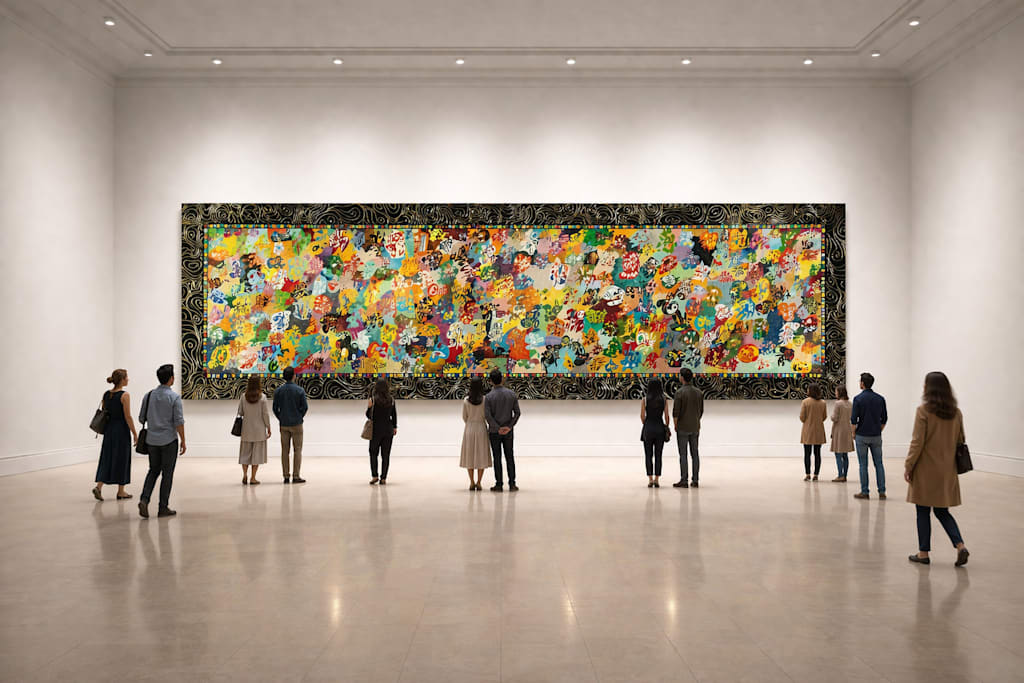
In an era defined by migration, technological transformation, cultural fragmentation, and the constant renegotiation of belonging, museums and cultural institutions face a profound challenge: how can art help us understand what it means to be human in an increasingly interconnected world?
Developed by El Arte Monumental, The Architecture of Identity is a major artistic and cultural research initiative that examines the invisible structures through which humanity constructs identity, belonging, memory, and collective meaning.
The Architecture of Identity responds directly to this question.
More than a collection of paintings, it is a large-scale visual research project that examines identity as a constructed system—an evolving architecture shaped by memory, belief, culture, history, and collective consciousness. Through monumental abstraction, the series proposes that identity is not fixed or singular, but a dynamic structure continuously built and rebuilt across generations.
For museums, foundations, galleries, universities, and cultural organizations seeking exhibitions that engage contemporary global discourse, The Architecture of Identity offers a rare intersection of artistic innovation, philosophical inquiry, and public relevance.
Beyond Representation
Traditional portraiture seeks to depict individuals. The Architecture of Identity seeks to reveal the invisible frameworks through which individuals and societies define themselves.
The collection abandons direct representation in favor of layered abstract systems that function as visual architectures. Geometric structures, organic forms, symbolic fields, and energetic spatial compositions create environments rather than images.
These works do not portray identity—they construct experiences of identity.
Viewers encounter paintings as spatial phenomena that unfold through movement, observation, and reflection. The result is an immersive encounter that encourages audiences to consider how identities emerge from larger networks of culture, history, and shared human experience.
A Global Conversation
One of the most significant challenges facing contemporary institutions is the need to present exhibitions capable of speaking across cultural boundaries.
The Architecture of Identity was conceived precisely for this purpose.
The collection addresses universal questions:
Who are we?
How do societies construct belonging?
What connects individuals across nations, religions, and ideologies?
How do collective memories shape future civilizations?
Can humanity develop a shared cultural consciousness?
Because the works avoid literal narrative and national symbolism, they remain accessible to diverse audiences while retaining intellectual depth.
This universality allows institutions to position the exhibition within conversations surrounding cultural identity, migration, globalization, intercultural dialogue, social cohesion, and the future of humanity.
Monumental Scale for Contemporary Spaces
Museums increasingly seek exhibitions capable of transforming architectural environments rather than simply occupying them.
The paintings within The Architecture of Identity are conceived at a monumental scale, enabling them to function as architectural interventions within galleries, museums, public institutions, and cultural centers.
Each work establishes a powerful physical presence that alters the visitor's perception of space.
The exhibition can be presented as:
A museum-scale solo exhibition
A thematic institutional exhibition
A biennial or triennial project
A cultural diplomacy initiative
A university research exhibition
A public engagement and educational program
Its flexibility allows curators to adapt the project to different architectural and cultural contexts while maintaining conceptual coherence.
Art as Research
Increasingly, leading museums are embracing artistic research as an essential component of contemporary practice.
The Architecture of Identity collection operates simultaneously as an artistic and intellectual investigation.
The project draws upon themes from:
Cultural anthropology
Philosophy
Sociology
Political theory
Collective memory studies
Religious studies
Psychology
Systems theory
This interdisciplinary framework provides institutions with opportunities to develop accompanying educational programs, lectures, symposia, publications, and academic partnerships.
The exhibition therefore functions not only as a visual experience but as a platform for dialogue and knowledge production.
Relevance for Contemporary Audiences
Public expectations of museums continue to evolve.
Visitors increasingly seek experiences that address urgent social questions while offering meaningful personal reflection.
The Architecture of Identity meets this demand by engaging issues central to contemporary life:
Identity and belonging
Cultural diversity
Social fragmentation
Collective memory
Human interconnectedness
Global citizenship
The future of civilization
The exhibition invites audiences to move beyond division and consider identity as a shared human architecture rather than a source of separation.
In doing so, it creates opportunities for reflection, conversation, and cultural understanding.
A Vision for the Future
At its core, The Architecture of Identity research proposes a hopeful vision.
While contemporary discourse often emphasizes conflict between cultures, ideologies, and communities, this collection explores the structures that unite humanity beneath apparent differences.
The works suggest that identity itself may be understood as a living architecture—one continuously shaped by relationships, histories, and collective aspirations.
For museums and institutions seeking projects that combine visual impact with intellectual significance, The Architecture of Identity offers a compelling opportunity to engage audiences in one of the most important conversations of our time.
It is not merely an exhibition of paintings.
It is an invitation to examine the invisible structures through which humanity understands itself.
And in doing so, to imagine new forms of connection across cultures, generations, and civilizations.
About the Creator
Daniel Varzari
American art curator.
Enjoyed the story? Support the Creator.
Subscribe for free to receive all their stories in your feed.
Comments
There are no comments for this story
Be the first to respond and start the conversation.