
Why Museums and Cultural Institutions Are Turning Toward The Architecture of Conflict
A Monumental Investigation into the Structures of Human Conflict
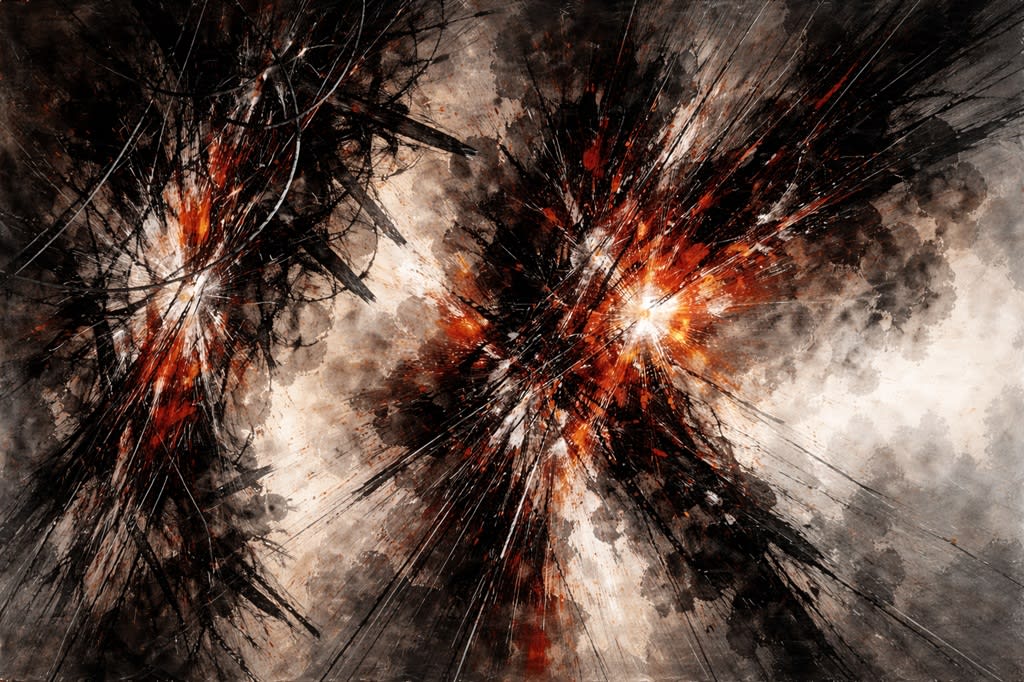
Developed by El Arte Monumental, The Architecture of Conflict is a major artistic and cultural research project examining conflict as one of the fundamental forces shaping human civilization.
“The Architecture of Conflict examines war not as isolated historical rupture, but as a continuous structural condition embedded within human civilization. The works draw from key historical conflicts spanning antiquity to the present, not as narrative reconstructions but as pressure points within a recurring system of violence. The series translates conflict into formal conditions—tension, fragmentation, compression, and collapse. The battlefield becomes surface; the event becomes condition. What remains is not representation, but the residue of force—distributed across composition, rhythm, and rupture.”
(El Arte Monumental, Catalogue: 6 WARS — The Architecture of Conflict, 2026)
Rather than depicting specific battles or historical events, the collection explores the underlying systems through which conflict emerges, evolves, and transforms societies. Through monumental abstraction, the works investigate power, ideology, memory, territoriality, belief, identity, and the persistent tensions that have accompanied humanity throughout history.
At a time when societies worldwide are confronting political polarization, cultural fragmentation, migration crises, historical trauma, and geopolitical instability, museums and cultural institutions are increasingly seeking exhibitions capable of addressing these realities through thoughtful and meaningful artistic engagement.
The Architecture of Conflict offers precisely such a platform.
It is not an exhibition about war.
It is an exhibition about the structures that produce conflict and the human consequences that follow.
The Vision of El Arte Monumental
El Arte Monumental was founded on the belief that art can function as a tool for investigating the invisible systems that shape human existence.
Its research explores identity, belief, conflict, memory, collective consciousness, and the evolving architecture of civilization itself.
Within this framework, The Architecture of Conflict represents one of the foundation's principal studies, examining how conflict becomes embedded within cultural, political, psychological, and historical structures.
The project seeks not to glorify violence but to understand it.
Through abstraction, it transforms conflict from an event into an object of reflection and critical inquiry.
Beyond Historical Narrative
Most exhibitions about conflict focus on historical documentation.
The Architecture of Conflict approaches the subject differently.
The collection abandons direct representation in favor of complex visual systems that reveal conflict as an architectural condition.
Layered compositions, fragmented structures, opposing forces, disrupted geometries, and monumental spatial tensions create visual environments that evoke confrontation, transformation, collapse, resistance, and renewal.
The works function as symbolic landscapes in which viewers encounter the psychological and cultural dimensions of conflict rather than its literal imagery.
This approach allows audiences from diverse cultural backgrounds to engage with the subject through universal human experience.
Conflict as a Human Condition
Conflict has shaped every civilization.
It has influenced borders, religions, political systems, economies, migrations, technologies, and collective identities.
The Architecture of Conflict asks:
Why does conflict persist throughout history?
How do societies construct enemies and alliances?
What role does memory play in sustaining conflict?
How does power shape narratives of victory and defeat?
Can humanity develop new structures capable of reducing violence and division?
These questions place the exhibition within some of the most urgent discussions facing contemporary society.
Relevance for Contemporary Institutions
Museums increasingly serve as spaces for dialogue rather than repositories of objects alone.
Institutions are expected to engage with complex social realities while fostering public understanding and critical reflection.
The Architecture of Conflict addresses themes that resonate globally:
Collective memory
Historical trauma
Political systems
Migration and displacement
Cultural division
National identity
Human rights
Peacebuilding and reconciliation
The exhibition offers institutions an opportunity to engage audiences in meaningful conversations about the causes and consequences of conflict without relying on political partisanship or historical simplification.
Monumental Scale and Spatial Experience
The paintings are conceived at an architectural scale, transforming galleries into immersive environments.
Rather than illustrating conflict, the works create spatial experiences through which visitors physically encounter tension, fragmentation, instability, resilience, and reconstruction.
The exhibition can be adapted to:
Contemporary art museums
Historical museums
Cultural foundations
International biennials
Universities
Research institutions
Public cultural programs
Its flexibility allows curators to connect the project with local histories while maintaining universal relevance.
Art as Research
As museums increasingly embrace artistic research, The Architecture of Conflict provides a framework that bridges visual practice and intellectual inquiry.
The project intersects with:
History
Sociology
Political theory
Anthropology
Memory studies
Peace and conflict studies
Psychology
Cultural studies
This interdisciplinary foundation creates opportunities for lectures, conferences, educational programs, publications, and academic partnerships.
The exhibition functions simultaneously as a visual experience and a platform for public dialogue.
A Necessary Conversation
Conflict remains one of humanity's most persistent realities.
Yet understanding conflict requires more than historical analysis.
It requires reflection on the structures that produce division and the possibilities that exist beyond it.
The Architecture of Conflict invites audiences to examine not only the history of conflict but its continuing presence within contemporary society and within ourselves.
Through monumental abstraction, the exhibition transforms conflict into a subject of contemplation, encouraging visitors to consider how humanity might move from cycles of confrontation toward new forms of coexistence.
A Platform for Institutional Collaboration
For museums, foundations, galleries, and universities seeking exhibitions that combine visual impact, intellectual depth, and contemporary relevance, The Architecture of Conflict offers a unique opportunity.
Presented by El Arte Monumental, the project stands as both an artistic achievement and an evolving research platform dedicated to understanding one of the defining forces of human civilization.
It is not simply an exhibition.
It is an invitation to investigate the architecture of conflict itself—and through that investigation, to imagine the architecture of peace.
“Rather than depicting specific events or narratives, the works translate the psychological, political, and cultural architectures of conflict into abstract forms, revealing the invisible systems through which power, resistance, and transformation emerge” (El Arte Monumental, The Architecture of Conflict Collection, 2026).
Further Information
Collection:
The Architecture of Conflict Collection
Research Catalogue:
The Architecture of Conflict Catalogue
Exhibitions Program:
About the Creator
Daniel Varzari
American art curator.
Enjoyed the story? Support the Creator.
Subscribe for free to receive all their stories in your feed.
Comments
There are no comments for this story
Be the first to respond and start the conversation.