
When the Architect Burns His Own Cathedral
Why INTJs Surrender to Addiction When Their Energy Runs Out
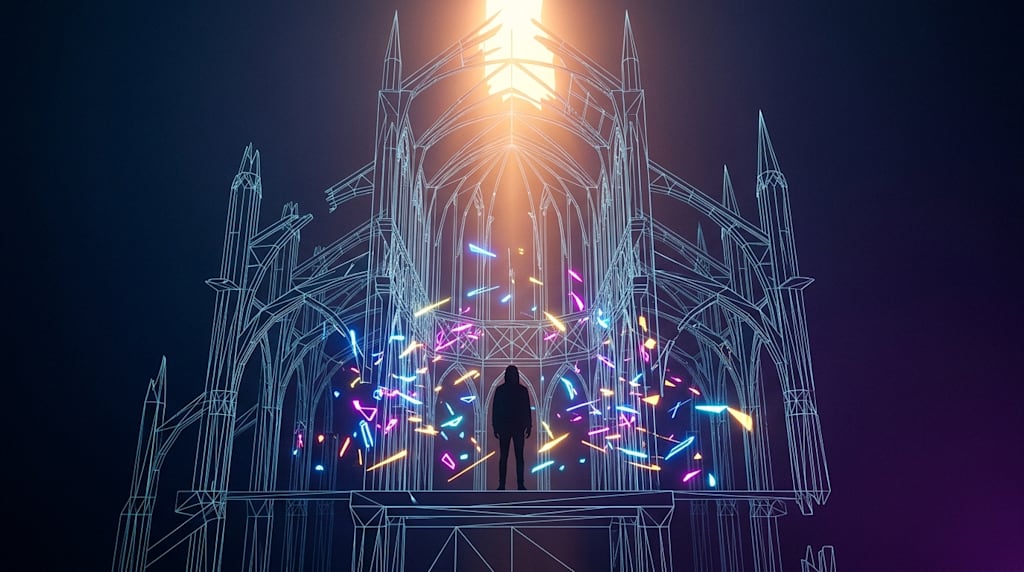
Inside the INTJ's mind, a Gothic cathedral stands by nature.
Ni sketches the skyline's blueprint. Te lays every brick and buttress in its ordained place. In this architecture, every rose window must be symmetrical, every flying buttress must bear its load in perfect equilibrium. Control is the cathedral's only foundation.
But when energy runs low, the foundation begins to sink.
Ni no longer rehearses the future. It descends into an endless corridor of mirrors. Te no longer wields its axe. It scatters into a heap of rusted parts. And then a tragedy of profound irony unfolds: the architect who once despised cheap ornamentation begins to frantically string neon lights across the sanctuary walls.
That is addiction.
That garish, cheap light pollution is the last rational act of self‑preservation—a desperate attempt to keep the entire structure from collapsing into total darkness.
I
For the INTJ, exhaustion is never a bodily groan.
It is an avalanche of cognitive order.
For others, rest means shutting down. For the INTJ, rest means system corruption. When energy bottoms out, we lose the ability to project the present into the future. Every decision blurs. Every second of time slips through our fingers like sand. This loss of control—this psychic撕裂—is far more devastating than any physical pain.
The INTJ harbors a pathological loathing for meaninglessness. We operate under a near‑obsessive compulsion: every moment must be filled; the CPU must remain running.
When high‑intensity strategic planning (Te) fails to engage, the brain activates an emergency protocol: if high‑quality output is impossible, flood the bandwidth with low‑quality, high‑frequency stimulation.
And so the trough arrives—all‑night binges of mindless short‑form video, devouring millions of words of web novels in a single sitting, sinking into repetitive loops of strategy games, even chasing sensory stimulation at dangerous edges.
This is not depravity. This is a cognitive tourniquet.
We use dopamine as temporary mortar to patch the cracks left by a collapsed belief system.
II
The INTJ cannot easily submit to pure emotional release.
Crying. Venting. Complaining. To us, these are ineffective entropy—they solve nothing; they only expose our cards.
But addiction is different. It offers a perfectly closed logical loop:
Scrolling short‑form video—each swipe primes the brain for an unknown stimulus, dopamine firing with surgical precision.
Binge eating—chewing is a primitive, effective soothing ritual; the spike in blood sugar instantly delivers a signal of "survival secured."
Staying up late—in the dead silence, the world finally stops demanding output from the INTJ, and time becomes a privately compressible commodity.
We descend with a judging eye.
We know better than anyone what these behaviors will cost us the next day—the emptiness, the physical revulsion. But precisely because we are too aware of how much energy actual reconstruction demands, we are all the more desperate for a way to downclock our thinking in this moment.
And so Se (extraverted sensing) —the INTJ's inferior function—makes its distorted entrance. It hijacks the senses, driving us to chase raw physical pleasure in the here and now as an escape from the weight of responsibility in the there and then.
III
The cruelest core of low‑energy addiction lies in the INTJ's interior interrogation chamber—a room with no doors, no windows, and no exit.
When Te fails, Ni loses its brakes. It spirals inward without end, deconstructing everything into meaninglessness. At the same time, Fi (introverted feeling) awakens—a rusted blade that begins its repetitive questioning.
No dialogue. No narrator's voice announcing, "he felt pain."
Just an INTJ at 3 AM, phone face‑down on the pillow, staring at the ceiling, lying motionless for seventeen minutes. Then picking the phone back up.
This is what the Ni‑Fi loop looks like in reality.
More devastating still: the INTJ conducts a high‑intensity self‑trial while in the throes of addiction. A cold prosecutor lives inside the mind, stuffing junk food into the stomach while smirking in the subconscious:
You can't even control this.
You burn whatever little willpower remains to fight the behavior. When you fail, shame floods in. Shame drains more energy. Depleted energy intensifies the craving.
The deadlock is complete.
IV
The INTJ's greatest cognitive error is believing that lying in bed scrolling through a phone counts as rest.
It does not.
For a Ni‑dominant INTJ, passively receiving fragmented information is the most energy‑depleting activity there is. The brain automatically tries to extract patterns from the random noise. The CPU overheats while spinning in neutral.
Genuine rest is active rest. It is a transfer of control to a different object, not a surrender.
For the addictive impulses that arise during low energy, there is a protocol built on the INTJ's own底层 logic. I call it the Ruins Reconstruction Protocol. Simple. Three rules.
Rule One: Pre‑commit "Sacred Decay Time"
Do not try to quit addiction cold turkey. That violates the law of energy conservation.
Schedule a daily 20‑minute system maintenance window. During these 20 minutes, indulge completely—scroll mindless videos, eat junk food, do nothing. But set an alarm. When time's up, stop.
And within those 20 minutes, no self‑judgment is permitted.
This is a rationally sanctioned "controlled micro‑collapse." When you grant it legitimacy, it loses its power to consume you.
Rule Two: Upgrade the Stimulus Tier
If you must consume, consume things that have logical structure but no connection to your real life:
Hard sci‑fi worldbuilding bibles. Complex board game rulebooks. Architectural history diagrams. In‑depth film criticism.
This still engages Se, but it lightly recruits Ni for pattern recognition. It wraps your sensory intake in a layer of intellectual armor, which drastically reduces the emptiness that follows.
Rule Three: Deploy Somatic Anchors to Disrupt the Internal Tribunal
When you sense the Ni‑Fi loop about to engage, immediately perform a small action with clear physical feedback:
Run cold water over your wrists for ten seconds.
Do five deep squats.
Empty an entire drawer and arrange its contents again.
The point is not the value of the action. It is its completion. When you finish a physical task with a beginning and an end, you preserve a spark of Te. This sends a signal to the brain:
The tower is still operational. The system has not crashed.
V
The INTJ's life is, by nature, a war against entropy.
We often mistake true strength for the absence of collapse. But the most精密 instruments require scheduled maintenance shutdowns. Low‑energy addictive behavior is simply the system sounding its overload alarm.
The mature INTJ is not the one who never touches low‑grade pleasure. It is the one who can move in and out of low‑grade states with grace.
When you can look calmly at the version of yourself struggling in the abyss and say:
"I know you're tired. I'm letting you get through tonight on this cheap dopamine."
—you have reclaimed genuine control.
Control is not sealing every leak. It is knowing, when the flood comes, how to channel the water—and trusting that when the waters recede, you will still possess the ability to draw newer, stronger blueprints.
On the ruins, there is no shame.
When energy returns, those soot‑stained INTJ hands will still build towers that reach the sky.
Because for the INTJ, rebuilding is our birthright. But allowing ourselves to temporarily crumble—that is wisdom earned.
Afterword
After I typed the final period, I stood up.
I took every dish out of the dishwasher and rearranged them by size.
Not OCD.
Just confirming: I finished something.
Then I sat on the couch.
Did not pick up my phone.
Outside the window, the sky was just beginning to lighten. I didn't stay up tonight.
This is the best evidence an INTJ can give themselves.
About the Creator
Jin
Writer of reamstories
https://reamstories.com/jin
Enjoyed the story? Support the Creator.
Subscribe for free to receive all their stories in your feed. You could also become a paid subscriber, letting them know you appreciate their work.
Comments
There are no comments for this story
Be the first to respond and start the conversation.