
War System VI: Convergence at Ukraine War Exhibition
The Architecture of Contemporary Conflict and Global Interdependence
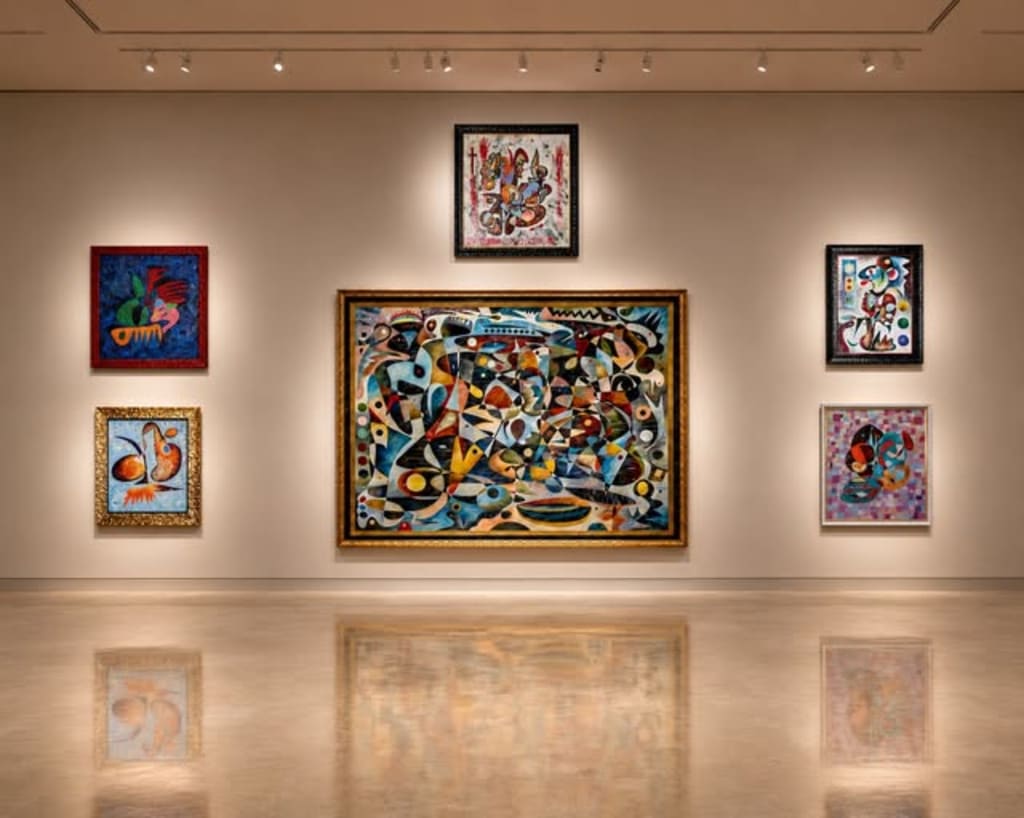
War System VI: Convergence at Ukraine War represents the culmination of the 6 WARS project and the most structurally complex exhibition within the series. While the preceding exhibitions examined historical conflicts through systems of conquest, transformation, ideological confrontation, and global warfare, this exhibition addresses a conflict that remains unresolved. Rather than presenting war as a completed historical event, it investigates conflict as an active and evolving condition operating simultaneously across military, political, economic, technological, informational, and humanitarian domains.
At the center of the installation stands Ukraine War (2022–2025), a monumental composition that functions as the principal field of convergence. Unlike traditional representations of warfare, the painting does not depict combat. Instead, it constructs an environment of intersecting trajectories, fragmented structures, and competing forces whose relationships remain unstable and unresolved. The composition reflects a condition in which multiple systems occupy the same space, generating continuous negotiation between expansion, resistance, adaptation, and transformation.
What distinguishes this exhibition from the previous War Systems is the introduction of a vertical axis through the placement of Brothers in Struggle (2023) above the central work. Occupying the highest position within the installation, the painting functions as a symbolic horizon rather than a supporting element. It introduces the human dimension that precedes political alignment and military confrontation. Positioned above the field of conflict, the work suggests that shared histories, cultural proximities, and human relationships remain present even when political systems produce division. The painting operates as a reminder that conflict emerges within existing structures of connection rather than between isolated entities.
The lateral works establish a broader geopolitical framework. Joe Biden (2025), Putin (2014), Xi Jinping (2025), and Zelenski (2024) do not function as portraits in a conventional sense. Instead, they represent distinct centers of influence operating within an interconnected global system. Each painting examines a different configuration of authority, strategy, national interest, political agency, and international power. Their significance emerges not individually but through their relationships to one another and to the central work.
The installation resists narrative interpretation and historical illustration. Meaning emerges through the interaction of multiple fields of influence rather than through a linear account of events. The viewer encounters a system of overlapping structures in which military operations, diplomacy, information, economics, identity, and sovereignty become inseparable. The exhibition reveals conflict as a condition extending beyond the battlefield into the broader architecture of contemporary global relations.
Formally, the exhibition achieves a remarkable balance between horizontal and vertical organization. The surrounding works establish a network of geopolitical relationships, while the elevated position of Brothers in Struggle introduces an ethical and human dimension that transcends strategic calculations. This dual structure transforms the installation from a study of war into an examination of the systems through which conflict is experienced, interpreted, and sustained.
As the concluding chapter of the 6 WARS project, War System VI: Convergence at Ukraine War expands the series beyond historical analysis toward a reflection on the nature of contemporary conflict itself. It proposes that modern warfare can no longer be understood solely through military events or political decisions. Instead, it emerges as a complex architecture of interconnected systems operating across national, technological, cultural, and human domains.
The exhibition's greatest achievement lies in its ability to visualize uncertainty. Unlike earlier wars that can be interpreted through historical outcomes, the Ukraine War remains an evolving condition. By refusing closure, the installation captures the defining characteristic of contemporary conflict: a state of continual negotiation in which the future remains unresolved and the architecture of global power remains in motion.
About the Creator
Daniel Varzari
American art curator.
Enjoyed the story? Support the Creator.
Subscribe for free to receive all their stories in your feed.
Comments
There are no comments for this story
Be the first to respond and start the conversation.