
War System V: Convergence at Hawai Sakusen
Imperial Identity and the Architecture of Strategic Destiny
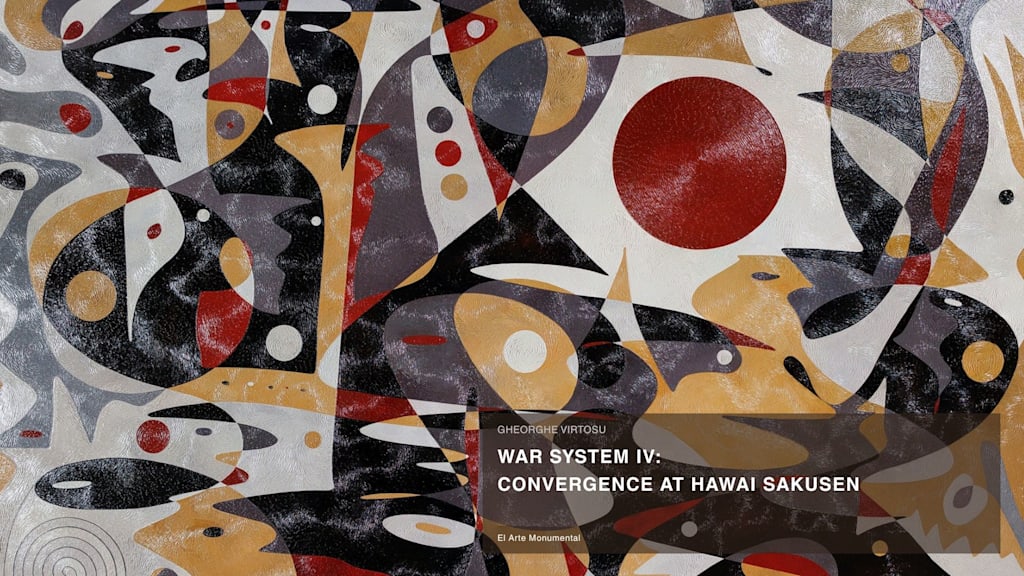
War System V: Convergence at Hawai Sakusen marks a significant shift within the War Systems series. Whereas previous exhibitions examined the formation of power, its transformation, fragmentation, and global reorganization, this exhibition investigates the cultural and ideological foundations through which military action becomes possible. The focus is not the event itself, but the structures of belief, authority, and identity that precede and sustain it.
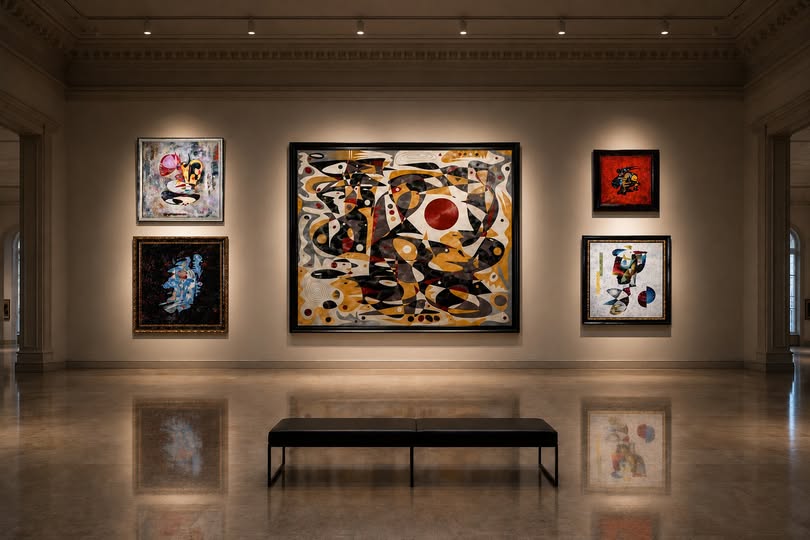
The composition is distinguished by a complex balance between concentration and dispersion. Multiple trajectories intersect without establishing a stable hierarchy, generating a field in which strategic coordination and uncertainty coexist. The viewer encounters a structure of converging intentions rather than a representation of military engagement. Conflict appears as a process of organization operating across multiple levels simultaneously.
The surrounding works expand this investigation through distinct but interconnected perspectives.
The Japanese Spirit introduces the exhibition's most direct engagement with collective identity. Suspended within a luminous field, the central structure appears simultaneously stable and fluid, suggesting the persistence of cultural values beyond specific historical circumstances. Rather than functioning as an expression of nationalism, the work examines how symbolic systems contribute to collective cohesion and historical continuity.
Emperor Kōtoku introduces a different dimension of authority. The composition combines concentration and expansion, producing a visual tension between centralized power and the broader structures through which legitimacy is sustained. The painting is less concerned with an individual ruler than with the mechanisms through which authority becomes institutionalized and transmitted across generations.
Among the surrounding works, Female Samurai Warrior is perhaps the most distinctive. Its reduced scale and concentrated composition introduce an intimate counterpoint to the monumental structures elsewhere in the exhibition. The painting shifts attention from state power toward personal commitment, discipline, and sacrifice. It broadens the exhibition's examination of conflict by introducing the individual as a participant within larger cultural systems.
Emperor Hirohito occupies a particularly important position within the installation. The work neither glorifies nor condemns its subject. Instead, it visualizes leadership as a condition of mediation between competing forces. The surrounding field appears simultaneously ordered and unstable, suggesting the tensions inherent in maintaining authority during periods of historical transformation. The painting's ambiguity becomes one of its principal strengths.
What distinguishes War System V from the previous exhibitions is its emphasis on cultural and symbolic structures. Gaugamela focused on the formation of power. Waterloo examined its transformation. World War I explored systemic fragmentation. World War II investigated global reorganization through ideological confrontation. Hawai Sakusen, by contrast, turns attention toward the underlying systems of belief through which political and military action acquire meaning.
The installation reinforces this shift. The surrounding works do not operate primarily as opposing forces but as interconnected dimensions of a larger cultural architecture. Authority, identity, tradition, sacrifice, and strategic purpose circulate around the central painting, creating a field in which military conflict appears inseparable from the symbolic structures that support it.
The exhibition's greatest achievement lies in its ability to transform a specific historical operation into a broader examination of collective consciousness. Historical reference remains present, but it functions as a framework rather than a subject. The paintings are less concerned with what happened than with the systems through which historical action becomes imaginable.
Ultimately, War System V: Convergence at Hawai Sakusen succeeds as a study of the relationship between culture and power. Through abstraction, scale, and spatial organization, the exhibition proposes that strategic conflict emerges not only from political decisions or military capabilities, but also from deeper structures of identity, belief, and historical imagination. Its contribution lies in revealing how those invisible architectures continue to shape the course of history.
About the Creator
Daniel Varzari
American art curator.
Enjoyed the story? Support the Creator.
Subscribe for free to receive all their stories in your feed.
Comments
There are no comments for this story
Be the first to respond and start the conversation.