
War System IV: Convergence at World War II
Total War and the Reconfiguration of Global Power
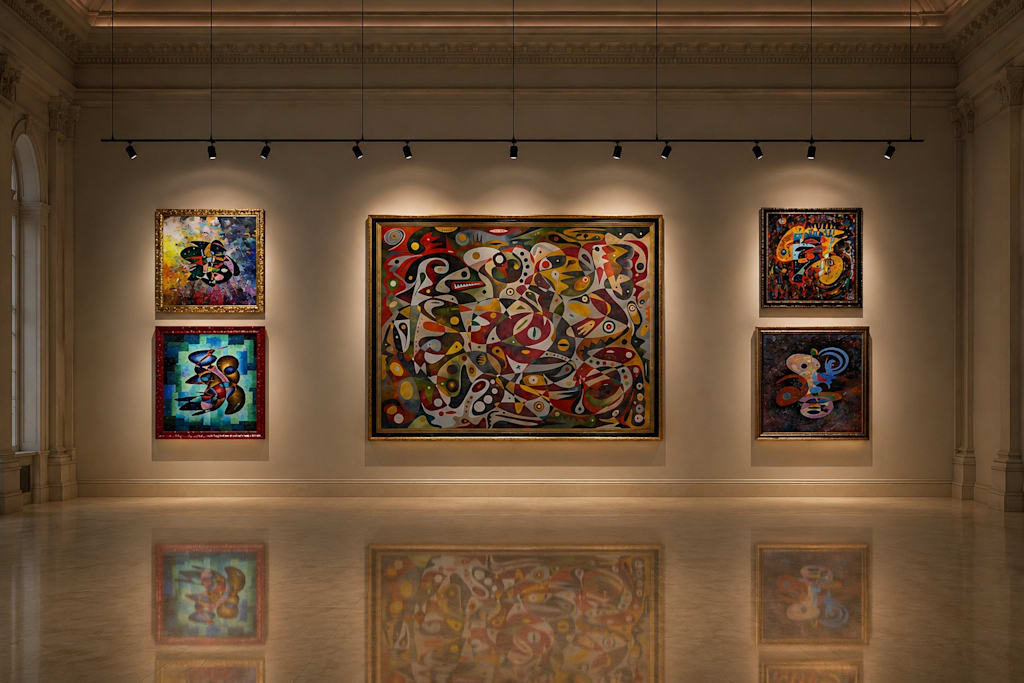
If War System III: Convergence at World War I examined the fragmentation of established systems, War System IV: Convergence at World War II investigates what follows when those fractures evolve into a struggle for global reorganization. The exhibition is not primarily concerned with military operations or historical chronology. Instead, it explores how competing ideologies, political leadership, and structures of power converge within a single field of conflict whose consequences extend far beyond the battlefield.
At the centre of the installation stands World War II (2006–2008), a monumental painting whose visual density immediately distinguishes it from the preceding exhibitions. Whereas World War I dispersed authority across a fragmented field, World War II appears more concentrated, more compressed, and more confrontational. Forms collide, overlap, and compete for dominance within a tightly organized composition. The painting generates a sense of relentless pressure, as if multiple systems are attempting to occupy the same space simultaneously. The result is a visual structure that conveys totalization rather than fragmentation—a world in which political, military, and ideological forces have become inseparable.
The surrounding works function as distinct centres of influence operating around this larger field. Their arrangement creates a system of competing visions rather than a collection of individual portraits. Although each work bears the name of a historical figure, the paintings resist biographical interpretation. Instead, they examine different configurations of authority, leadership, and ideological projection.
Adolf Hitler is perhaps the most visually aggressive work in the exhibition. Set against a dark and volatile environment, the composition appears compressed within itself, generating an atmosphere of intensity and containment. The painting conveys a force that seeks expansion while simultaneously consuming its own structure. Rather than presenting a historical individual, it visualizes the destructive concentration of ideological power.
Opposite it, Winston Churchill introduces a different type of authority. The composition is more open and spatially balanced, creating an impression of resilience rather than domination. The work functions less as an image of command and more as a structure of endurance. Within the exhibition, it acts as a counterweight to the forces of destabilization operating elsewhere.
Franklin D. Roosevelt occupies a distinct position within the installation. The luminous and expansive field surrounding the central form creates a sense of projection beyond immediate conflict. Compared with the darker works nearby, the painting appears outward-looking, suggesting coordination, alliance, and strategic reconstruction. It introduces a language of future orientation into an exhibition otherwise dominated by confrontation.
The most structurally enigmatic of the satellite works is Stalin. The painting reduces authority to a compact arrangement of interacting forms suspended within a dark field. Unlike the expansive projection of Roosevelt or the volatility of Hitler, the work suggests opacity, control, and concentration. Its ambiguity becomes one of its strengths, allowing power to appear simultaneously stable and unpredictable.
The installation succeeds because it does not present these figures as protagonists within a historical narrative. Instead, they function as symbolic structures operating within a larger system. The exhibition avoids reducing World War II to personalities while acknowledging that leadership, ideology, and state power became inseparable components of global conflict.
Viewed within the broader War Systems sequence, the exhibition marks a significant development. If Gaugamela explored the formation of power, Waterloo examined its transformation, and World War I revealed its fragmentation, then World War II investigates the attempt to reorganize a fractured world through competing visions of political order. The central question is no longer who possesses power, but what form power takes when conflict becomes global in scale.
The exhibition's strongest achievement lies in its capacity to translate total war into a visual language of compression, confrontation, and systemic interaction. Rather than depicting destruction directly, the paintings construct an environment in which opposing forces become locked within a shared structure from which no element can be isolated. History is presented not as a sequence of events but as a field of competing systems struggling to define the future.
Ultimately, War System IV: Convergence at World War II is less a study of war than a study of global reconfiguration. Through abstraction, scale, and spatial organization, the exhibition proposes that World War II was not merely a conflict between nations but a struggle over the architecture of the modern world itself.
About the Creator
Daniel Varzari
American art curator.
Enjoyed the story? Support the Creator.
Subscribe for free to receive all their stories in your feed.
Comments
There are no comments for this story
Be the first to respond and start the conversation.