
War System III: Convergence at World War I Exhibition
The Architecture of Systemic Collapse
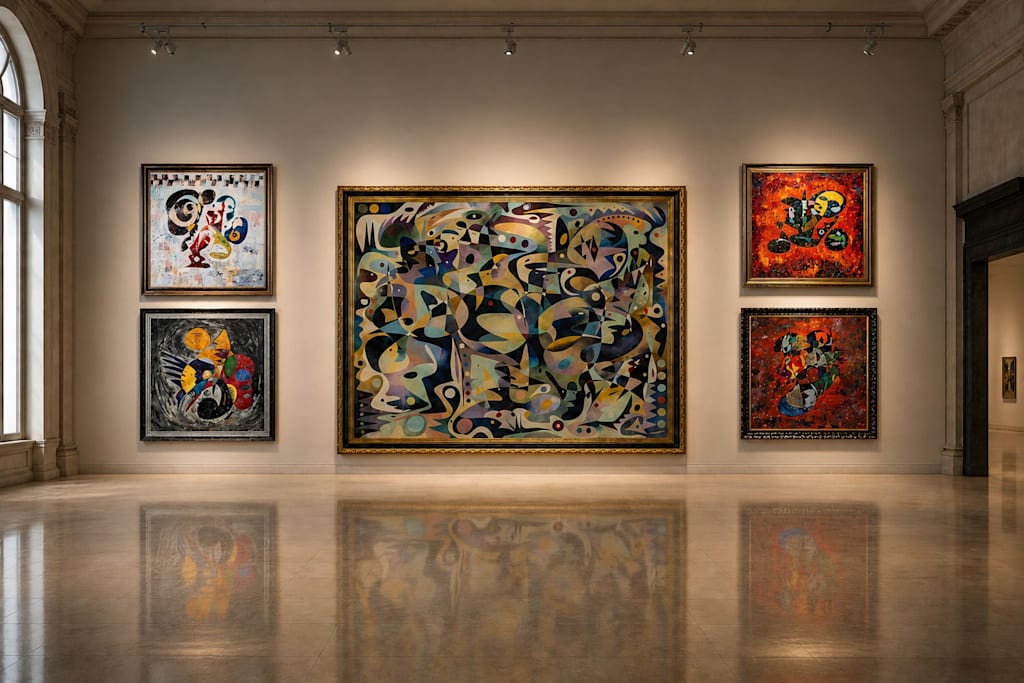
The most striking achievement of War System III: Convergence at World War I is its refusal to reduce the First World War to a story of leaders, nations, or military campaigns. Instead, the exhibition presents war as a condition produced by interacting systems whose complexity exceeds the intentions of any individual participant. Through five paintings arranged around a monumental central work, the exhibition transforms historical conflict into a visual study of fragmentation, instability, and systemic convergence.
At the centre of the installation, World War I (2004–2006) dominates the space both physically and conceptually. Unlike traditional battle paintings, however, it offers no focal event and no recognizable hierarchy. Forms emerge and dissolve across the surface in a dense network of overlapping structures, producing an image that resists stable orientation. The eye moves continuously without arriving at a definitive centre. This absence of visual authority becomes the painting’s principal statement. Conflict appears not as an action directed by identifiable actors but as a field of competing forces operating simultaneously across the composition.
The surrounding works function less as supporting narratives than as individual pressures acting upon the central system. Their placement around the monumental painting creates a visual structure in which causes, ideologies, ambitions, and disruptions appear to circulate around a larger condition of instability.
World’s Intriguers introduces a language of political maneuvering and concealed influence. Against a pale and fragmented ground, the figure appears suspended between presence and dissolution. The painting suggests negotiation, intrigue, and strategic calculation rather than direct confrontation. It establishes the exhibition’s concern with forces that operate indirectly yet possess significant historical consequences.
In contrast, Elements of Great Power presents a concentrated image of geopolitical pressure. The dark vortex-like environment surrounding the central structure creates a sense of compression and containment. The work evokes the accumulation of ambitions, rivalries, and competing interests that characterize great-power politics. It functions as a visual model of forces gathering before release.
Gavrilo Princip shifts the exhibition into a different register. Set against a turbulent field of black and grey, the composition appears both disruptive and catalytic. Rather than portraying an individual, the painting visualizes the sudden intervention of a force capable of destabilizing an existing system. Its significance lies not in biography but in consequence.
The exhibition reaches its most intense emotional register with Revolutionary Ideology. Surrounded by a saturated field of red and orange, the central structure appears immersed within an environment of transformation and volatility. Here ideology is not presented as an abstract concept but as an active condition capable of reshaping political reality. The work expands the exhibition beyond military conflict into the realm of ideas and collective belief.
Viewed together, the paintings reveal a significant shift within the broader War Systems series. Where earlier exhibitions revolve around identifiable centres of authority—Alexander at Gaugamela or Napoleon at Waterloo—War System III presents a world in which authority becomes increasingly dispersed. The exhibition replaces singular power with networks of influence, replacing heroic figures with interacting systems whose consequences extend beyond individual control.
What ultimately distinguishes the exhibition is its ability to translate a historical turning point into a coherent visual language. The installation suggests that the First World War was not simply a military conflict but a moment in which established structures of power began to fracture under the pressure of competing political, ideological, and social forces. Rather than depicting war itself, the exhibition investigates the conditions that make war possible.
As a result, War System III: Convergence at World War I succeeds not as a historical reconstruction but as a meditation on systemic collapse. Its strongest contribution lies in demonstrating how abstraction can reveal relationships that narrative history often obscures. The exhibition proposes that modern conflict emerges not from isolated actions but from complex networks of interaction whose cumulative pressures eventually exceed the capacity of any system to contain them.
About the Creator
Daniel Varzari
American art curator.
Enjoyed the story? Support the Creator.
Subscribe for free to receive all their stories in your feed.
Comments
There are no comments for this story
Be the first to respond and start the conversation.