
War System II: Convergence at Waterloo Exhibition
Conflict, Leadership, and Historical Transformation
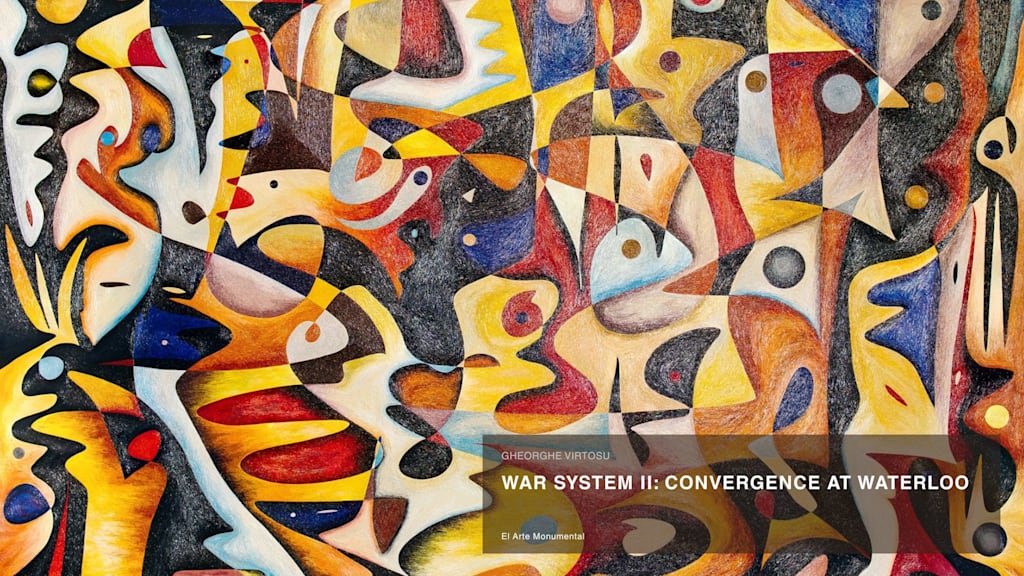
War System II: Convergence at Waterloo is less concerned with warfare itself than with the conditions that surround it. Where many historical exhibitions focus on military events, victories, or defeats, this exhibition examines the unstable relationships between ambition, strategy, leadership, and historical change. The result is not a visual reconstruction of Waterloo, but an abstract investigation into the forces that make historical transformation possible.
At the centre of the exhibition stands Battle of Waterloo (2001–2003), a monumental painting that functions as the system's principal field of interaction. Unlike traditional battle imagery, the work offers no identifiable armies, landscapes, or moments of combat. Instead, it presents a dense network of intersecting forms, shifting trajectories, and competing structures. The composition appears simultaneously organized and unstable, creating a visual environment in which no single force dominates the whole. Conflict emerges not as a confrontation between opponents but as a condition of continuous negotiation between competing energies.
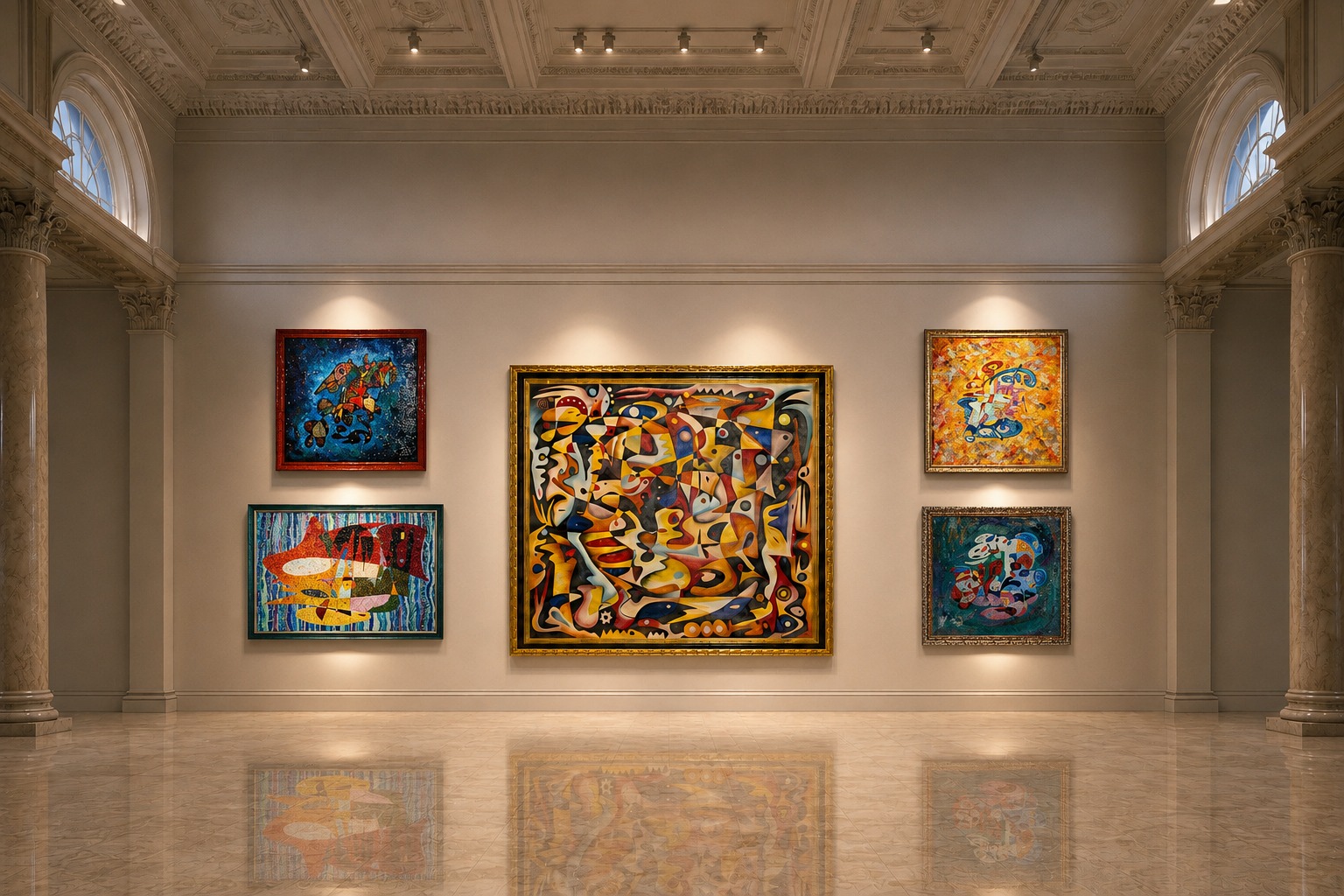
The painting's greatest strength lies in its refusal of hierarchy. Forms intersect, overlap, and redirect one another across the surface, producing a field of perpetual transformation. Rather than depicting the outcome of a battle, the work visualizes the uncertainty that precedes and accompanies historical change.
The surrounding works expand this investigation through distinct but interconnected perspectives.
Napoleon Bonaparte is perhaps the exhibition's psychological centre. Set against a luminous field of yellow and gold, the painting projects authority, ambition, and self-construction. Yet the central figure remains fragmented and unstable, suggesting that leadership itself is never fully coherent. The work avoids heroic representation and instead presents power as a fragile structure sustained through constant negotiation between opposing forces.
Napoleon's Adviser introduces a more analytical dimension. Its strong horizontal organization contrasts with the vertical tensions present elsewhere in the exhibition. The painting suggests planning, calculation, and strategic thought rather than direct action. Visually, it operates as a counterbalance to the more expressive works, reinforcing the idea that historical events emerge not only from ambition but also from systems of deliberation and organization.
On the opposite side of the installation, Horatio Nelson functions as an external force within the exhibition's broader structure. The dark blue field surrounding the central form creates an atmosphere of distance and containment. Compared with the works associated with Napoleon, the painting appears less expansive and more concentrated, introducing a visual language of restraint, opposition, and resistance.
The most enigmatic work is Dreams Rider. Unlike the others, it does not immediately align itself with historical or political structures. Its compact form suspended within a cosmic blue field suggests imagination, projection, or symbolic aspiration. Within the context of the exhibition, the painting operates as a reminder that historical systems are not driven solely by military and political realities, but also by ideals, visions, and collective myths.
The installation itself plays a crucial role in the exhibition's success. The paintings are not arranged as a chronological narrative but as a spatial network of relationships. The viewer moves between ambition and strategy, authority and resistance, reality and imagination. Meaning emerges through these encounters rather than through historical explanation.
What distinguishes War System II from War System I: Convergence at Gaugamela is its emphasis on instability rather than convergence. Whereas the earlier exhibition explored the formation and concentration of power, Waterloo examines the moment at which systems become vulnerable to transformation. The exhibition is less about the architecture of conflict than about the architecture of historical change.
The historical references remain largely external to the imagery. Without titles, viewers would not identify Napoleon, Nelson, or Waterloo as specific historical subjects. Yet this apparent limitation is also one of the exhibition's strengths. The paintings are not illustrations of historical figures; they are abstractions of the forces through which history is shaped. Their significance lies not in representation but in structure.
Ultimately, War System II: Convergence at Waterloo succeeds as a coherent exploration of leadership, strategy, ambition, resistance, and transformation. Through a disciplined language of abstraction and a carefully constructed installation, the exhibition shifts attention away from the spectacle of battle and toward the underlying systems through which societies experience change. Its achievement lies in transforming history from narrative into structure, and conflict from event into process.
About the Creator
Daniel Varzari
American art curator.
Enjoyed the story? Support the Creator.
Subscribe for free to receive all their stories in your feed.
Comments
There are no comments for this story
Be the first to respond and start the conversation.