
War System I: Convergence at Gaugamela Systemic Abstraction and the Architecture of Conflict
Beyond Historical Narrative
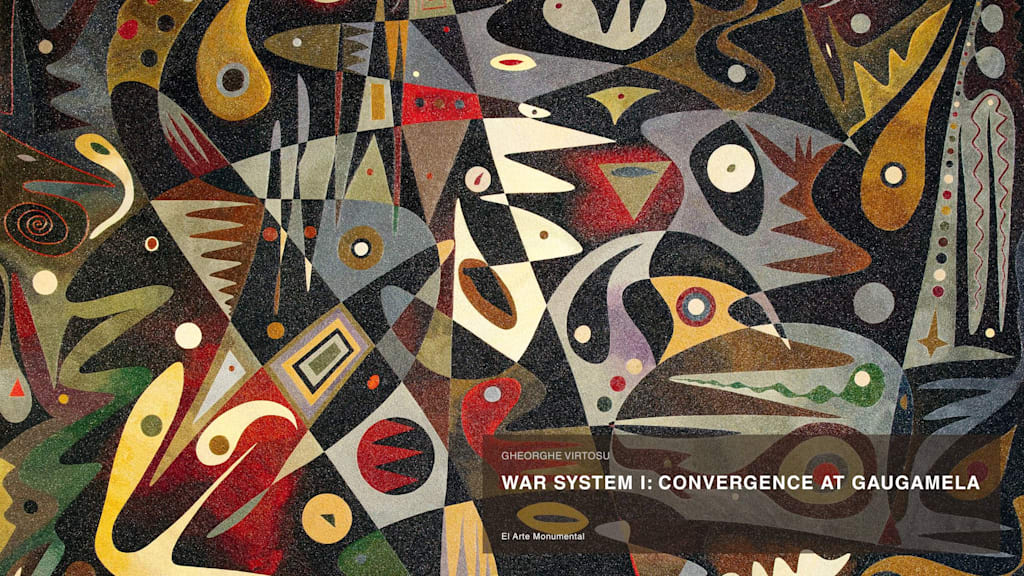
War System I: Convergence at Gaugamela, Solo System-Based Exhibition
War System I: Convergence at Gaugamela succeeds not because it represents history, but because it reorganizes it. Rather than reconstructing the famous battle between Alexander III of Macedon and Darius III through narrative imagery, the exhibition transforms historical conflict into a spatial and visual system. Warfare appears not as an event but as a condition of interacting forces operating across multiple paintings and through the architecture of the exhibition itself.
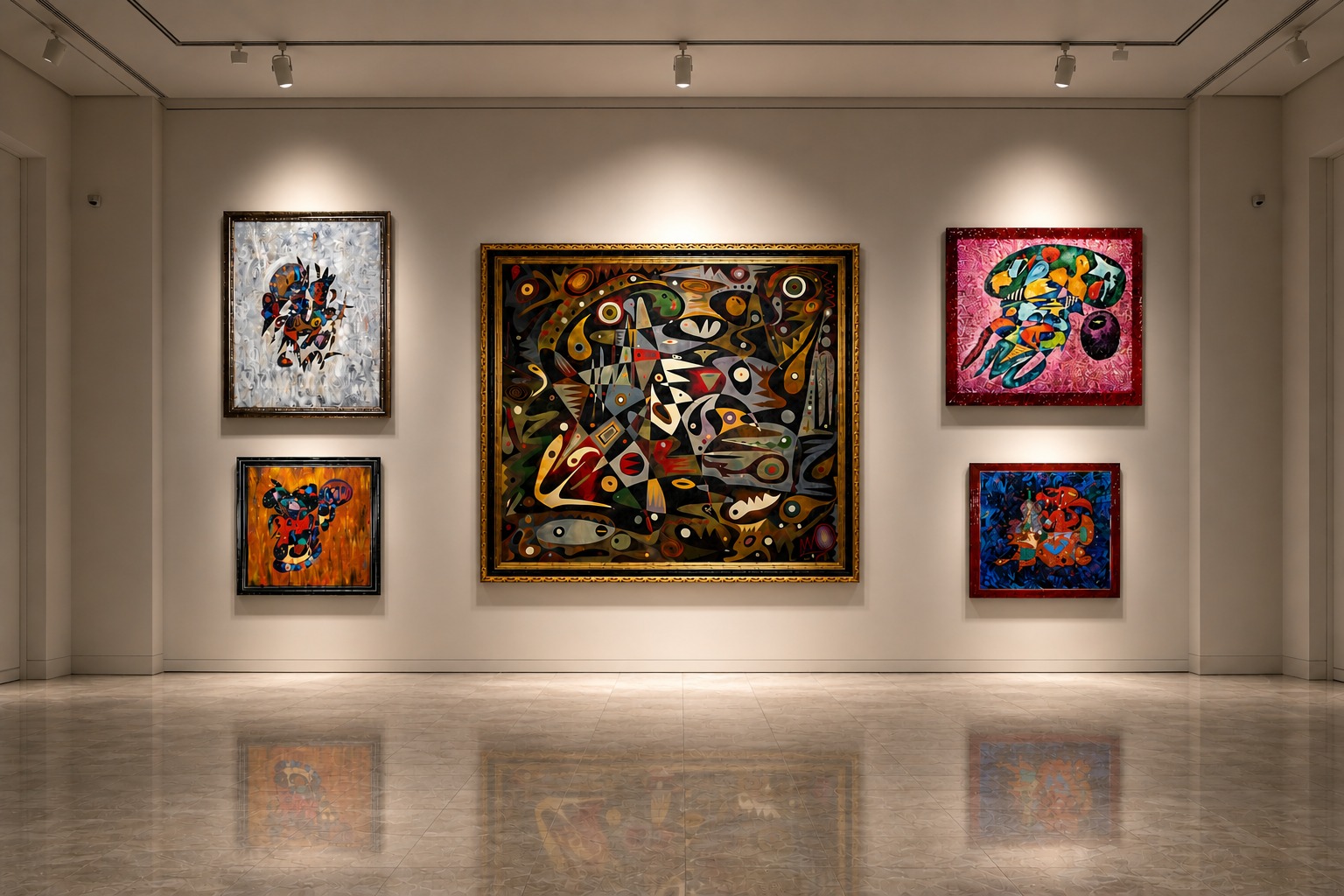
At the centre of the installation stands Battle of Gaugamela (2000–2002), a monumental canvas that functions as the exhibition's structural core. The painting is neither descriptive nor illustrative. Instead, it presents a dense field of interlocking forms, vectors, circular motifs, ruptures, and convergences that deny any single point of focus. The viewer's eye is continuously redirected across the surface, creating an experience of perpetual movement and instability. Conflict emerges as a distributed condition rather than a confrontation between identifiable actors. The painting's scale reinforces this effect, transforming the work into an environment rather than an image.
The exhibition's greatest achievement, however, lies in the relationship between the central painting and the four surrounding works. Installed around Battle of Gaugamela, Philip II of Macedonia (2021), Alexander The Great (2009), Darius III (2005), and Babylonian Human (2008) operate as interconnected structures within a larger visual system. Their arrangement establishes a network of tensions and correspondences that extends beyond historical subject matter.
On the left side of the installation, Philip II of Macedonia introduces a remarkable sense of concentration. Suspended within a vast grey field, its compressed abstract structure appears as a visual act of formation and consolidation. Below it, Alexander The Great expands outward through energetic red and black forms that project movement, ambition, and transformation. Together, the two works establish a coherent visual progression from concentration to expansion, creating one of the exhibition's most persuasive spatial relationships.
The right side introduces a more complex dynamic. Babylonian Human shifts attention away from conflict toward civilization itself. Its luminous palette and greater openness suggest continuity, culture, and collective existence. Below it, Darius III presents a structure caught between stability and fragmentation, a form that appears simultaneously resistant and vulnerable. Rather than constructing a simplistic opposition between victor and defeated ruler, the installation establishes a richer dialogue between civilization, power, and the pressures that threaten their coherence.
What distinguishes the exhibition from many conceptually driven historical projects is the consistency of its visual language. Across all five works, recurring motifs—organic fragments, eye-like forms, circular structures, vectors, and geometric interruptions—create a shared vocabulary that binds the paintings together without reducing them to repetition. The exhibition achieves coherence through formal relationships rather than through narrative explanation.
Importantly, the works do not attempt to portray historical personalities in any conventional sense. Their subjects remain largely inaccessible through imagery alone. Without titles, viewers would not identify Alexander, Philip, Darius, or Babylon as specific historical entities. Yet this apparent limitation ultimately reveals the exhibition's true ambition. The paintings are less concerned with representing historical figures than with visualizing the systems of power, organization, expansion, resistance, and cultural transformation through which history unfolds.
Seen as individual paintings, several of the works might appear enigmatic or self-contained. Seen together, they become components of a larger structure. The exhibition demonstrates that meaning does not reside solely within the canvases but emerges through their spatial relationships. The installation itself becomes an active medium of interpretation.
War System I: Convergence at Gaugamela is therefore most successful when understood not as an exhibition about a battle, but as an exhibition about the architecture of conflict. Through a disciplined and coherent language of systemic abstraction, it transforms a historical event into a visual investigation of how forces converge, interact, and reshape civilizations. Its achievement lies not in illustrating the past, but in making visible the structural conditions through which historical transformation becomes possible.
About the Creator
Daniel Varzari
American art curator.
Enjoyed the story? Support the Creator.
Subscribe for free to receive all their stories in your feed.
Comments
There are no comments for this story
Be the first to respond and start the conversation.